Discriminant Function

Introduction
In a quadratic equation, there is an important component called the discriminant. The discriminant is used to determine the type of roots of a quadratic equation or quadratic function.
It is denoted by and defined as:
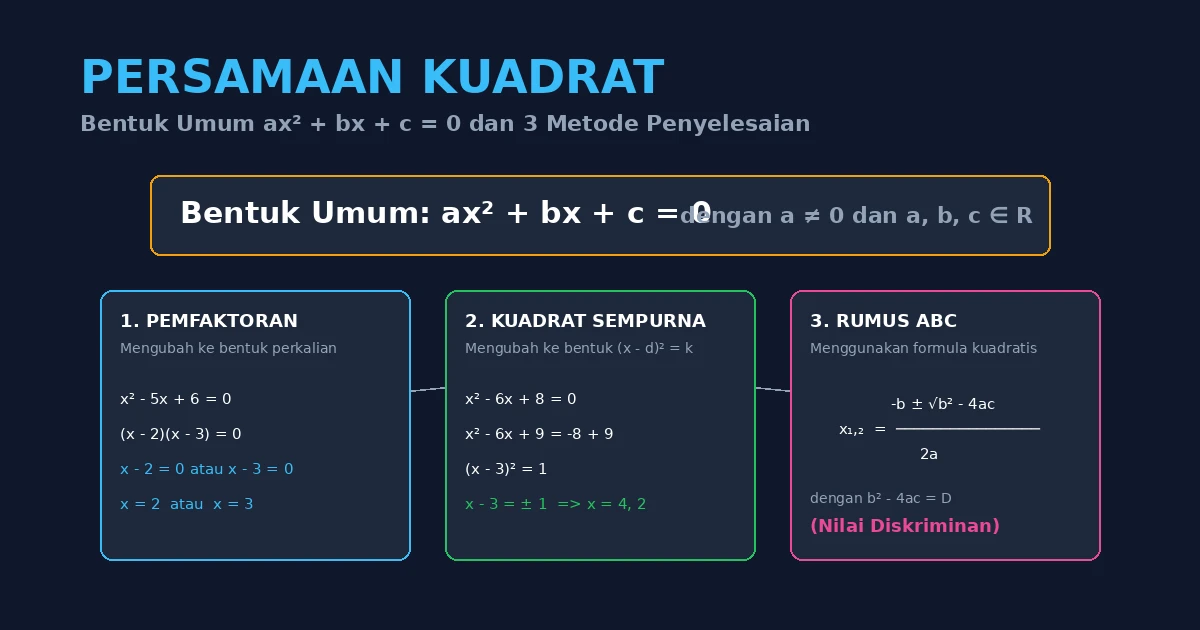
where , , and are the real constants in the quadratic equation:
Definition of the Discriminant
In general, a discriminant is a quantity that depends on the coefficients of a polynomial and can be used to determine properties of its roots.
For quadratic equations, the discriminant is a practical tool for identifying the nature of the roots without fully solving the equation.
Types of Roots of Quadratic Equations
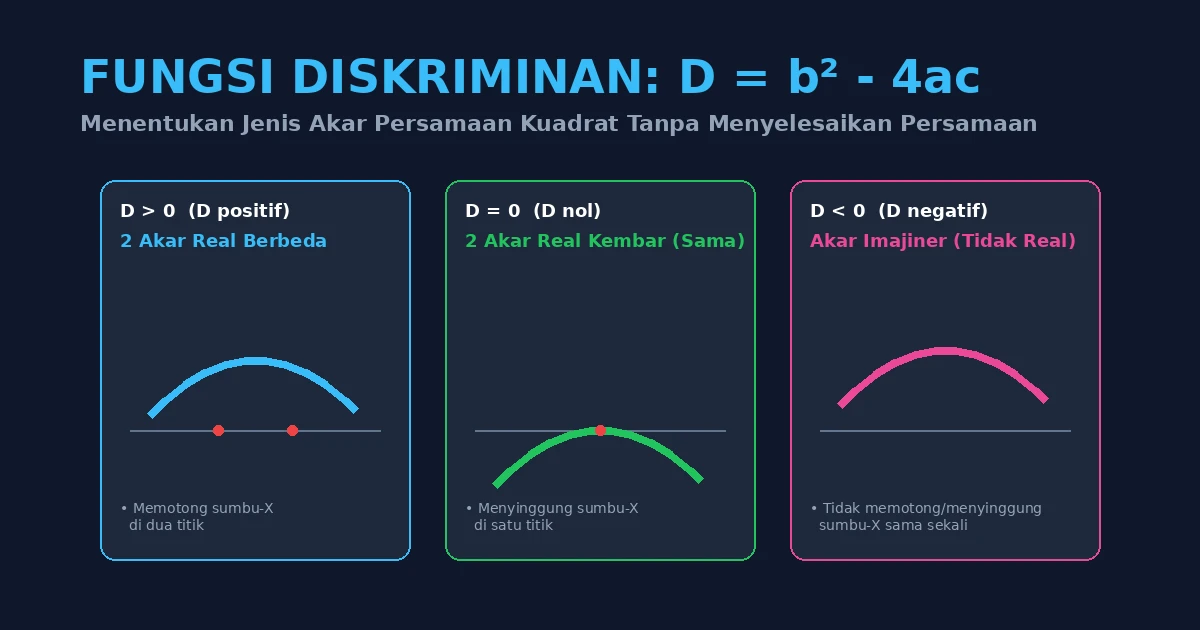
The value of the discriminant determines the type and number of roots of a quadratic equation.
1. If
The quadratic equation has two distinct real roots.
- If is a perfect square, both roots are rational.
- If is not a perfect square, both roots are irrational.
2. If
The quadratic equation has two equal real roots.
3. If
The quadratic equation has no real roots. Its roots are imaginary.
Example Problems and Discussion
Example 1
Determine the type of roots of the following quadratic equations without solving them completely:
Answer
a.
Given:
Since , the discriminant is a perfect square.
So, the roots are real, distinct, and rational.
b.
Given:
Since , the equation has two equal real roots.
So, the roots are real, equal, and rational.
c.
Given:
Since , the equation has no real roots.
So, the roots are imaginary.
Example 2
Given the quadratic equation:
What value of makes the equation have equal real roots?
Answer
For equal real roots, the discriminant must satisfy:
Thus:
Therefore:
Closing
The expression is called the discriminant of the quadratic equation and is denoted by . This value is what distinguishes the type of roots of the equation.
So, the main use of the discriminant is to determine the type of roots of a quadratic equation quickly.