Contents

Radical Forms and Fractional Exponents

Irrational numbers are closely related to radical forms. Numbers such as 2\sqrt{2}, 3\sqrt{3}, and 5\sqrt{5} are examples of irrational numbers written in radical form.

Rational numbers are numbers that can be expressed as ab\dfrac{a}{b} where aa and bb are integers and b0b \ne 0.

Irrational numbers are numbers that cannot be expressed as ab\dfrac{a}{b} where aa and bb are integers and b0b \ne 0.

Examples of rational numbers: 5-5, 25-\dfrac{2}{5}, 00, 33, 34\dfrac{3}{4}.

Examples of irrational numbers: 2\sqrt{2}, 3\sqrt{3}, 5\sqrt{5}.

When evaluated with a calculator, irrational numbers appear as non-terminating and non-repeating decimals. For example:

2=1.414213562 \sqrt{2}=1.414213562\ldots

The union of rational and irrational numbers is called the set of real numbers.

Radical forms and fractional exponents

Consider the following examples:

  1. 4=22=2\sqrt{4}=\sqrt{2^2}=2
  2. 9=32=3\sqrt{9}=\sqrt{3^2}=3
  3. 16=42=4\sqrt{16}=\sqrt{4^2}=4

These examples follow the definition:

a2=a \sqrt{a^2}=a

for positive real aa.

However, for 2\sqrt{2} there is no rational number whose square is 2. Numbers of this kind are called radical forms.

Examples:

2, 3, 5 \sqrt{2},\ \sqrt{3},\ \sqrt{5} ac+bc=(a+b)c a\sqrt{c}+b\sqrt{c}=(a+b)\sqrt{c} acbc=(ab)c a\sqrt{c}-b\sqrt{c}=(a-b)\sqrt{c}

where a,b,cRa,b,c \in \mathbb{R} and c0c \ge 0.

Simplify:

  1. 43234\sqrt{3}-2\sqrt{3}
  2. 25+35452\sqrt{5}+3\sqrt{5}-4\sqrt{5}
  3. 15725715\sqrt{7}-25\sqrt{7}
  1. 4323=(42)3=234\sqrt{3}-2\sqrt{3}=(4-2)\sqrt{3}=2\sqrt{3}
  2. 25+3545=(2+34)5=52\sqrt{5}+3\sqrt{5}-4\sqrt{5}=(2+3-4)\sqrt{5}=\sqrt{5}
  3. 157257=(1525)7=10715\sqrt{7}-25\sqrt{7}=(15-25)\sqrt{7}=-10\sqrt{7}
ab×cd=acbd a\sqrt{b}\times c\sqrt{d}=ac\sqrt{bd}

where a,b,c,dRa,b,c,d \in \mathbb{R}, b0b \ge 0, and d0d \ge 0.

Find:

  1. 23×522\sqrt{3}\times 5\sqrt{2}
  2. 8×12\sqrt{8}\times \sqrt{12}
  3. (25)(22)32(3523)(2\sqrt{5})(2\sqrt{2})-3\sqrt{2}(3\sqrt{5}-2\sqrt{3})
23×52=(2×5)3×2=106 \begin{aligned} 2\sqrt{3}\times 5\sqrt{2} &=(2\times 5)\sqrt{3\times 2}\\ &=10\sqrt{6} \end{aligned}
8×12=8×12=96=16×6=46 \begin{aligned} \sqrt{8}\times \sqrt{12} &=\sqrt{8\times 12}\\ &=\sqrt{96}\\ &=\sqrt{16\times 6}\\ &=4\sqrt{6} \end{aligned}
(25)(22)32(3523)=410910+66=510+66 \begin{aligned} (2\sqrt{5})(2\sqrt{2})-3\sqrt{2}(3\sqrt{5}-2\sqrt{3}) &=4\sqrt{10}-9\sqrt{10}+6\sqrt{6}\\ &=-5\sqrt{10}+6\sqrt{6} \end{aligned} paqb=pqab \frac{p\sqrt{a}}{q\sqrt{b}}=\frac{p}{q}\sqrt{\frac{a}{b}}

where a,b,p,qa,b,p,q are real numbers and a0a \ge 0, b0b \ge 0.

Find:

  1. 728\dfrac{\sqrt{7}}{\sqrt{28}}
  2. 10852\dfrac{10\sqrt{8}}{5\sqrt{2}}
728=728=14=12 \frac{\sqrt{7}}{\sqrt{28}} =\sqrt{\frac{7}{28}} =\sqrt{\frac{1}{4}} =\frac{1}{2}
10852=104×252=20252=4 \frac{10\sqrt{8}}{5\sqrt{2}} =\frac{10\sqrt{4\times 2}}{5\sqrt{2}} =\frac{20\sqrt{2}}{5\sqrt{2}} =4

Rationalizing the denominator means changing a fraction whose denominator is irrational into one whose denominator is rational.

ab=ab×bb=abb \frac{a}{\sqrt{b}} =\frac{a}{\sqrt{b}}\times \frac{\sqrt{b}}{\sqrt{b}} =\frac{a\sqrt{b}}{b}

Rationalize:

  1. 45\dfrac{4}{\sqrt{5}}
  2. 67\dfrac{-6}{\sqrt{7}}
  3. 36\dfrac{\sqrt{3}}{\sqrt{6}}
  1. 45=455\dfrac{4}{\sqrt{5}}=\dfrac{4\sqrt{5}}{5}
  2. 67=677\dfrac{-6}{\sqrt{7}}=\dfrac{-6\sqrt{7}}{7}
36=36×66=186=326=122 \frac{\sqrt{3}}{\sqrt{6}} =\frac{\sqrt{3}}{\sqrt{6}}\times \frac{\sqrt{6}}{\sqrt{6}} =\frac{\sqrt{18}}{6} =\frac{3\sqrt{2}}{6} =\frac{1}{2}\sqrt{2}

Fractions with denominators of the form p+qp+\sqrt{q} or pqp-\sqrt{q} are rationalized by multiplying by the conjugate of the denominator.

Rationalize:

  1. 83+5\dfrac{8}{3+\sqrt{5}}
  2. 3336\dfrac{3\sqrt{3}}{3-\sqrt{6}}
83+5=83+5×3535=8(35)95=8(35)4=2(35)=625 \begin{aligned} \frac{8}{3+\sqrt{5}} &=\frac{8}{3+\sqrt{5}}\times \frac{3-\sqrt{5}}{3-\sqrt{5}}\\ &=\frac{8(3-\sqrt{5})}{9-5}\\ &=\frac{8(3-\sqrt{5})}{4}\\ &=2(3-\sqrt{5})\\ &=6-2\sqrt{5} \end{aligned}
3336=3336×3+63+6=33(3+6)96=33(3+6)3=3(3+6)=33+18=33+32 \begin{aligned} \frac{3\sqrt{3}}{3-\sqrt{6}} &=\frac{3\sqrt{3}}{3-\sqrt{6}}\times \frac{3+\sqrt{6}}{3+\sqrt{6}}\\ &=\frac{3\sqrt{3}(3+\sqrt{6})}{9-6}\\ &=\frac{3\sqrt{3}(3+\sqrt{6})}{3}\\ &=\sqrt{3}(3+\sqrt{6})\\ &=3\sqrt{3}+\sqrt{18}\\ &=3\sqrt{3}+3\sqrt{2} \end{aligned}

This is done by multiplying by the conjugate of a±b\sqrt{a}\pm\sqrt{b}.

Rationalize:

  1. 85+2\dfrac{8}{\sqrt{5}+\sqrt{2}}
  2. 5323\dfrac{5}{3\sqrt{2}-\sqrt{3}}
85+2=85+2×5252=8(52)52=83(52) \begin{aligned} \frac{8}{\sqrt{5}+\sqrt{2}} &=\frac{8}{\sqrt{5}+\sqrt{2}}\times \frac{\sqrt{5}-\sqrt{2}}{\sqrt{5}-\sqrt{2}}\\ &=\frac{8(\sqrt{5}-\sqrt{2})}{5-2}\\ &=\frac{8}{3}(\sqrt{5}-\sqrt{2}) \end{aligned}
5323=5323×32+332+3=5(32+3)183=5(32+3)15=13(32+3)=2+133 \begin{aligned} \frac{5}{3\sqrt{2}-\sqrt{3}} &=\frac{5}{3\sqrt{2}-\sqrt{3}}\times \frac{3\sqrt{2}+\sqrt{3}}{3\sqrt{2}+\sqrt{3}}\\ &=\frac{5(3\sqrt{2}+\sqrt{3})}{18-3}\\ &=\frac{5(3\sqrt{2}+\sqrt{3})}{15}\\ &=\frac{1}{3}(3\sqrt{2}+\sqrt{3})\\ &=\sqrt{2}+\frac{1}{3}\sqrt{3} \end{aligned}

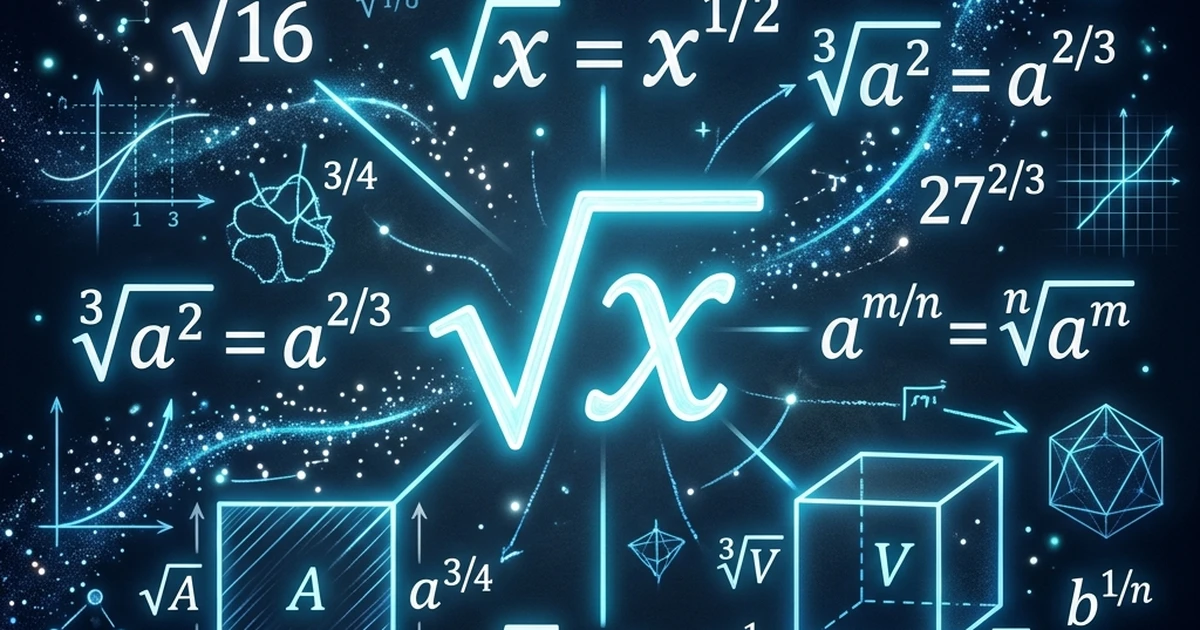
Square roots such as 2\sqrt{2}, 3\sqrt{3}, 5\sqrt{5}, and 10\sqrt{10} can be written using fractional exponents:

2=212,3=312,5=512,10=1012 \sqrt{2}=2^{\frac{1}{2}},\quad \sqrt{3}=3^{\frac{1}{2}},\quad \sqrt{5}=5^{\frac{1}{2}},\quad \sqrt{10}=10^{\frac{1}{2}}

The general relationship is:

amn=amn a^{\frac{m}{n}}=\sqrt[n]{a^m}

with a0a \ge 0 and m,nm,n positive integers.

For a review, see the material on exponents.

  1. Express the following radical forms as exponents:
    • 43\sqrt[3]{4}
    • 165\sqrt[5]{16}
  2. Express the following fractional exponents as radicals:
    • 3233^{\frac{2}{3}}
    • 2352^{\frac{3}{5}}
  1. As exponents:
    • 43=223=223\sqrt[3]{4}=\sqrt[3]{2^2}=2^{\frac{2}{3}}
    • 165=245=245\sqrt[5]{16}=\sqrt[5]{2^4}=2^{\frac{4}{5}}
  2. As radicals:
    • 323=323=933^{\frac{2}{3}}=\sqrt[3]{3^2}=\sqrt[3]{9}
    • 235=235=852^{\frac{3}{5}}=\sqrt[5]{2^3}=\sqrt[5]{8}

After studying radical forms and fractional exponents, do the evaluation by:

  1. clicking the correct answer,
  2. clicking Next to move to the next question,
  3. clicking Submit after all questions are done,
  4. checking the score at the bottom,
  5. calculating the final mark as score divided by maximum score times 100.

That concludes this material on radical forms and fractional exponents.

Related Content