Sphere

Introduction
A sphere is one of the most familiar curved-surface solids in everyday life. Footballs, marbles, and many round containers are good examples. This article covers the elements of a sphere, its surface area, its volume, and how its volume changes when the radius changes.
A. Basic Competencies
3.7 Generalize the surface area and volume of curved-surface solids such as cylinders, cones, and spheres.4.7 Solve contextual problems related to the surface area and volume of curved-surface solids and their combinations.
B. Learning Objectives
After studying this lesson, students are expected to be able to:
- identify the elements of a sphere
- calculate the surface area of a sphere
- calculate the volume of a sphere
- compare sphere volumes after a change in radius
- determine the change in sphere volume when the radius changes
C. Lesson Material
1. Elements of a Sphere
A sphere is a curved solid bounded by a single curved surface. It can be formed by rotating a semicircle through 360° about its diameter.

Important elements:
- a sphere has one curved surface
- the distance from the center to any point on the surface is the radius, denoted by
2. Surface Area of a Sphere
One way to understand the formula is to compare half of a sphere with a rectangle covered by thread.
Illustrations:


From this activity, the surface area of a hemisphere equals the area of a rectangle with:
- length = circumference of the circle =
- width = radius =
So:
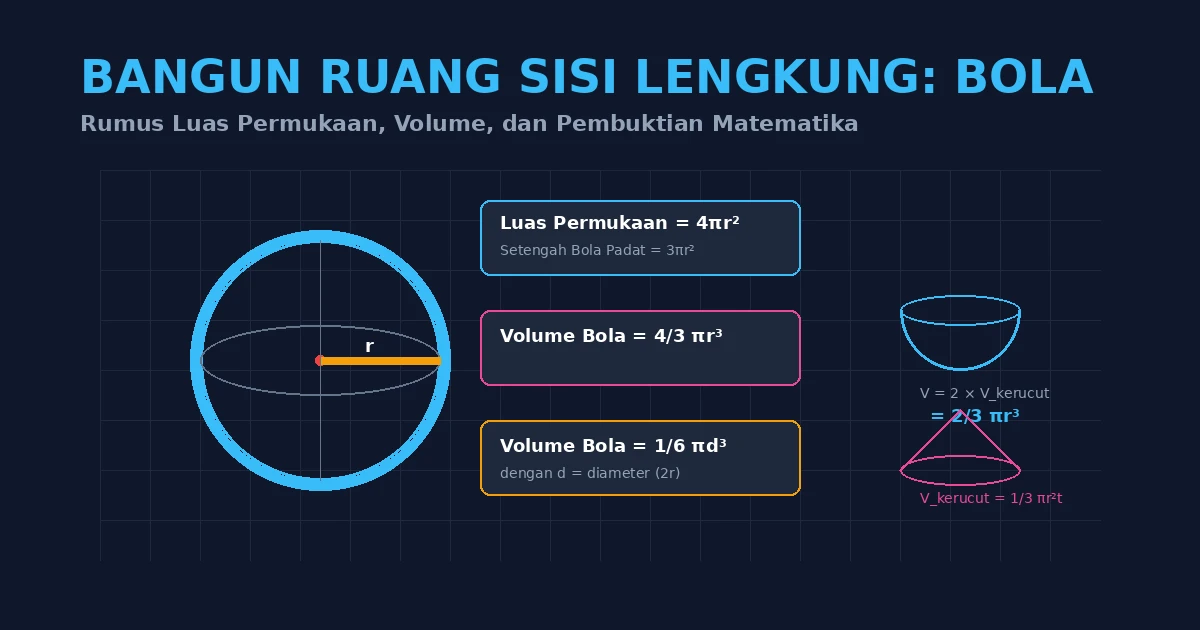
Therefore, the surface area of the whole sphere is:
Thus:
Example 1
A sphere has radius 7 cm. Find its surface area.

So:
Example 2
If the surface area of a sphere is 154 cm², find its radius.
So the radius is:
Example 3
A solid hemisphere has radius 10 cm. Find its surface area.

Surface area of a solid hemisphere = area of the curved half-sphere + area of the circular base.
So:
3. Volume of a Sphere
The sphere volume formula can be derived by comparing a hemisphere with two cones of radius and height .

From that comparison:
Hence the volume of the whole sphere is:
Since , we also get:
So:
Example 1
A sphere has radius 21 cm. If , find its volume.
So:
Example 2
A sphere of radius 6 cm is placed into a cylinder filled with water so that the water level rises. If the cylinder base radius is 15 cm, find the rise in water level.
Let the sphere radius be cm and the cylinder radius be cm. Since the displaced water volume equals the sphere volume:
So the water rises by:
4. Comparing Sphere Volumes
Because sphere volume depends on , a change in radius has a strong effect on the volume.

If a sphere originally has radius and volume , then:
if the new radius is , then:
if the radius becomes times the original radius, then:
Example
A sphere has radius 2 cm. Find the ratio of the original volume to the new volume in each case:
- the radius increases by
3 cm - the radius decreases by
1 cm - the radius becomes
2times the original radius
Solutions:
Radius increases by
3 cm:Radius decreases by
1 cm:Radius becomes
2times the original:
5. GeoGebra Simulation
Move the slider to the right or left to change the sphere radius. Use the ON and OFF buttons to start or stop the surface-area and volume animation.
6. Evaluation
There are two jars for storing sugar as shown below.

Determine which jar can hold more sugar, assuming both jars have the same wall thickness.
Closing
The sphere is an important curved-surface solid because many applied geometry problems depend on its surface area, volume, and radius relationships. Once these formulas are understood, comparison and volume-change problems become much easier.