The Yin-Yang Symbol: The Philosophy of Duality

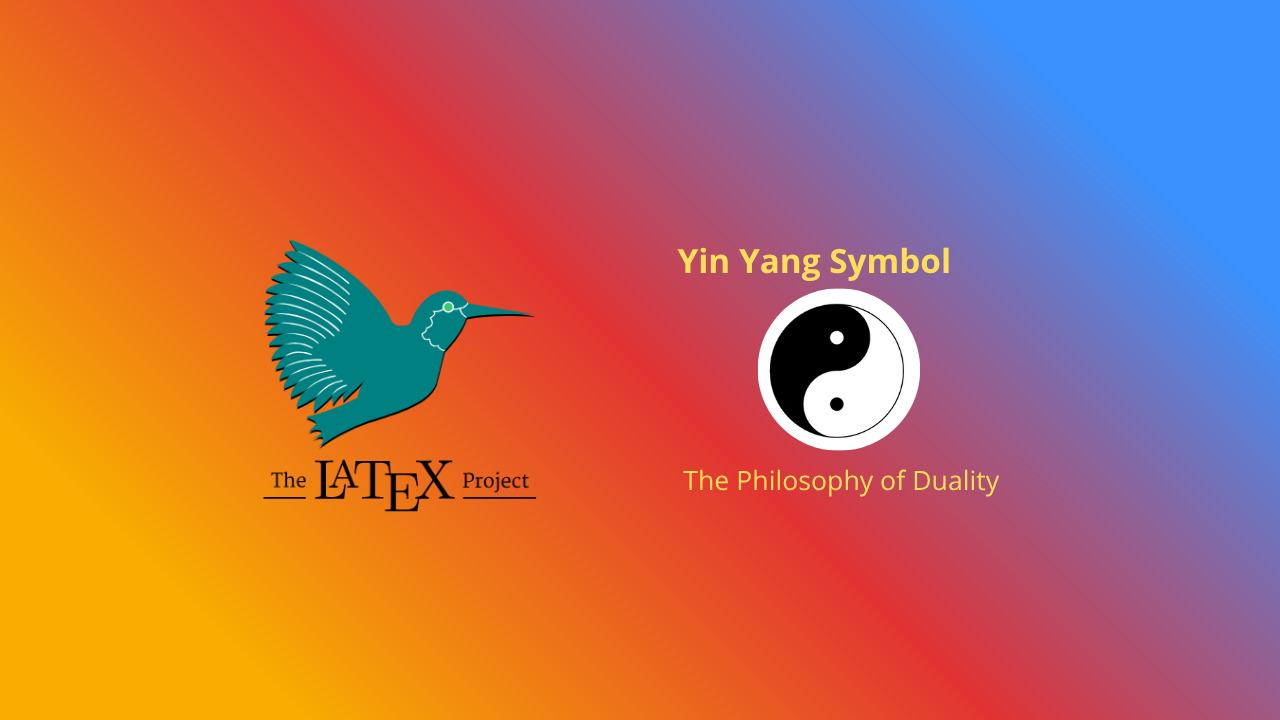
This article discusses the philosophy and mathematical structure of the Yin-Yang symbol and demonstrates how to draw it precisely and beautifully using LaTeX TikZ.
1 Introduction
The Yin-Yang symbol (☯) is one of the most recognizable icons in Eastern philosophy, particularly within Taoism.
It represents the unity of two opposing yet complementary forces:
- Yin symbolizes darkness, passivity, femininity, and coldness.
- Yang symbolizes brightness, activity, masculinity, and warmth.
This symbol is not only aesthetically balanced but also a mathematical visualization of equilibrium.
Using LaTeX TikZ, we can recreate the Yin-Yang symbol with geometric precision and artistic harmony.
2 LaTeX Source Code
Below is the complete LaTeX code to draw the Yin-Yang symbol using TikZ:
\documentclass{article}
\usepackage{tikz}

\begin{document}

\begin{tikzpicture}

  % Color half of the circle
  \begin{scope}
    \clip (0,0) circle (1cm);
    \fill[black] (0cm,1cm) rectangle (-1cm, -1cm);
  \end{scope}

  % Fill the heads
  \fill[black] (0,0.5) circle (0.5cm);
  \fill[white] (0,-0.5) circle (0.5cm);

  % Fill the eyes
  \fill[white] (0,0.5) circle (0.1cm);
  \fill[black] (0,-0.5) circle (0.1cm);

  % Outer circle
  \draw (0,0) circle (1cm);

\end{tikzpicture}

\end{document}
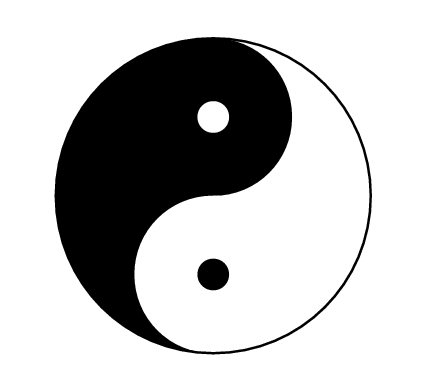
The output produced:
3 Code Structure Explanation
3.1 Document Declaration
\documentclass{article}
\usepackage{tikz}articledefines the basic document type.tikzenables vector-based drawing directly within LaTeX.
3.2 TikZ Environment
\begin{tikzpicture} ... \end{tikzpicture}This environment contains all the commands to draw the Yin-Yang symbol.
3.3 Drawing the Half-Circle (Yin)
\begin{scope}
  \clip (0,0) circle (1cm);
  \fill[black] (0cm,1cm) rectangle (-1cm, -1cm);
\end{scope}\cliprestricts the drawing area to a circle with a 1 cm radius.- The rectangle filled with black creates the left half of the symbol.
The right half remains white, forming the Yang.
3.4 Drawing the Two Inner Circles (Heads of Yin and Yang)
\fill[black] (0,0.5) circle (0.5cm);
\fill[white] (0,-0.5) circle (0.5cm);- A black circle on top represents Yang within Yin.
- A white circle on the bottom represents Yin within Yang.
Together, they illustrate balance and transformation.
3.5 Adding the Small Circles (Eyes)
\fill[white] (0,0.5) circle (0.1cm);
\fill[black] (0,-0.5) circle (0.1cm);- The white dot in the black area and the black dot in the white area symbolize that each element contains the seed of its opposite — the core principle of Yin-Yang philosophy.
3.6 Drawing the Outer Circle
\draw (0,0) circle (1cm);Creates the boundary that unifies the entire shape and maintains visual harmony.
4 Visual and Philosophical Analysis
| Element | Color | Symbolic Meaning | Geometric Form |
|---|---|---|---|
| Left half | Black (Yin) | Darkness, night, introspection | Half circle |
| Right half | White (Yang) | Light, day, action | Half circle |
| White dot in Yin | Yang energy in Yin | Small white circle | |
| Black dot in Yang | Yin energy in Yang | Small black circle |
The two sides do not conflict destructively; they complement each other.
This symbol also embodies the idea of dynamic equilibrium — nothing is entirely black or white.
5 Experimental Variations
You can modify the parameters in TikZ for creative exploration:
| Element | Modification | Visual Effect |
|---|---|---|
| Color | \fill[blue] or \fill[red] |
Changes symbolic mood |
| Size | Change (1cm) to (2cm) |
Enlarges the entire figure |
| Position | Adjust (0,0) coordinates |
Moves the symbol on the canvas |
| Line style | Add [thick, dashed] |
Creates a calligraphic aesthetic |
Example variation:
\fill[blue!50!black] (0,0.5) circle (0.5cm);6 Scientific and Artistic Relevance
The Yin-Yang symbol bridges philosophy, mathematics, and art:
- Philosophy: Represents harmony in opposites.
- Geometry: Built from perfect circles and symmetrical relationships.
- Art: A timeless visual balance of contrast and unity.
- Education: Ideal for demonstrating geometric symmetry and cultural meaning in LaTeX TikZ.
7 Conclusion
The Yin-Yang symbol beautifully illustrates the unity within duality.
Through LaTeX TikZ, we can recreate it precisely while appreciating the deep philosophical essence behind its structure.
Every curve and color embodies the harmony of science and spirituality.
8 References
- Lao Tzu. Tao Te Ching. Trans. D.C. Lau. Penguin Classics, 1963.
- Needham, J. (1954). Science and Civilization in China. Cambridge University Press.
- PGF/TikZ Manual, Version 3.1.10 (2023).
- Li, X. (2018). Yin-Yang Theory and Its Mathematical Interpretation. Beijing University Press.
Written by: Aan Triono
License: CC BY-SA 4.0