White Dot Illusion: Perceptual Contrast in a Dark Grid Pattern

This article discusses the visual illusion of white dots appearing in a dark grid pattern, where the brain creates contrast perceptions that are not physically present. Built using LaTeX PSTricks, it provides a complete explanation of the code structure and the perceptual mechanisms behind it.
1 Introduction
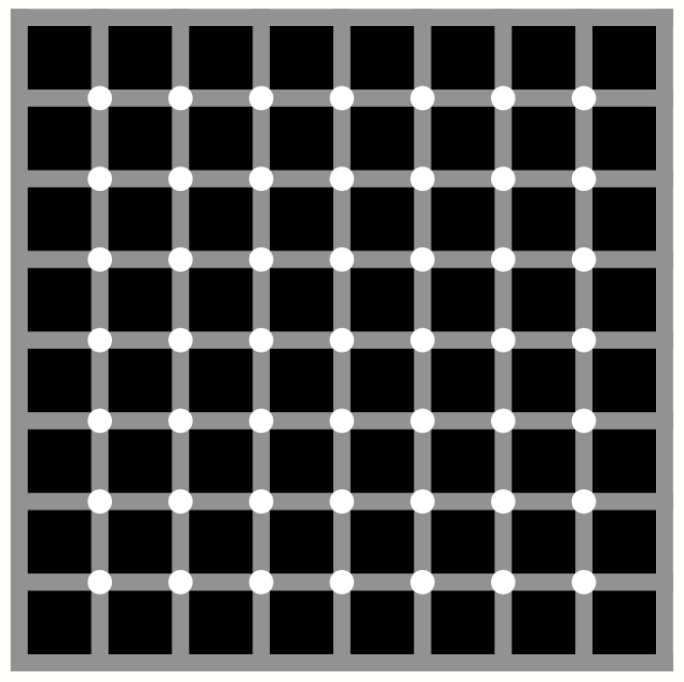
Optical illusions reveal how the human brain interprets visual information beyond mere physical reality. One fascinating example is the Hermann Grid Illusion, also known as the White Dot Illusion, where white or gray dots appear and disappear at the intersections of dark grid lines.
This phenomenon occurs due to lateral inhibition in the retina — a neural mechanism that enhances contrast but also leads to perceptual distortions.
In this article, we recreate this effect using LaTeX PSTricks and explain the structure of the code along with the underlying perceptual science.
2 LaTeX Source Code
Below is the complete LaTeX source used to visualize the illusion:
\documentclass[pstricks,border=12pt]{standalone}
\newpsstyle{gridstyle}
{
    gridlabels=0,
    gridwidth=6pt,
    subgriddiv=1,
    gridcolor=gray,
}
\begin{document}
\begin{pspicture}(8,8)
    \psframe*(8,8)
    \psgrid[style=gridstyle]
    \psset{linecolor=white}
    \multips(0,1)(0,1){7}{\multips(1,0)(1,0){7}{\qdisk(0,0){4.242pt}}}
\end{pspicture}
\end{document}
The output produced:
3 Explanation of Code Structure
3.1 Document Declaration
\documentclass[pstricks,border=12pt]{standalone}Specifies that the document uses the standalone class, which produces a single figure without page margins or headers.
The pstricks option enables PSTricks, a LaTeX package for creating PostScript-based vector graphics.
3.2 Defining the Grid Style
\newpsstyle{gridstyle}
{
    gridlabels=0,
    gridwidth=6pt,
    subgriddiv=1,
    gridcolor=gray,
}
Defines a new drawing style named gridstyle:
gridlabels=0disables coordinate labels.gridwidth=6ptsets grid line thickness.gridcolor=graycolors the grid lines gray.subgriddiv=1ensures no subgrid divisions are drawn.
3.3 PSTricks Drawing Environment
\begin{pspicture}(8,8)Creates a drawing area of 8x8 units where all graphical elements are placed.
3.4 Background and Grid
\psframe*(8,8)
\psgrid[style=gridstyle]\psframe*(8,8)draws a solid black square background.\psgrid[style=gridstyle]overlays a gray grid on top of the background using the defined style.
3.5 Setting Line Color
\psset{linecolor=white}Sets the current drawing color to white, so that the subsequent dots will contrast with the dark background.
3.6 Drawing White Dots Using multips
\multips(0,1)(0,1){7}{\multips(1,0)(1,0){7}{\qdisk(0,0){4.242pt}}}Draws the pattern of white dots forming the grid illusion:
- The first
\multipsrepeats the inner pattern vertically 7 times. - The inner
\multipsrepeats horizontally 7 times per row. \qdisk(0,0){4.242pt}draws a small white circular dot of radius ≈ 4.24pt at each grid intersection.
3.7 Closing the Environments
\end{pspicture}
\end{document}
Ends both the drawing and the document environments, generating the final figure.
4 Visual and Perceptual Analysis
The final output produces a dark grid where white dots seem to flicker or disappear at intersections.
This illusion arises from lateral inhibition — when bright and dark areas interact, neurons responsible for detecting light suppress their neighbors’ activity, leading to false contrast enhancement.
| Observation | Neural Explanation |
|---|---|
| Dots vanish at intersections | Lateral inhibition reduces local contrast |
| Dots reappear when stared at directly | Focused vision minimizes surround inhibition |
5 Experimental Variations
You can adjust the parameters in the code to explore perceptual effects:
| Parameter | Purpose | Visual Effect |
|---|---|---|
gridwidth |
Grid line thickness | Alters strength of illusion |
gridcolor |
Grid color | Affects contrast intensity |
Dot size (\qdisk) |
Controls dot visibility | Larger dots reduce illusion |
| Number of repetitions | Changes grid density | More intersections strengthen illusion |
Example modification:
\psgrid[style=gridstyle,gridcolor=lightgray]
\qdisk(0,0){3pt}
6 Scientific and Artistic Relevance
The Hermann Grid Illusion bridges visual neuroscience, mathematics, and art.
It demonstrates how simple geometry can expose deep insights into human perception. Applications include:
- Cognitive psychology — studying spatial inhibition and lightness perception.
- Visual design — understanding how contrast guides attention.
- Mathematical art — turning perceptual science into geometric beauty.
7 Conclusion
The White Dot Illusion exemplifies how perception is context-dependent, not purely physical.
By using LaTeX PSTricks, we can mathematically and aesthetically recreate this effect, merging science and art in a single figure.
8 References
- Hermann, L. (1870). Eine Erscheinung simultanen Contrastes. Pflügers Archiv für die gesamte Physiologie.
- Coren, S., & Girgus, J. S. (1978). Seeing is Deceiving: The Psychology of Visual Illusions. Lawrence Erlbaum.
- Gregory, R. L. (1997). Eye and Brain: The Psychology of Seeing. Oxford University Press.
- PSTricks User Manual, Version 3.1.8 (2023).
Written by: Aan Triono
License: CC BY-SA 4.0