The Circle Illusion: Symmetry, Geometry, and Visual Distortion

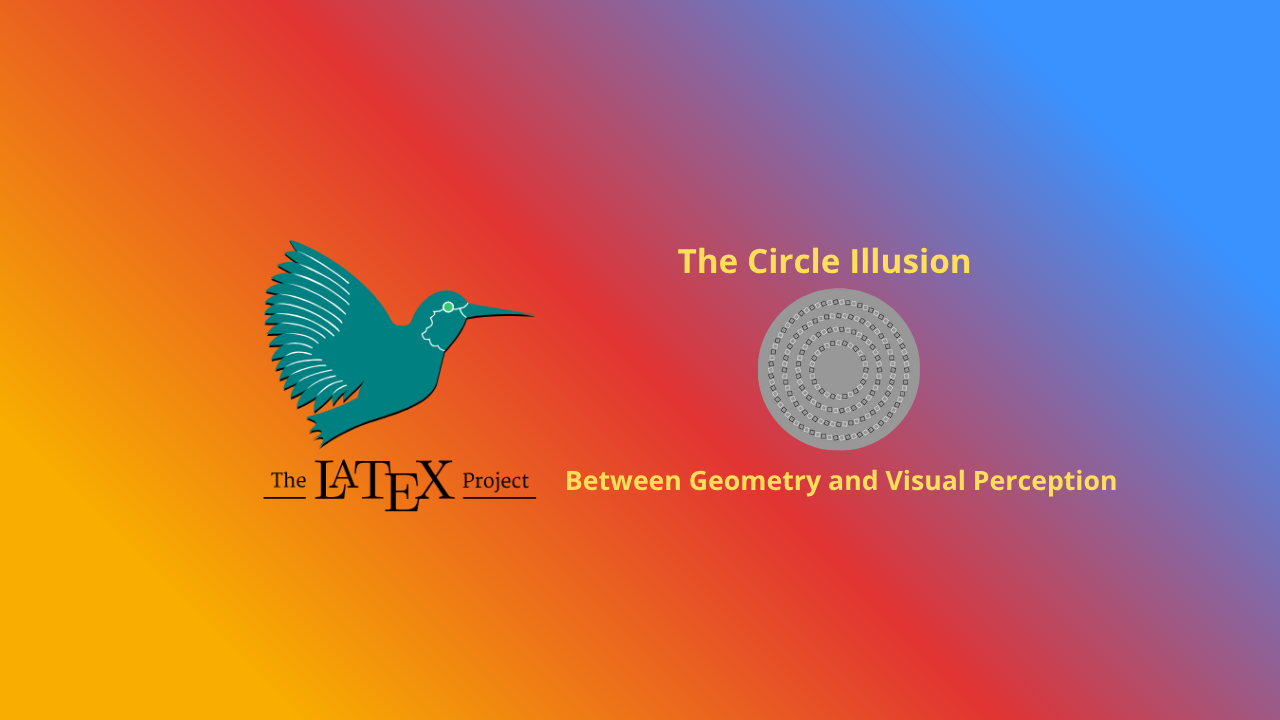
This article explores the geometric circle illusion created with LaTeX TikZ, where concentric circles and rotated squares interact to produce visual distortion despite perfect mathematical symmetry.
1 Introduction
In the realm of visual perception, simple geometry can create complex illusions.
One such case is the concentric circle illusion, where repeated circular patterns appear distorted when combined with rotated square elements.
This article explains how to construct the pattern using LaTeX TikZ and explores how the human visual system interprets these shapes, creating a misleading sense of imbalance or curvature.
2 LaTeX Source Code
\documentclass[border=10pt,tikz]{standalone}
\pagecolor{gray!5}
\begin{document}
    \begin{tikzpicture}[x=4cm,y=4cm,every rectangle node/.style={draw,thick,red,rotate=45,minimum width=0.707*4cm,minimum height=0.707*4cm}]
        \foreach \y in {1,...,3}
            \foreach \x in {1,...,3}{%
                \foreach \diameter in {1,...,6}
                    \draw[gray,thick] (\x,\y) circle (1/12*\diameter);
                \node[rectangle] at (\x,\y) {};
            }
    \end{tikzpicture}
\end{document}
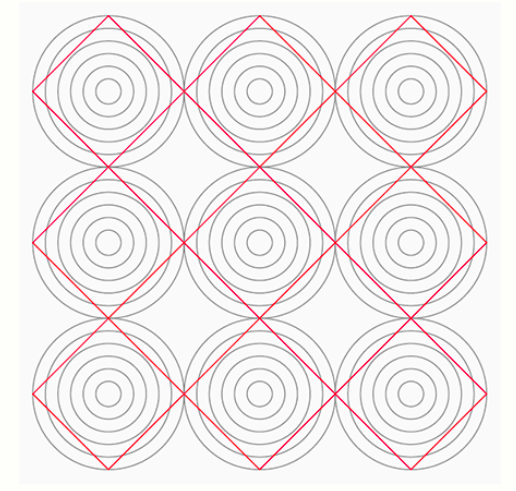
The output produced:
3 Code Structure Explanation
3.1 Document Declaration
\documentclass[border=10pt,tikz]{standalone}The standalone class generates a single image without full document margins.
border=10pt adds a small padding, and tikz loads the TikZ package for vector graphics.
3.2 Background Color
\pagecolor{gray!5}Sets a light gray background to improve contrast and visual comfort.
3.3 TikZ Environment
\begin{tikzpicture}[x=4cm,y=4cm,...]Defines the drawing area. Scaling ensures each grid unit equals 4 cm for consistent proportions.
3.4 Rectangle Node Style
every rectangle node/.style={draw,thick,red,rotate=45,minimum width=0.707*4cm,minimum height=0.707*4cm}Defines the appearance of square nodes:
draw,thick,red: Draws red squares with thick borders.rotate=45: Rotates each square by 45°, forming a diamond shape.- Dimensions (
0.707*4cm) ensure proper scaling after rotation (√2/2 × 4 cm).
3.5 Grid of Circles
\foreach \y in {1,...,3}
    \foreach \x in {1,...,3}{ ... }
Generates a 3×3 grid of circle clusters centered at coordinates (x, y).
3.6 Concentric Circles
\foreach \diameter in {1,...,6}
    \draw[gray,thick] (\x,\y) circle (1/12*\diameter);
Draws six concentric circles per grid point, producing a layered depth illusion.
3.7 Square Nodes
\node[rectangle] at (\x,\y) {};Places a red rotated square at each grid center, creating a visual conflict between radial (circular) and diagonal (square) orientation — the essence of the illusion.
4 Visual Analysis
The illusion emerges from the interaction between circle symmetry and diagonal orientation.
The human eye perceives competing directional cues:
| Visual Factor | Perceptual Effect |
|---|---|
| Diagonal squares | Create tension and apparent skew |
| Concentric circles | Reinforce radial focus |
| Neutral colors | Maintain balance between shapes |
Together, they form an impression of distortion even though all elements are mathematically aligned.
5 Experimental Variations
| Parameter | Function | Visual Impact |
|---|---|---|
Number of circles (1,...,6) |
Controls layering | More circles amplify depth illusion |
| Square color | e.g., blue or orange |
Alters focal emphasis |
| Rotation angle | Change to 30° or 60° | Shifts perceived distortion |
| Circle spacing | Modify 1/12 to 1/10 |
Changes density and overlap |
Example variation:
\node[rectangle,draw=blue,rotate=30] at (\x,\y) {};6 Scientific and Artistic Relevance
This pattern demonstrates how geometry influences perception:
- Cognitive psychology: illustrates orientation conflict and visual interpretation.
- Geometric art: transforms mathematical symmetry into aesthetic patterns.
- Information visualization: helps understand alignment perception.
- Design: used in architecture and optical art for dynamic compositions.
7 Conclusion
The circle illusion shows that perfect symmetry does not guarantee stable perception.
By combining concentric geometry and diagonal rotation, our brains fabricate curvature where none exists.
Using LaTeX TikZ, such illusions can be precisely modeled — turning mathematics into visual art.
8 References
- Gregory, R. L. (1997). Eye and Brain: The Psychology of Seeing. Oxford University Press.
- Coren, S., & Girgus, J. S. (1978). Seeing is Deceiving: The Psychology of Visual Illusions. Lawrence Erlbaum.
- Ware, C. (2013). Information Visualization: Perception for Design. Morgan Kaufmann.
- PGF/TikZ Manual, Version 3.1.10 (2023).
Written by: Aan Triono
License: CC BY-SA 4.0