Creating Pompeii Mosaic Patterns with LaTeX TikZ

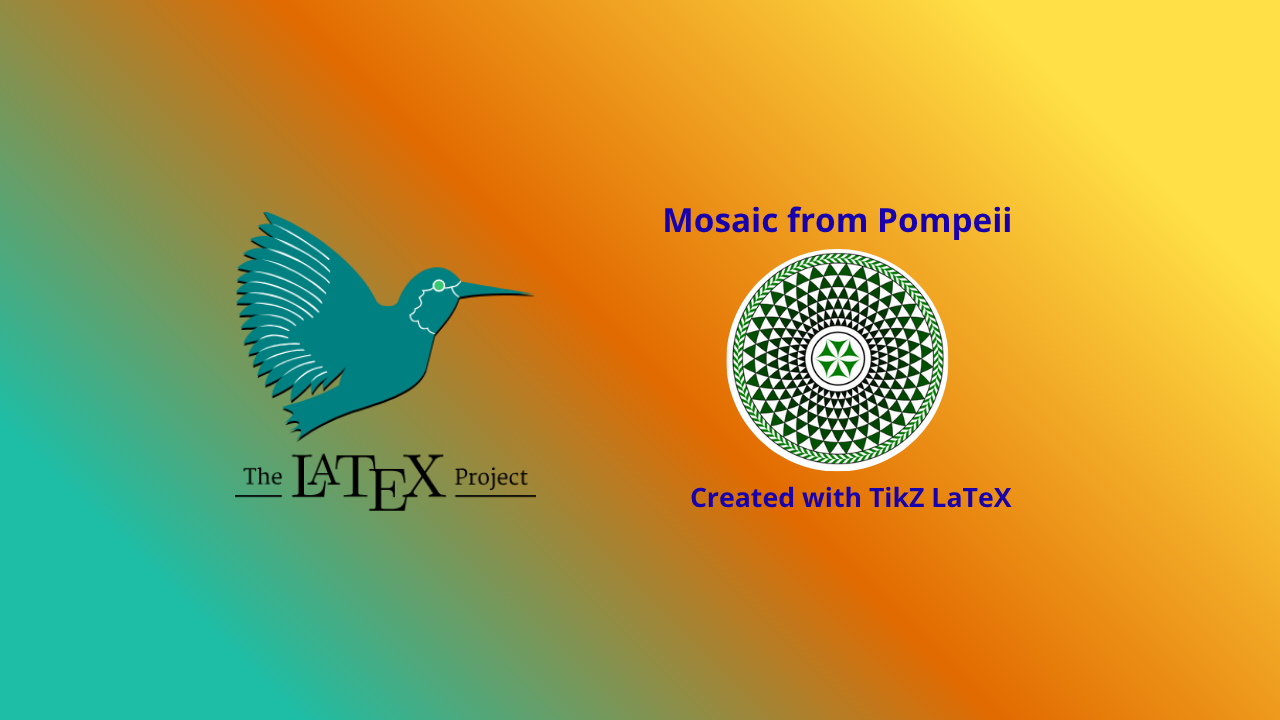
This article discusses a comprehensive analysis of Daniel Steger’s LaTeX TikZ code for generating Pompeii mosaic patterns — covering code structure, visual philosophy, and scientific and artistic relevance.
1 Introduction
This work originates from Daniel Steger, who reinterpreted ancient mosaic patterns from the Casa degli Amorini Dorati in Pompeii. Using LaTeX TikZ, he reconstructed complex geometric forms through the principles of circle intersection and rotational symmetry.
The purpose of this article is to dissect the code thoroughly: from technical structure, mathematical principles, visual-philosophical interpretation, to scientific and artistic relevance in the modern era.
2 LaTeX Source Code
Below is the complete code for generating Pompeii mosaic patterns using TikZ:
% Author: Daniel Steger
% Source: Mosaic from Pompeji
% Casa degli Armorini Dorati, Living room, mosaic
\documentclass{minimal}
\usepackage{tikz}

\begin{document}

\begin{tikzpicture}[cap=round]
% Colors
\colorlet{anglecolor}{green!50!black}
\colorlet{bordercolor}{black}

%Configuration
\def\alpha{5} % degree
\def\layer{5}

\begin{scope}[scale=5]
\pgfmathsetmacro\sinTriDiff{sin(60-\alpha)}
\pgfmathsetmacro\cosTriDiff{1-cos(60-\alpha)}
\pgfmathsetmacro\radiusC{sqrt(\cosTriDiff*\cosTriDiff + \sinTriDiff*\sinTriDiff)}
\pgfmathsetmacro\startAng{\alpha + atan(\sinTriDiff/\cosTriDiff)}
\pgfmathsetmacro\al{\alpha*\layer}

\foreach \x in {0,\alpha,...,\al}
{
  \pgfmathsetmacro\ang{\x + \startAng}
  \pgfmathsetmacro\xRs{\radiusC*cos(\ang)}
  \pgfmathsetmacro\yRs{\radiusC*sin(\ang)}
  \pgfmathsetmacro\radiusLayer{\xRs + sqrt( 1 - \yRs*\yRs )}
  \pgfmathsetmacro\angRs{acos(\yRs)}
  \pgfmathsetmacro\angRss{acos(\radiusC*sin(\ang-\alpha))}
  \colorlet{anglecolor}{black!\ang!green}
  \pgfmathsetmacro\step{2*\alpha - 180}
  \pgfmathsetmacro\stop{180-2*\alpha}

  \foreach \y in {-180, \step ,..., \stop}
  {
    \pgfmathsetmacro\deltaAng{\y-\x}
    \filldraw[color=anglecolor,draw=bordercolor]
        (\y-\x:\radiusLayer)
                arc (-90+\angRs+\deltaAng : \alpha-90+\angRss+\deltaAng :1)
                arc (\alpha+90-\angRss+\deltaAng : 2*\alpha+90-\angRs+\deltaAng :1)
                arc (\deltaAng+2*\alpha : \deltaAng : \radiusLayer);
  }
}

\pgfmathsetmacro\xRs{\radiusC*cos(\al+\startAng)}
\pgfmathsetmacro\yRs{\radiusC*sin(\al+\startAng)}
\pgfmathsetmacro\radiusLayer{\xRs + sqrt( 1 - \yRs*\yRs )}
\draw[line width=2, color=bordercolor] (0,0) circle (.8*\radiusLayer);
\pgfmathsetmacro\radiusSmall{.7*\radiusLayer}

\foreach \x in {-60,0,...,240}
{
    \fill[color=anglecolor] (\x:\radiusSmall) arc (-180+\x+60: -180+\x: \radiusSmall)
                             arc (0+\x: -60+\x: \radiusSmall)
                             arc (120+\x: 60+\x: \radiusSmall);
}

\foreach \x in {0, 4, ..., 360}
{
  \fill[color=anglecolor] (\x:1) -- (\x+3:1.05) -- (\x+5:1.05) -- (\x+2:1) -- cycle;
  \fill[color=anglecolor] (\x+5:1.05) -- (\x+7:1.05) -- (\x+4:1.1) -- (\x+2:1.1) -- cycle;
}
\draw[line width=1, color=bordercolor] (0,0) circle (1);
\draw[line width=1, color=bordercolor] (0,0) circle (1.1);
\end{scope}

\end{tikzpicture}
\end{document}
Keluaran yang dihasilkan:

3 Code Structure Explanation
3.1 Initialization and Packages
\documentclass{minimal}
\usepackage{tikz}
The code uses the minimal class for pure graphics purposes and the tikz package for drawing vector shapes.
3.2 Color and Parameter Settings
\colorlet{anglecolor}{green!50!black}
\colorlet{bordercolor}{black}
\def\alpha{5}
\def\layer{5}anglecolor: dark green gradient color used for rotational effects.bordercolor: border of each shape in black.\alpha: angular interval between elements (5°).\layer: number of main layers (5).
3.3 Basic Geometry Calculations
This section utilizes trigonometry to determine the position and radius of circles resulting from intersections.
\pgfmathsetmacro\sinTriDiff{sin(60-\alpha)}
\pgfmathsetmacro\cosTriDiff{1-cos(60-\alpha)}
\pgfmathsetmacro\radiusC{sqrt(\cosTriDiff^2 + \sinTriDiff^2)}
These values form the foundation for the intersection points between circles that create the hexagonal or flower pattern.
3.4 Creating Segments and Main Pattern
The main \foreach loop block repeats rotation every \alpha degrees.
\foreach \x in {0,\alpha,...,\al}In each iteration:
- Center point coordinates are calculated.
- Intersection angles (
\angRs,\angRss) are obtained usingacos. - Arc patterns are created through three interconnected
arccommands, forming leaf-like or scale-like shapes.
3.5 Center and Outer Decorative Elements
This section adds a center circle and small petal ornaments around it.
\foreach \x in {-60,0,...,240}Forms six symmetric elements, symbolizing the hexagonal harmony characteristic of Roman mosaics.
While the outer circle:
\foreach \x in {0, 4, ..., 360}Produces a gear teeth pattern, symbolizing order and continuity.
4 Visual and Philosophical Analysis
Visually, this pattern forms order born from repetition and circle intersections. In the context of classical Pompeii aesthetics:
- Circles represent perfection and eternity.
- Intersections symbolize the connection between earthly and divine elements.
- The green-black gradient provides contrast between life and structure, giving spatial depth.
Its philosophy approaches the concept of mandala, but with an ancient Western geometric touch — not Eastern spirituality, but rather aesthetic rationality.
5 TikZ Variation Experiments
You can explore the following parameters to create variations:
| Parameter | Visual Effect | Example |
|---|---|---|
\alpha |
Controls pattern density | \def\alpha{10} → sparser shape |
\layer |
Number of rotation layers | \def\layer{8} → deeper pattern |
anglecolor |
Color scheme | Replace with blue!50!black |
scale |
Overall pattern size | scale=3 → denser pattern |
These experiments demonstrate the flexibility of TikZ as a code-based artistic medium.
6 Scientific and Artistic Relevance
From a scientific perspective:
- This code demonstrates rotational transformation, circle intersection, and polar symmetry.
- It can be applied in computational geometry, vector graphics, and visual mathematics education.
Artistically:
- It revives the aesthetics of Roman architecture in a digital medium.
- It serves as a concrete example of how code can become an art canvas.
7 Conclusion
Through exploring Daniel Steger’s work, we learn that:
“Code can be a form of art equal to brush and canvas — only it draws with logic and symmetry.”
With LaTeX TikZ, the relationship between science, art, and geometry unites in harmony echoing the glory of Pompeii.
8 References
- Daniel Steger, TikZ example: Mosaic from Pompeji, TeXample.net
- Till Tantau, The TikZ and PGF Manual, v3.1.10, 2024.
- Plato, Timaeus: on geometry and cosmic order.
- Gombrich, E. H. The Sense of Order: A Study in the Psychology of Decorative Art. Oxford University Press, 1979.
Written by: Aan Triono
License: CC BY-SA 4.0