Circle

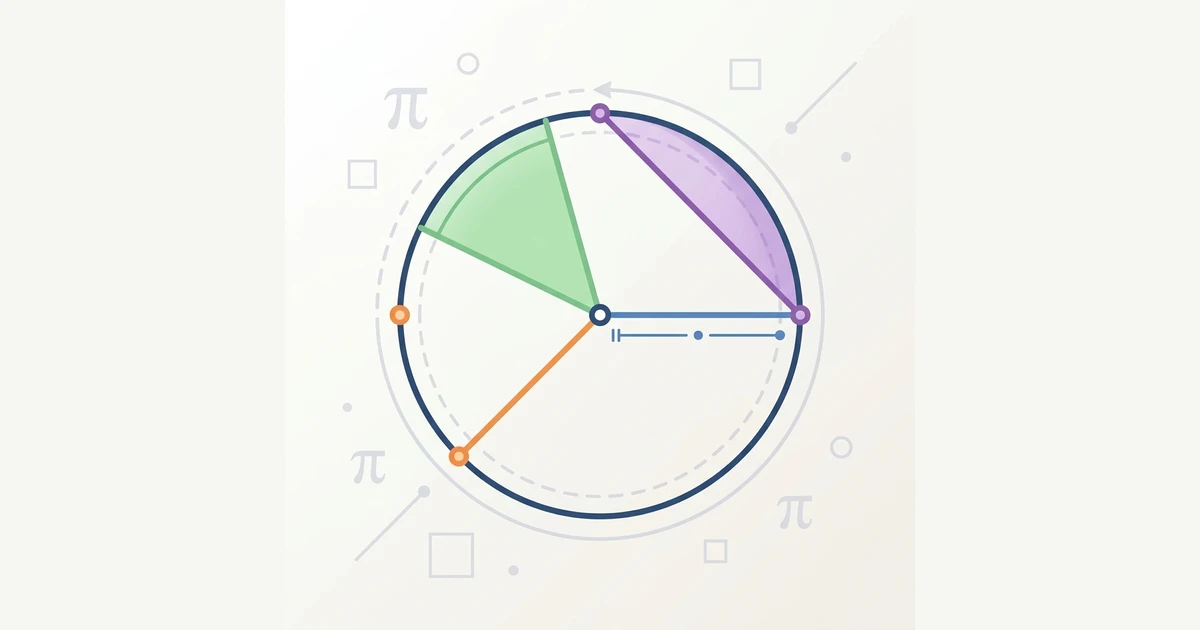
Introduction
This lesson covers the definition of a circle, the elements of a circle, the approximation of , the formulas for circumference and area, and a few contextual examples.
Basic Competencies
3.7 Explain central angles, inscribed angles, arc length, and the area of a sector, along with their relationships.
4.7 Solve problems related to central angles, inscribed angles, arc length, and the area of a sector.
Learning Objectives
After studying this material, students are expected to be able to:
- Derive the formula for the circumference of a circle from contextual situations.
- Derive the formula for the area of a circle from contextual situations.
- Explain the relationship between a central angle and arc length.
- Explain the relationship between a central angle and sector area.
- Solve problems involving circumference and area of circles.
Material
1. Definition of a Circle

A circle is a simple closed curve whose points are all the same distance from one fixed point. That fixed point is called the center of the circle. The distance from the center to a point on the circle is called the radius.
The region enclosed by the circle is called the circular region.
2. Elements of a Circle

Important elements of a circle include:
- Center, the point equidistant from all points on the circle, for example point .
- Radius, a line segment from the center to a point on the circle, for example , , and .
- Diameter, a line segment connecting two points on the circle and passing through the center, for example .
- Arc, a curved part of the circle, for example arc .
- Chord, a line segment connecting two points on the circle, for example .
- Sector, the region bounded by two radii and an arc, for example sector .
- Segment, the region bounded by a chord and its arc, for example segment .
- Apothem, the shortest segment from the center to a chord, for example .
3. Approximating the Value of

The circumference of a circle is the length of the path around the edge of the circle.
To approximate , try the following activity:
- Find several circular objects such as coins, wheels, or cans.
- Measure the circumference and the diameter of each object.
- Compute
circumference / diameter. - Record the results in a table.
| No | Object | Circumference | Diameter | Circumference / Diameter |
|---|---|---|---|---|
| 1 | First object | … | … | … |
| 2 | Second object | … | … | … |
| 3 | Third object | … | … | … |
With careful measurement, the ratio will approach a constant number, namely .
Common approximations are:
4. Circumference of a Circle
From the activity above:
Since , then:
So the circumference formula is:
where:
- = circumference
- = diameter
- = radius
Usually, is used when the radius or diameter is a multiple of 7, while is used in other cases.
Examples
- Find the circumference of a circle with radius cm.
- A motorcycle wheel has radius cm.
- Find the circumference.
- Find the distance traveled after rotations.
- A circular garden has diameter m. If palm trees are planted every meters along the boundary, how many trees are needed?
- Find the perimeter of the shaded region in the following two figures.


Solutions
So the circumference is cm.
So the circumference is cm.
Distance traveled after rotations:
- Garden boundary:
Number of trees:
So palm trees are needed.
- First figure:
So the perimeter of the shaded region is cm.
Second figure:
So the perimeter of the shaded region is cm.
5. Area of a Circle

The area of a circle is the area enclosed by its circumference.
One way to derive the formula is:
- Draw a circle.
- Divide it into two equal parts.
- Split it further into several sectors.
- Rearrange the sectors so that the shape approaches a rectangle.

As the number of sectors increases, the new shape approaches a rectangle with:
- length circumference
- width
Thus:
In terms of diameter:
So the area formula is:
where:
- = area
- = radius
- = diameter
Examples
- Find the area of a circle if:
- the radius is cm
- the diameter is cm
- Find the radius if the area is .
- Find the area of the shaded region in the following three figures.


Solutions
- If cm:
So the area is .
If cm:
So the area is .
So the radius is cm.
- First figure:
Area of the large square:
Shaded area:
Unshaded area:
So the unshaded area is .
Second figure:
So the shaded area is .
Third figure:
Since there are two equal segments:
So the total shaded area is .
6. Circle Optical Illusion
The following image is a circle optical illusion previously created using .

7. GeoGebra Simulation
This simulation shows the parts of a circle. Turn the elements on or off to inspect them.
8. Circumference and Area Simulation
Move the radius slider to see how the circumference and area change.
9. Evaluation
The old interactive worksheet in this article depended on a third-party embed that is no longer stable with the current theme. It has been removed to keep the page rendering intact.
If needed, the evaluation can be replaced later with:
- a stable Hugo shortcode,
- an external worksheet link,
- or a local quiz component.
This completes the circle lesson and its main elements. Suggestions and corrections can be added through the available feedback channel.