Rotation

Introduction

A. Learning Objectives
After studying the rotation material (rotation) This is expected to:
Explain geometric transformations (rotation) which is connected to contextual problems.
Solve contextual problems related to geometric transformations (rotation).
B. Material
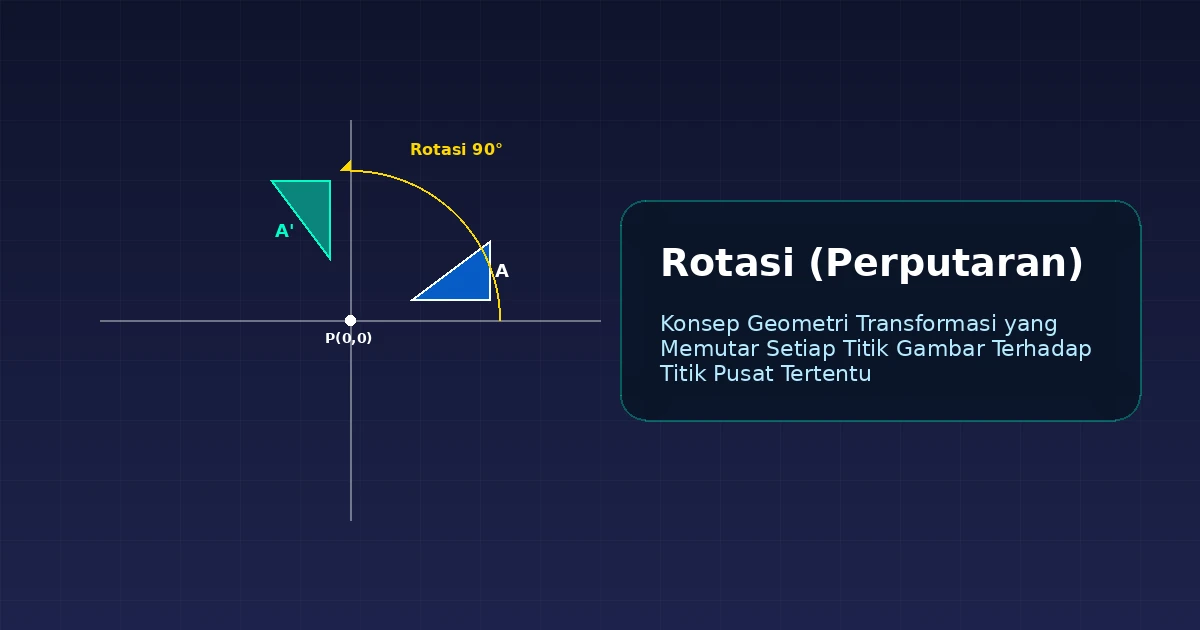
Have you ever ridden a merry-go-round? When you ride the merry-go-round, you will see that the carousel revolves around a pole in the middle. While rotating the pole remains in place. In the case of a merry-go-round, the pole functions as the center point of rotation, while those who are rotated are the people sitting on the merry-go-round. Rotation is a form of transformation that rotates each point in the image to a certain angle and direction towards a fixed point. This fixed point is called the center of rotation. The angle of the object’s image with respect to its initial position is called the rotation angle. Look at the following image:
To be able to rotate, information is needed about the angle of rotation, direction of rotation and center point of rotation.* Rotation angleThe rotation angle is * Direction of rotationBased on the rules for determining quadrants, the direction of rotation is positive if counterclockwise and the direction of rotation is negative if clockwise.* Center point of rotationThe center of rotation is a coordinate point. If the center of rotation is not specified then the center of rotation is the origin O(0.0)**Example of the first question:**A point A(2.4) rotated with the center of rotation being the origin O(0.0). Determine the rotation result of point A if it is rotated counterclockwise by:a. rotation angle b. rotation angle c. rotation angle d. rotation angle **Solution:**The steps to get the rotation results from point A are as follows:(i) Measure the distance from the point (0, 0) to the point A(2, 4)(ii) Rotate it with the center point (0, 0) as far as counterclockwise.(iii) The point obtained is the result of rotation A(2, 4), that is A’(-4, 2).(iv) Repeat steps (i) - (iii) for rotation angles , , and .a. Point rotation results A(2, 4) for rotation angle is A’(-4, 2)b. Point rotation results A(2, 4) for rotation angle is A’’(-2, -4)a. Point rotation results A(2, 4) for rotation angle is A’’’(4, -2)a. Point rotation results A(2, 4) for rotation angle is A’’’’(2, 4)To make it clearer, see the following image:
**Example of the second question:**A triangle ABC with A(1, 4), B(1, 6), And C(3, 6) rotated with a center point O(0, 0) of clockwise. Describe the results of the rotation.**Solution:**To get the rotation results of triangle ABC, do the following steps:(i) Measure the distance from the point (0, 0) to the point A(1, 4)(ii) Rotate it with the center (0, 0) as far as clockwise.(iii) The point obtained is the result of rotation A(1, 4), that is A’(4, -1).(iv) Do the same activities for point B and point C to obtain B(6, -1) And C(6, -3)(v) Connect points A’, B’, and point C’ to obtain a triangle A’B’C’ as shown in the following image.

Rotational SymmetryRotational symmetry is closely related to rotation. A shape has rotational symmetry if it can be rotated at its center and returned to its original position more than once in one complete rotation, as in the picture below.

The number of times it returns to its original position in one complete rotation or is called the degree of rotational symmetry. All figures will return to their original position at least once when rotated . So every shape has a degree of rotational symmetry of at least one. Only shapes that have a degree of rotational symmetry of 2 or more are said to have rotational symmetry.**Conclusion :**From the rotation results in the example problem, it can be concluded that the rotation results of a point with a center of rotation O(0, 0) and rotated counterclockwise as shown in the following table:
| Rotation Angle | Starting Point | Shadow | Example |
|---|---|---|---|
| $90^0$ | *A(x,y)* | *A(-y, x)* | *A*(2, 4) become *A'*(-4, 2) |
| $180^0$ | *A(x,y)* | *A(-x -,y)* | *A*(2, 4) become *A'*(-2, -4) |
| $270^0$ | *A(x,y)* | *A(y, -x)* | *A*(2, 4) become *A'*(4, -2) |
| $360^0$ | *A(x,y)* | *A(x,y)* | *A*(2, 4) become *A'*(2, 4) |
**Simulation:**Below we present a rotation simulation of a quadrilateral ABCD. 1. Move the quadrilateral ABCD or writing corners to the right and to the left.
- Below we present a rotation simulation of a triangle ABC.Slide/Move point D or triangle ABC in any direction
C. Evaluation
After studying this rotation material, please do the following questions:
- The flat shape A’B’C’D’E’F’ below is an image of the flat shape ABCDEF after undergoing rotation with the center of rotation O(0, 0) and a certain rotation angle.

a. Determine the angle of rotation.b. Is the direction of rotation counterclockwise?
- Point B(2, 1) rotated with a rotation angle of counterclockwise. Determine the result of the rotation. This is the material for rotational submaterial geometric transformation. Hopefully it’s useful, Thank you. 😊🙏