Pythagorean Triples

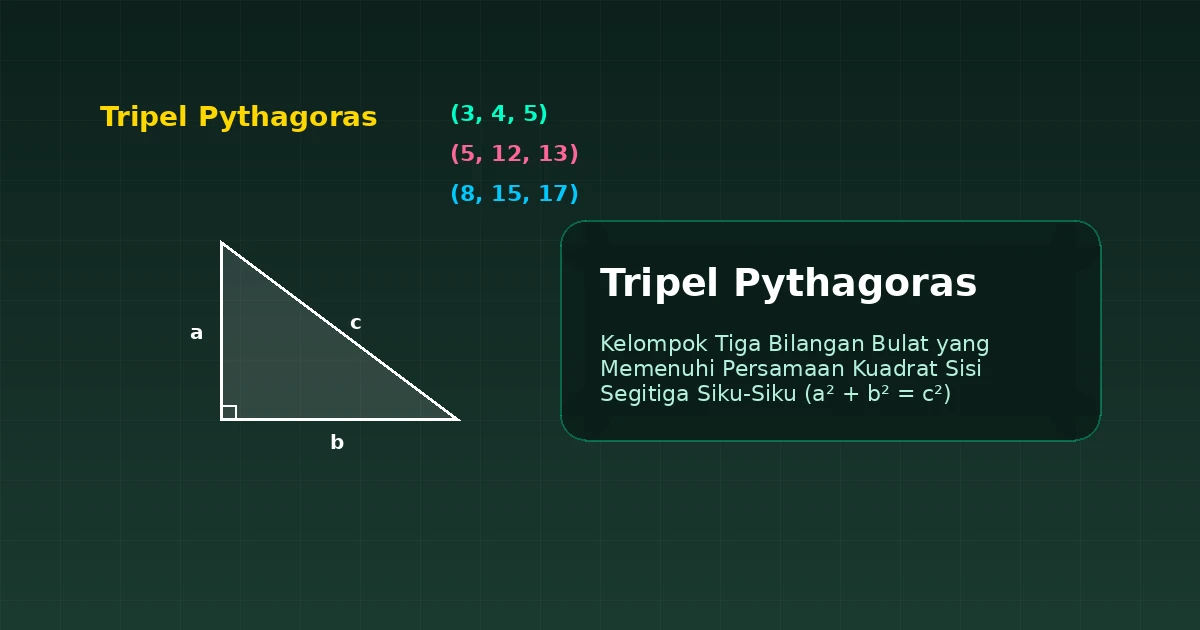
Introduction
From the Pythagorean theorem, we know the relation:
Three positive integers that satisfy this equation are called Pythagorean triples. If the three numbers have no common factor other than 1, the triple is called a primitive Pythagorean triple.
Basic Formula
If and are positive integers with , then one standard form of a Pythagorean triple is:

Proof
Let:
Then:
So really is a Pythagorean triple.
Area and Perimeter
If the legs and hypotenuse of a right triangle are written in this form, then:
Area
Perimeter
In some cases, the area and the perimeter are equal. Starting from:
we can derive:
Examples:
- if and , then area = perimeter =
24 - if and , then area = perimeter =
30
Types of Pythagorean Triples
1. Primitive Pythagorean Triples
A Pythagorean triple is called primitive if:
Some useful properties:
- at least one of , , or is odd
- one of or is even
- is always odd
2. Twin Primitive Pythagorean Triples
A primitive triple is called twin primitive when the difference between the hypotenuse and the longer leg is 1.
Using:
if , the twin condition gives:
So:
If , then:
which has no positive integer solution.
3. Composite Pythagorean Triples
A triple is called composite when the three numbers still have a common factor greater than 1.
Example 1
Prove that if one of or is even in a primitive Pythagorean triple , then must be odd.
Solution
Use an indirect proof. Suppose is even while and are odd.
Write:
Substitute into the Pythagorean equation:
The left-hand side is not an integer, but must be an integer. This contradiction shows that cannot be even. Therefore, must be odd.
Example 2
Find all primitive Pythagorean triples with even and .
Solution
Take:
with conditions:
- and are relatively prime
- and are not both odd
The valid results are:
| Triple | |||||
|---|---|---|---|---|---|
| 2 | 1 | 3 | 4 | 5 | |
| 3 | 2 | 5 | 12 | 13 | |
| 4 | 1 | 15 | 8 | 17 | |
| 4 | 3 | 7 | 24 | 25 | |
| 5 | 2 | 21 | 20 | 29 | |
| 6 | 1 | 35 | 12 | 37 |
How to Generate Pythagorean Triples
General steps:
- choose two natural numbers and with
- compute , , and
- those three values form a Pythagorean triple
Examples:
| Triple | |||||
|---|---|---|---|---|---|
| 2 | 1 | 3 | 4 | 5 | |
| 3 | 1 | 8 | 6 | 10 | |
| 3 | 2 | 5 | 12 | 13 | |
| 4 | 3 | 7 | 24 | 25 | |
| 5 | 4 | 9 | 40 | 41 | |
| 6 | 5 | 11 | 60 | 61 |
Notes:
- every multiple of a Pythagorean triple is also a Pythagorean triple
- Pythagorean triples are not limited to integers; they also appear with rational or irrational numbers, such as or
Closing
Pythagorean triples provide a fast way to build right triangles without starting from scratch every time. Once the basic formula and the primitive conditions are understood, many useful numerical patterns become easy to generate.