Translation

Introduction
Learning Objectives
After studying translation, students are expected to be able to:
- Explain translation as a geometric transformation in contextual problems.
- Solve contextual problems involving translation.

Material
What is translation? What happens to the size and shape of an object after it is shifted?
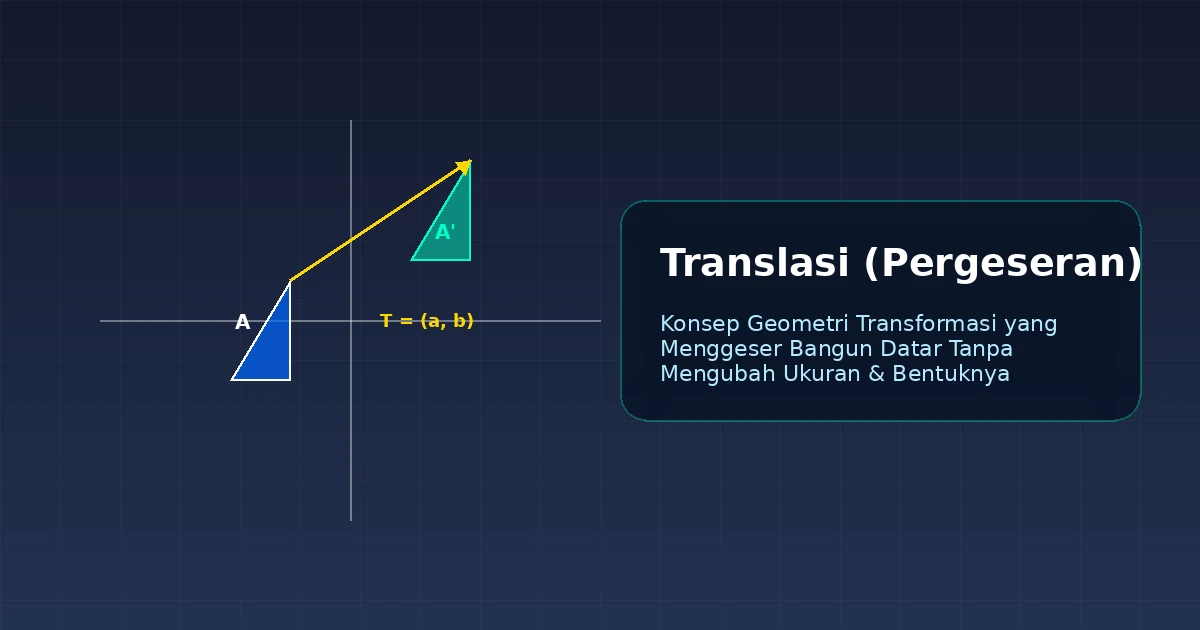
Translation is a geometric transformation that moves a figure from one position to another without changing its size, shape, or orientation. A figure may be shifted upward, downward, to the left, or to the right.
Look at the following illustration.

From the picture above, we can conclude that when a figure is translated:
- each point moves in the same direction and by the same distance;
- the figure keeps the same orientation, size, and shape as before the translation.
To perform a translation, we need to know how far a point moves horizontally and vertically. This displacement is represented by the translation vector
where:
- represents the horizontal shift;
- represents the vertical shift.
If is positive, the figure moves to the right. If is negative, it moves to the left. If is positive, it moves upward. If is negative, it moves downward.
Example
Point is translated by the vector . Determine the image of point .
Solution
Point moves three units to the right and two units downward, so:
Therefore, the image of point is .

Conclusion
If a point is translated by , then its image is:
Evaluation
After studying this topic, solve the following problems.
- Point is translated 3 units to the right and 4 units downward. Determine its image.
- Look at the following figure.

Determine the translation required to obtain rectangle .
Closing
That is the discussion of translation as part of geometric transformations. I hope this material is useful.