Pythagorean theorem

Introduction
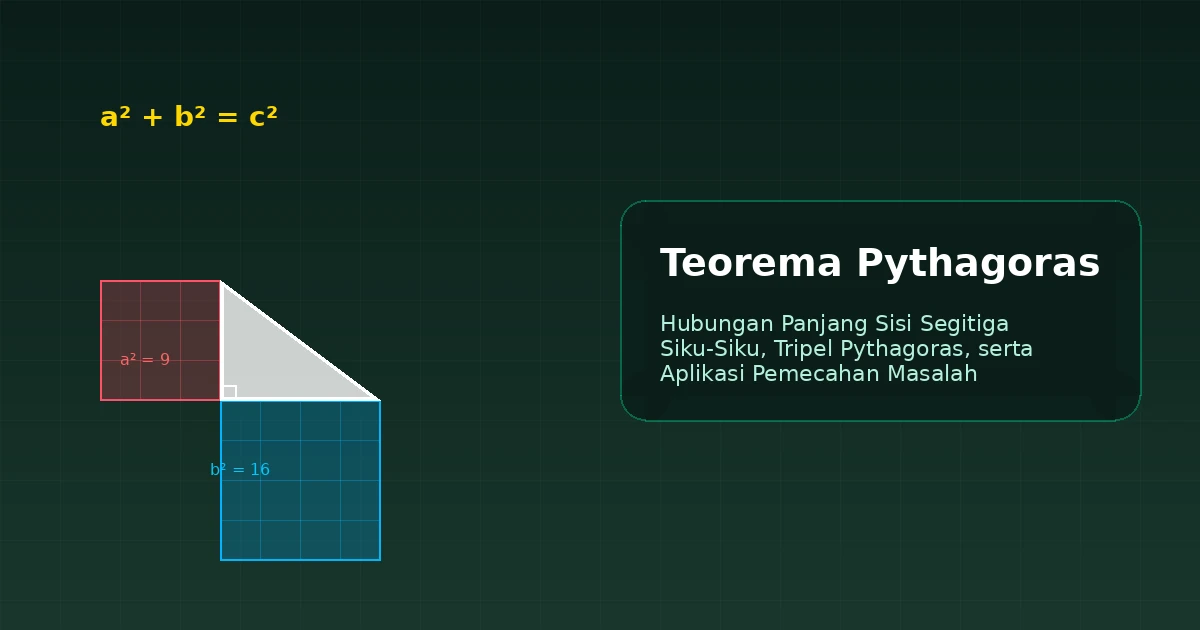
In a right triangle, there is a special relationship between the hypotenuse and the two legs. This relationship is known as the Pythagorean theorem.
Basic Competencies
3.6 Explain and prove the Pythagorean theorem and Pythagorean triples.
4.6 Solve problems related to the Pythagorean theorem and Pythagorean triples.
Learning Objectives
After studying this material, students are expected to be able to:
- Verify the Pythagorean theorem.
- Determine an unknown side of a right triangle when two sides are known.
- Determine the type of a triangle from its side lengths.
- Test whether three numbers form a Pythagorean triple.
- Apply the theorem to real-life problems.
Material
1. Discovering the Pythagorean Theorem

Triangle is right-angled at . The side opposite the right angle is called the hypotenuse, while the other two sides are called the legs.

From the square arrangements in the figure:
Since both large squares have the same area:


This means that in a right triangle, the square of the hypotenuse equals the sum of the squares of the two legs.

If the hypotenuse is and the legs are and , then:
or
Rearranged forms:
2. Using the Pythagorean Theorem
The theorem can be used to determine an unknown side of a right triangle when the other two sides are known.

Solutions
- For figure (a):
- For figure (b):
- For figure (c):
3. Determining the Type of Triangle from Its Sides
a. Converse of the Pythagorean Theorem
If a triangle satisfies:
then the triangle is a right triangle.

In general, if is the longest side:
- If , the triangle is right.
- If , the triangle is obtuse.
- If , the triangle is acute.
Examples
- A triangle has side lengths , , and .
So it is a right triangle.
- A triangle has side lengths , , and .
Because , the triangle is obtuse.
b. Pythagorean Triples
A Pythagorean triple is a set of three natural numbers that can be the side lengths of a right triangle.
Examples:
- , , and
So they form a Pythagorean triple.
- , , and
So they do not form a Pythagorean triple.
4. Side Ratios in Special Right Triangles
a. Isosceles right triangle

If , then:
Therefore:

If , then:
b. Right triangle with a angle


From the construction:
Meaning:
- the side opposite is the shortest side,
- the hypotenuse is twice that side,
- the remaining leg is times that side.

If , then:
5. Face Diagonals and Space Diagonals of a Cube

If the edge length of a cube is , then the face diagonal is:
The space diagonal is:
So for a cube with edge length :
- face diagonal =
- space diagonal =
6. Solving Word Problems
General steps for word problems using the Pythagorean theorem:
- Read the problem carefully.
- Draw a sketch.
- Identify the known and unknown sides.
- Use the appropriate formula.
- Check the result.
Example 1
Andi leans a ladder of length m against a tree. The bottom of the ladder is m from the base of the tree. How high is the top of the ladder above the ground?

So the height is m.
Example 2
A ship sails west for km and then south for km. How far is it now from its starting point?

So the ship is km from its starting point.
Evaluation
The old interactive worksheet in this article depended on a third-party embed that is no longer stable with the current blog theme. It has been removed so the page stays intact and readable.
It can be replaced later with:
- a stable Hugo shortcode,
- an external worksheet link,
- or a local quiz component.
This completes the Pythagorean theorem lesson. Corrections and suggestions can be shared through the available feedback channel.