History of TeX and LaTeX

Introduction
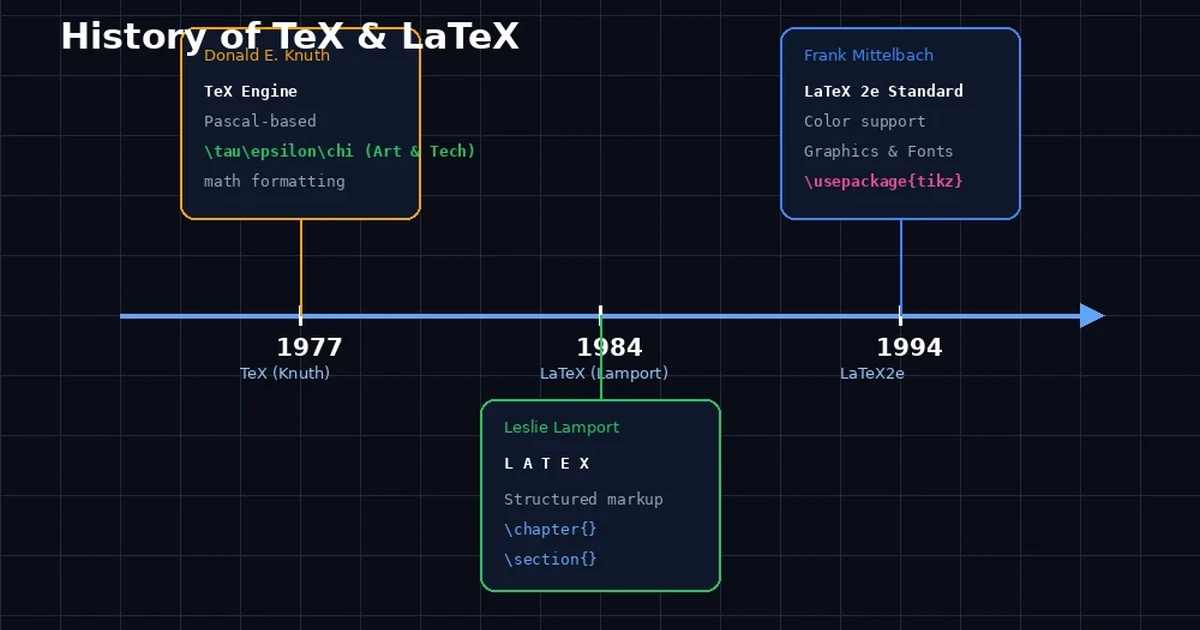
is document-processing software primarily intended for producing documents that contain mathematical notation. It was created by Donald E. Knuth in May 1977 as a document formatting language.
At first, was implemented in Pascal, but the implementation most widely used today is generally written in C. The commands available in modern implementations have also evolved significantly compared with Knuth’s original 1977 design.
is well known for producing high-quality documents. However, many users found its low-level commands difficult to use for structured documents containing chapters, sections, paragraphs, numbered tables, figures, and similar elements.

To address that problem, Leslie Lamport wrote a number of additional commands that run on top of . This extension later became known as .
People often pronounce and as “text” and “latex”. Strictly speaking, that pronunciation is not correct. The word comes from the Greek letters , sharing the same root as the word technology. Because of that, the intended pronunciation is closer to “tekh” and “latekh”.
When the stylized forms of or cannot be typeset properly, they may simply be written as TeX and LaTeX.
introduced by Leslie Lamport was first known as 2.09. Over time, continued to develop. The refined version that later became widely used is 2e, introduced in June 1994.
2e brought several improvements over 2.09, especially in support for color, fonts, and graphics. One reason for its release was to unify various formats that were not always compatible with one another, such as SLi, AMS, and others.
Advantages and Disadvantages of LaTeX
The standard version of has several advantages:
- an excellent standard for preparing text, technical formulas, and tables;
- easier use for authors once they are familiar with the workflow;
- document portability across multiple platforms;
- support for many languages;
- broad availability and free use;
- strong maintenance and support from the 3 team led by Frank Mittelbach.
On the other hand, also has several drawbacks:
- it can be difficult for beginners;
- it requires care and discipline because documents are written using structured syntax;
- documents must be compiled to see the final output, so writing often involves repeated trial and revision.
Closing
That is a short overview of the history of and . Understanding this background helps explain why remains especially strong for scientific and mathematical documents.