Prism

Introduction
This lesson covers the definition of a prism, its parts, diagonals, nets, surface area, volume, and volume changes.
Basic Competencies
3.9 Distinguish and determine the surface area and volume of polyhedra such as cubes, cuboids, prisms, and pyramids.
4.9 Solve problems related to the surface area and volume of those solids and their combinations.
Learning Objectives
After studying this material, students are expected to be able to:
- Identify faces, edges, plane diagonals, space diagonals, diagonal planes, and prism height.
- Draw prism nets.
- Determine the surface area of a prism.
- Derive and use the formula for the volume of a prism.
- Determine how prism volume changes when the base or height changes.
Material
1. Definition of a Prism
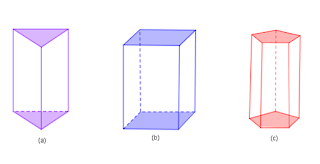
A prism is a polyhedron with two congruent and parallel faces, and lateral edges that are parallel to one another.
Based on the direction of the lateral edges, prisms are divided into:
- Right prisms, whose lateral edges are perpendicular to the base and top faces.
- Oblique prisms, whose lateral edges are not perpendicular to the base and top faces.

Prisms are named after the shape of their base, such as triangular prisms, rectangular prisms, pentagonal prisms, and so on.
2. Parts of a Prism
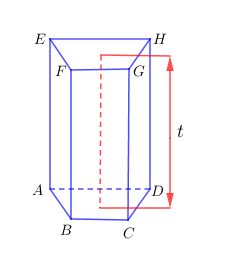
For the rectangular prism :
- Points and are the vertices.
- is the base face.
- is the top face.
- , , , and are the lateral faces.
- , , , and are the base edges.
- , , , and are the top edges.
- , , , and are the lateral edges.
- The prism height is the distance between the base and top faces. In a right prism, it equals the length of a lateral edge.
3. Plane Diagonals, Space Diagonals, and Diagonal Planes

In prism :
- and are diagonals of the base face.
- Plane is a diagonal plane, a plane containing a diagonal of the base and a corresponding diagonal of the top face.
- Segments , , and are space diagonals.
Important definitions:
- A plane diagonal joins two non-adjacent vertices on the same face.
- A space diagonal joins two vertices that do not lie on the same lateral face.
- A diagonal plane contains diagonals of the base and top faces.
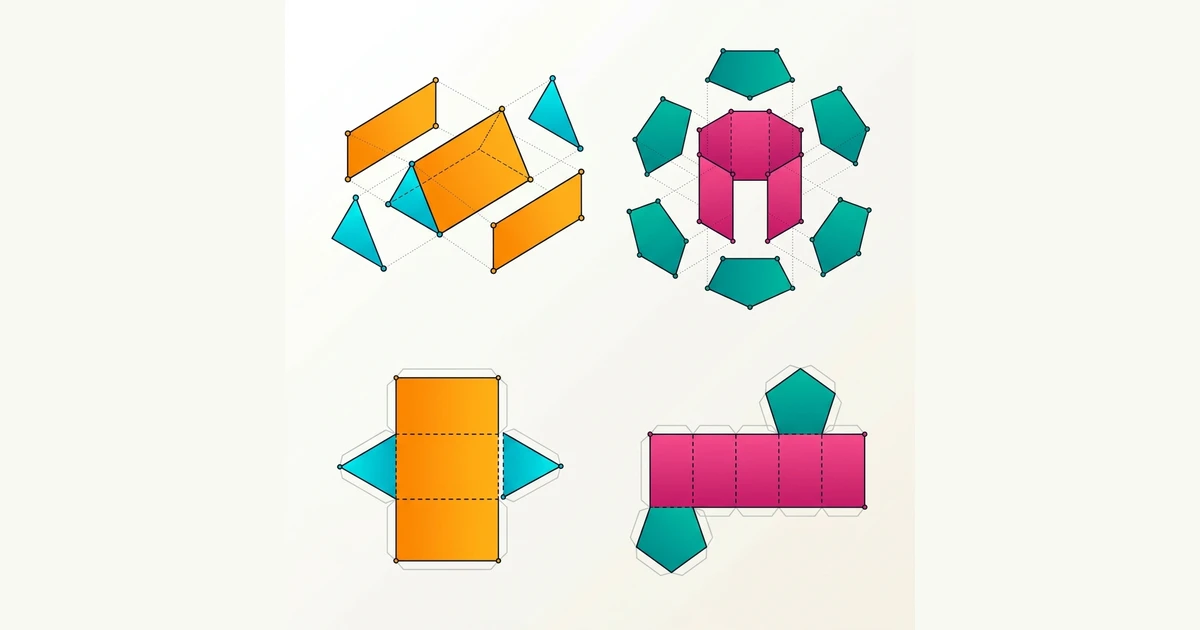
4. Prism Nets

To make a prism net:
- Build a prism model from cardboard.
- Cut along selected edges.
- Unfold the model until all faces lie flat.
5. Surface Area of a Prism
For the triangular prism , the surface area is the sum of two bases and all lateral faces:
So the formula is:
Examples
- A triangular prism has a right-triangle base with side lengths cm, cm, and cm. Its height is cm. Find the surface area.
- Find the surface area of the following prisms.


Solutions
So the surface area is .
- Trapezoidal prism:
So the surface area is .
Triangular prism:
So the surface area is .
6. Volume of a Prism

The volume formula is:
Examples
- Find the volume of a prism with height cm and a right-triangle base whose perpendicular sides are cm and cm.
- Find the volume of a prism with base area and height cm.
- Find the volume of the prism shown below.

Solutions
- Base area:
Volume:
So the volume is .
So the volume is .
- Consider . Since it is isosceles:
Area of :
Since the base consists of 5 congruent triangles:
So the volume is .
7. Change in Prism Volume
The volume of a prism depends on the area of its base and its height. If either changes, the volume changes as well.
Example:
A triangular prism has a right-triangle base with side lengths cm, cm, and cm, and prism height cm. The base is enlarged so the corresponding sides become cm, cm, and cm, while the height stays the same. Determine:
- the ratio of the new volume to the original volume,
- the amount of volume change.
Solution
Volume ratio:
Therefore:
Change in volume:
So the change in volume is .
GeoGebra Simulation
Use the following simulation to explore prism surface area and volume. Move the sliders for the triangle base, triangle height, and prism height.
Evaluation
- A triangular prism has a right-triangle base with perpendicular sides cm and cm. If the prism height is cm, find the surface area.
- Find the volume of each prism in the following figures.


That completes this prism lesson. Corrections and suggestions can be shared through the available feedback channel.