A bathroom wall has a rectangular shape and will be covered with square tiles. The length of the wall is 5 tiles longer than its width. If 300 tiles are needed to cover the wall, determine the length of the wall. Assume the area of one tile is 1 square unit.
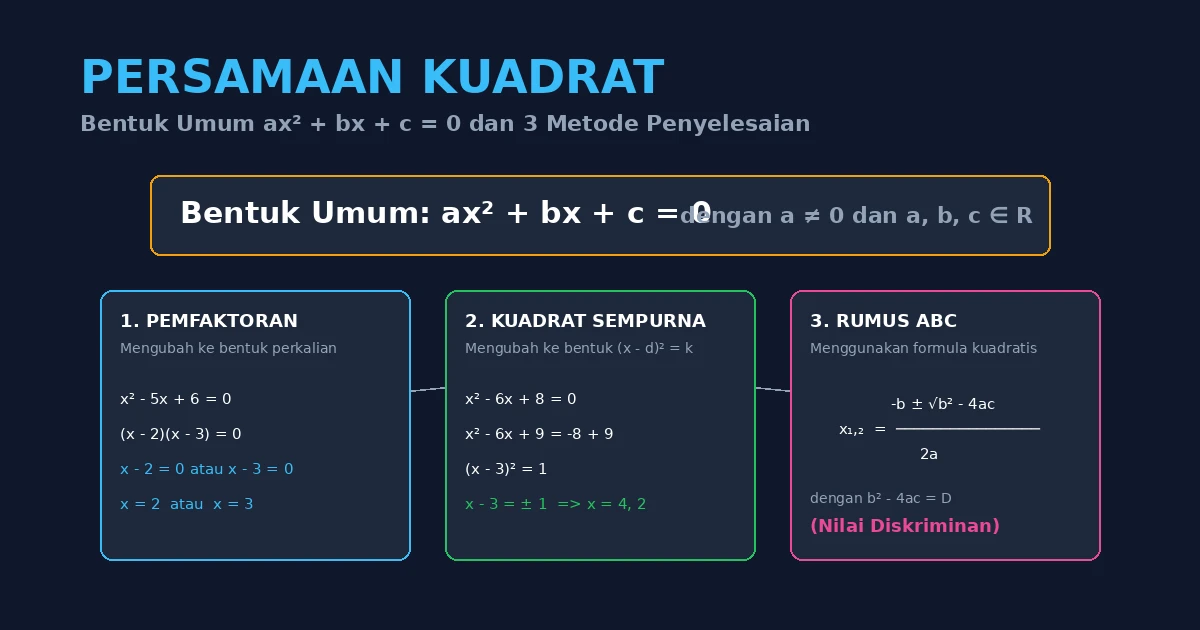
Problems like this can be modeled using a quadratic equation.
Definition of a Quadratic Equation
A quadratic equation is an equation containing a variable with highest degree two.
The general form is:
ax2+bx+c=0
where:
a, b, and c are real numbers,
a is the coefficient of x2,
b is the coefficient of x,
c is a constant,
a=0.
Types of Quadratic Equations
Observe the following examples.
2x2−6x+5=0
x2−4=0
x2−9x=0
Explanation:
The equation 2x2−6x+5=0 has a=2, b=−6, and c=5. Since all terms are present and nonzero, it is called a complete quadratic equation.
The equation x2−4=0 has a=1, b=0, and c=−4. Since it has no x term, it is called a pure quadratic equation.
The equation x2−9x=0 has a=1, b=−9, and c=0. Since its constant term is zero, it is called an incomplete quadratic equation.
Some equations are not written directly in general form, for example:
x2+7x=−10
x1+x−11=23
Such equations can still be transformed into the general quadratic form using algebraic operations.
Example
Rewrite 2x2=3x+20 into general form, then determine a, b, and c.
2x22x2−3x2x2−3x−20=3x+20=20=0
Therefore:
a=2
b=−3
c=−20
Roots of Quadratic Equations
A value of x that makes the equation true is called a root or solution of the quadratic equation.
In general, the roots can be found by:
factoring,
completing the square,
using the quadratic formula.
1. Factoring
Factoring changes an algebraic expression into a product form.
Example 1
Find the roots of:
4x2−25=0
Solution:
4x2−25(2x)2−52(2x−5)(2x+5)=0=0=0
So:
2x−52xx=0or2x+5=0=5or2x=−5=25orx=−25
Thus, the roots are:
x=25orx=−25
Example 2
Find the solution set of:
3x2−7x=0
Solution:
3x2−7xx(3x−7)=0=0
Hence:
xxx=0or3x−7=0=0or3x=7=0orx=37
So, the solution set is:
{0,37}
Example 3
Find the roots of:
x2−7x+10=0
Find two numbers whose sum is −7 and whose product is 10, namely −5 and −2.
After studying this material, complete the evaluation by following these steps:
click Start Quiz,
choose the correct answer,
click Next for the next question,
click Prev to return to the previous question,
click Reset to start again,
click Submit after finishing all questions,
check the score displayed at the bottom,
final value equals total score divided by maximum score, then multiplied by 100.
Closing
That concludes this material on quadratic equations for Grade IX SMP/MTs semester 1. If you find any mistakes, please leave a correction in the comments.