Definition of Sets

Introduction

When we shop in a fruit market or supermarket, we see fruits grouped by type, such as grapes, mangoes, and oranges. In mathematics, a collection like this can be called a set if its members are clearly defined.
Not every collection qualifies as a set. The objects in the collection must be identifiable without ambiguity.
Definition of a Set
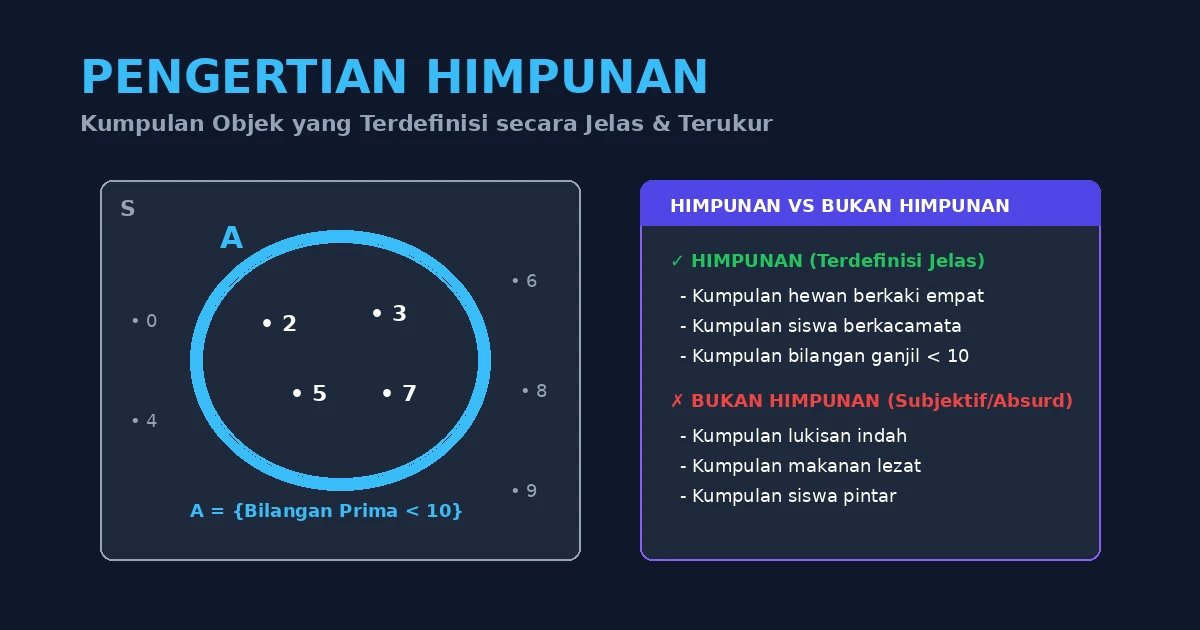
Examples of collections that are sets:
- the set of male students
- the set of four-legged animals
- the set of fruits whose names begin with the letter
S
Examples of collections that are not sets:
- the set of school subjects students like
- the set of delicious foods
- the set of clever students
From these examples, we can state:
A set is a collection of objects that is clearly defined.
The objects inside a set are called its members or elements.
Symbols and Notation
General rules for writing sets:
- set names usually use capital letters such as , , or
- the members are written inside curly braces
{ } - members are separated by commas
Examples:
Common number sets include:
- natural numbers
- whole numbers
- integers
- even numbers
- odd numbers
- prime numbers
- rational numbers
- irrational numbers
- real numbers
Ways to Describe a Set
A set can be written in several ways.
1. Using words
Example:
2. Using set-builder notation
Examples:
3. Listing all members
Examples:
Members of a Set
Suppose:
Then 1, 2, 3, 4, and 5 are members of , written as:
The symbol means “is a member of”, while means “is not a member of”.
Since 6 is not in the set , we write:
Number of Members
If is a set, the number of its members is written as . This is called the cardinality of .
- a set with finitely many members is a finite set
- a set with infinitely many members is an infinite set
Examples:
If is the set of integers between
0and6, thenso:
If is the set of natural numbers, then
so:
The Empty Set
Definition: The empty set is a set with no members. Its symbol is or { }.
The empty set is a subset of every set.
Examples:
Let be the set of Indonesian presidents whose names begin with
P. Since there are none:Let be the set of months with exactly
20days. Since no such month exists:
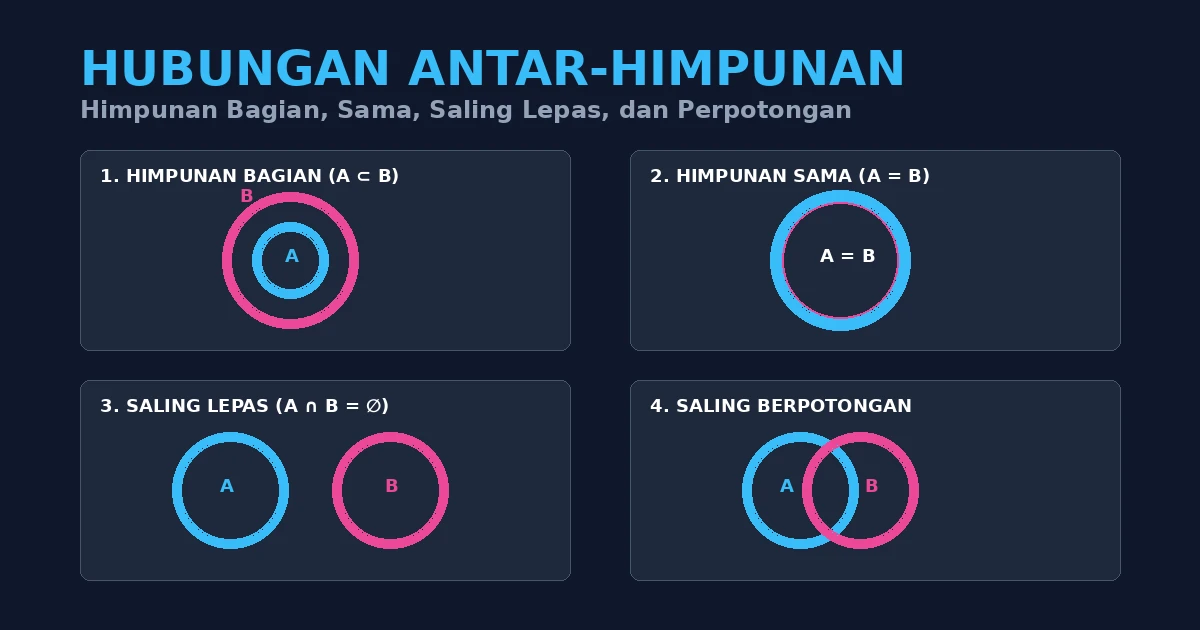
Subsets
Consider:
Every member of is also a member of , so:
But is not a subset of , so:
Likewise:
In general:
- is a subset of if every member of is also a member of
- is not a subset of if at least one member of is not in
Number of Subsets
Observe this pattern:
- if , then it has
2subsets - if , then it has
4subsets - if , then it has
8subsets
So we get the formula:
Examples:
, so . Therefore the number of subsets is:
, so . Therefore the number of subsets is:
Universal Set

If we are discussing cars, buses, trains, and airplanes, then the overall context is transportation. In set theory, this context is called the universal set.
The universal set is usually denoted by or .
Example:
Determine a possible universal set for:
Possible universal sets include:
- the set of whole numbers
- the set of natural numbers
- the set of integers
- the set of even numbers
Evaluation
Interactive exercises for this section are available in the original source.
Closing
This article introduced sets, set notation, the empty set, subsets, and the universal set. These are core ideas that support later topics in set theory and logic.