Probability


Basics of Probability
In daily life, we often hear statements such as:
- It will probably rain this afternoon.
- Joni has a big chance of becoming class president.
- Indonesia has only a small chance of beating Brazil in a football match.
Words like probably, big chance, and small chance describe how likely an event is. In mathematics, that likelihood can be studied more precisely.
Random Events
Try tossing a coin. We cannot know in advance whether the number side or the picture side will appear. This is an example of a random event, an event whose outcome cannot be determined before the experiment is carried out.
Simple activity:
- Prepare one die, one container, five red balls, and five yellow balls.
- Roll the die. Can you tell which face will appear?
- Put all the balls into the container, mix them, close your eyes, and take one ball.
- Repeat without closing your eyes.
From this activity, we see that some outcomes cannot be predicted beforehand. Those are random events.
Sample Points and Sample Space
When a coin is tossed, the possible outcomes are the number side and the picture side .
The set of all possible outcomes is called the sample space, denoted by . Its members are called sample points. The number of members in the sample space is written as .
There are three common ways to determine a sample space:
- by listing,
- by using a table,
- by using a tree diagram.
1. Determining the Sample Space by Listing
If two coins are tossed at the same time, the possible outcomes are:
with:
2. Determining the Sample Space with a Table
The sample space for two coins can also be shown with a table:
| A | G | |
|---|---|---|
| A | AA | AG |
| G | GA | GG |
So:
with:
3. Determining the Sample Space with a Tree Diagram
Another simple way is to use a tree diagram.
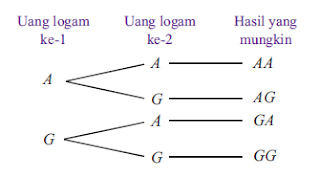
The result is still:
with:
Example Problem
Determine the sample space for the following experiments:
- rolling one die,
- tossing three coins at once,
- rolling two dice at once.
Solution
- For one die:
- For three coins, a tree diagram can be used.

- For two dice, a table can be used.

Calculating Probability
1. Understanding Events
In rolling one die, the sample space is:
Any subset of the sample space is called an event. For example:
is the event of getting an even number, so:
2. Probability Using Relative Frequency
Relative frequency is the ratio between the number of observed events and the number of trials.
If a coin is tossed 30 times and the picture side appears 13 times, then the relative frequency is:
Example Problem
Rino rolls a die 200 times. The results are:
- face 1 appears 25 times,
- face 3 appears 17 times,
- face 6 appears 56 times.
Find the relative frequency of each event.
Solution
- For face 1:
- For face 3:
- For face 6:
3. Probability Using the Formula
If every sample point is equally likely, then the probability of event is:
For example, when rolling a die:
If the event of prime numbers is:
then:
Example Problem
Siti throws one die. Determine the probability of getting:
- a 3,
- a number greater than 3,
- one of 1, 2, 3, 4, 5, 6,
- a number greater than 6.
Solution
Since:
- If , then:
- If , then:
- If , then:
- If , then:
Probability Values
Probability values always satisfy:
This means:
- means the event is impossible.
- means the event is certain.
- means the event may happen.
If is the complement of event , then:
or:
Example:
If the probability that Romi passes an exam is , then the probability that Romi does not pass is:
Example Problem
Fifteen cards are numbered from 1 to 15. One card is drawn at random. Determine the probability of drawing:
- an even number,
- a non-even number.
Solution
The sample space is:
- Even numbers:
so:
- Non-even numbers:
so:
Since is the complement of :
Expected Frequency
Expected frequency is the predicted number of times an event occurs in a certain number of trials.
Its formula is:
where:
- = expected frequency,
- = probability of event ,
- = number of trials.
Example Problem
A coin is tossed 30 times. Determine the expected frequency of the number side appearing.
Solution
Since:
then:
Example Problem
A die is rolled 100 times. Determine the expected frequency of:
- a prime-numbered face,
- a face numbered less than 3.
Solution
- Prime numbers on a die:
so:
Then:
- Numbers less than 3:
so:
Then:
Example Problem
In one area, the probability that a child contracts a disease is 0.05. Determine how many children are expected to contract the disease in a sample of 1,000 children.
Solution
So the expected number of children who contract the disease is 50.
Closing
That completes this lesson on probability. Corrections and suggestions can be shared through the available feedback channel.