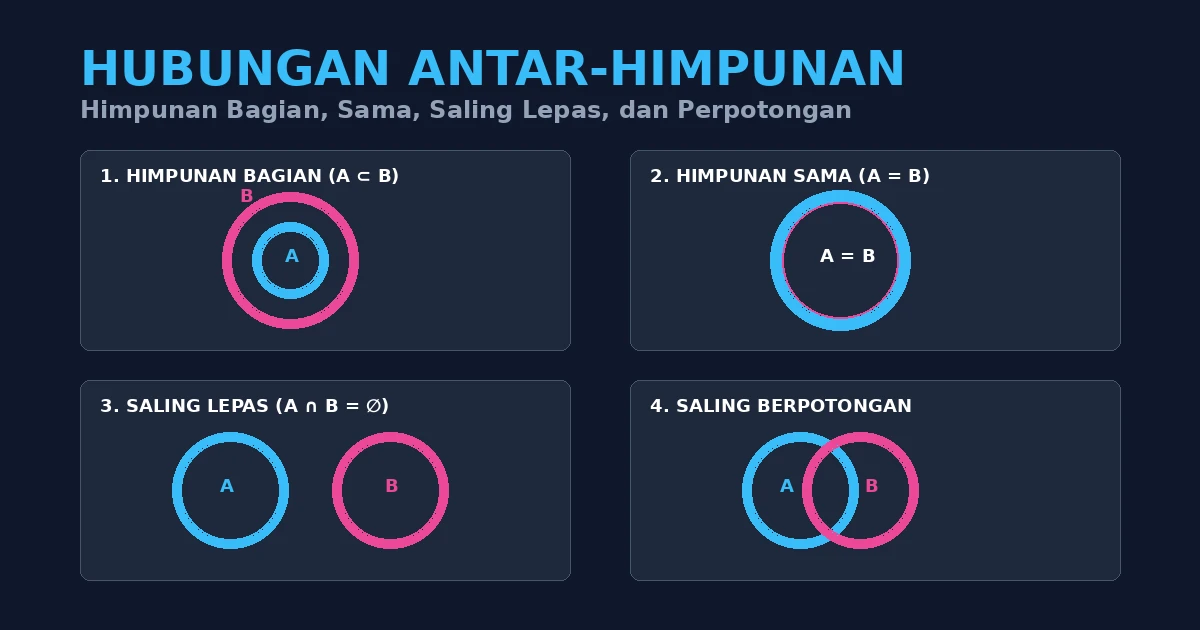
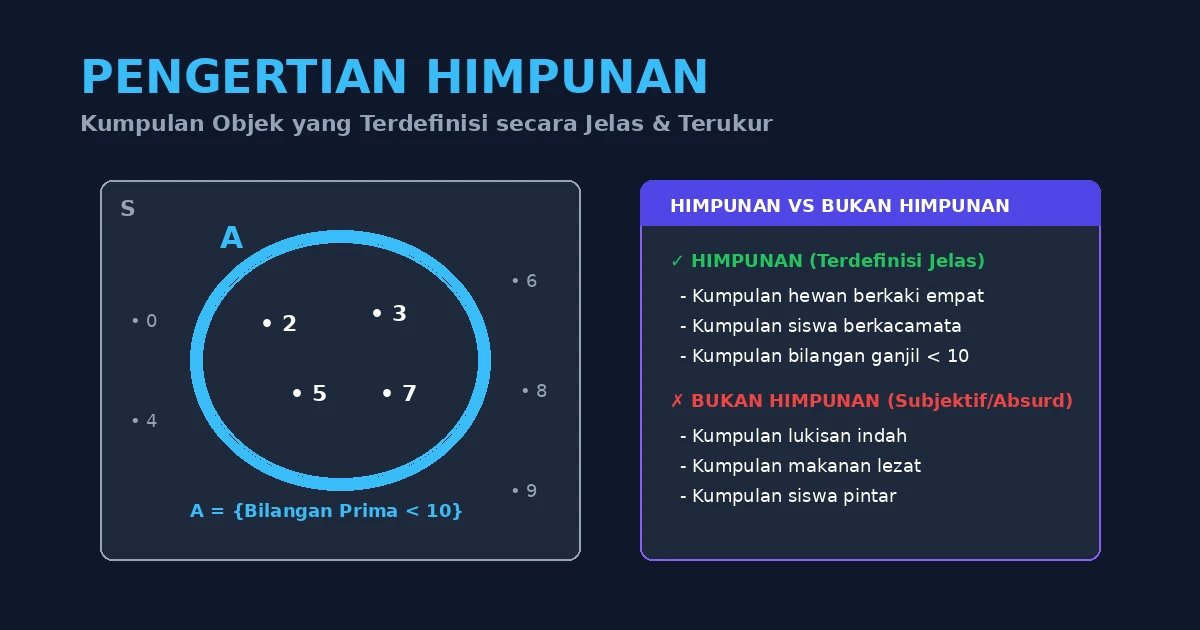
After the previous post we discussed meaning of set and presenting relationships between sets with a Venn diagram, so on this occasion we will discuss presenting set operations in Venn diagrams, the properties of set operations, and their application in solving everyday problems related to the concept of sets.
Here we will discuss set operations which include:
- intersection of two sets
- a combination of two sets
- difference (difference) of two sets
- complement of a set
Look at the following illustration. The results of a questionnaire from a group of students who liked basketball and football showed that Andi, Budi, Candra and Doni liked basketball. Apart from that, it is also noted that Eka, Fahmi, Budi and Doni like football. According to the results of the questionnaire above, are there students who like both types of sports?If presented in set form, the basketball fan set is denoted by A={Andi, Budi, Candra, Doni} and the football fan set is denoted by B={Eka, Fahmi, Budi, Doni}.

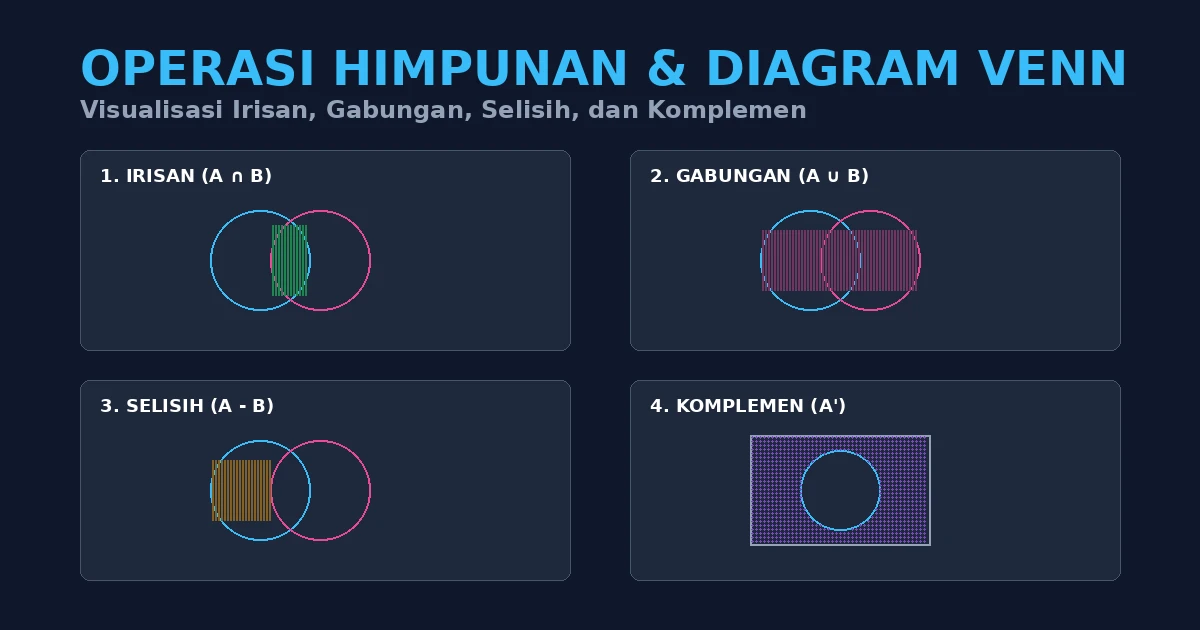
If the hobbies of a group of students are depicted using a Venn diagram, it appears that Budi and Doni like basketball and football which are intersections of the sets A and B. This can be written A∩B={Budi, Doni}. From this description it can be concluded as follows.
ConclusionThe intersection of the sets $A$ and $B$ is a set whose members are members of $A$ and $B$, denoted by $A\cap B=\{x|x\in A\ \text{and}\ x\in B\}$
Example. Given $A=\{1, 2, 3, 4, 5\}$ and $B=\{4, 5, 6, 7\}$a. Determine $A\cap B$ by registering members.b. Make a Venn diagram of the problem. Answer.a. $A=\{1, 2, 3, 4, 5\}$ and $B=\{4, 5, 6, 7\}$There are the same members of $A$ and $B$, namely $4$ and $5$ then $A\cap B=\{4, 5\}$b. The Venn diagram image looks like the following image.
 |
| Image: Intersection of two sets |
Consider the following two sets.
$A=\{\text{badminton, tennis, basketball, volleyball, football}\}$
$B=\{\text{football, karate, pencak silat, wrestling, judo}\}$If the members of $A$ and $B$ are combined, a new set will be obtained. The new set is written
$A\cup B=\{\text{badminton, tennis, basketball, volleyball, football, karate, pencak silat, wrestling, judo}\}$.The combination of these two sets can be expressed using a Venn diagram as shown in the following image.
 |
| Image: Combination of two sets |
ConclusionThe combination of sets $A$ and $B$ is a set whose members are members of set $A$ or members of set $B$, denoted by $A\cup B=\{x|x\in A\ \text{or}\x\in B\}$
Example. Given $A=\{2, 4, 6, 8, 10, 12\}$ and $B=\{2, 6, 10, 14, 18\}$a. Determine $A\cup B$ by listing its members.b. Create a Venn diagramAnswer.a. \(\begin{array}{rcl}A&=&\{2, 4, 6, 8, 10, 12\}\\B&=&\{2, 6, 10, 14, 18\}\\A\cup B&=&\{2, 4, 6, 8, 10, 12, 14, 18\}\end{array}\)b. The Venn diagram looks like the following image.
 |
| Image: Combination of two sets |
Look at the following two numbers.A={prime number less than 15}
$B=\{\text{odd numbers more than 5 and less than 20}\}$Are there prime numbers less than 15, but not odd numbers more than 5 and less than 20? If you make a Venn diagram of these two sets, you will get something like the following picture.
 |
| Figure: Difference between two sets |
Prime numbers that are less than 15 but not odd numbers that are more than 5 and less than 20 are the shaded part of the figure. In the shaded part there are the numbers 2, 3, and 5. The numbers 2, 3, and 5 are members of the set A, but not members of the set B. Next 2, 3, and 5 are called the differences of the sets A and B.
ConclusionThe difference between sets $A$ and $B$ is a set whose members are members of set $A$, but not members of set $B$, denoted by $A-B=\{x|x\in A, x\not\in B\}$
Example. GivenA={a,b,c,d,e,f} and B={a,e,i,o,u}a. Determine A−B by listing its members.b. Create a Venn diagram and shade A−B Answer.a. ABA−B==={a,b,c,d,e,f}{a,e,i,o,u}{b,c,d,f}b. Venn diagram
 |
| Figure: Difference between two sets |
Look at the following Venn diagram.
 |
| Figure: Complement of a set |
The Venn diagram shows S={1,2,3,4,5,6,7,8,9,10} and A={1,3,5,7}Is there a set S that is not a member of the set A? What is A⊂S ? The members of the set S that are not members of A are called complement or complement of A. The complement of A is written A′ or Ac. Based on the Venn diagram in the image above, we get A′=Ac={2,4,6,8,9,10}.Thus, the definition of complement of a set is as follows.
ConclusionIf $A$ is a set in $S$ then the members of the set $S$ that are not members of $A$ are called *complement* $A$ and written $A'$ or $A^c$, denoted by $A'=A^c=\{x|x\in S\ \text{and}\ x\not\in A\}$
Example. For example:
\(\begin {array}{rcl} S&=&\{\text{set\ names\ months\ in\ one\ year}\}\\A&=&\{\text{January, February, May, June, July}\}\\B&=&\{\text{September, October, November, December}\}\end{array}\)Determine:a. $A'$ by naming its members.b. $B'$ by naming its members. Answer.a. The members of $S$ who are not members of $A$ are March, April, August, September, October, November, and December. So :
$A'=\{\text{March, April, August, September, October, November, December}\}$b. The members of $S$ who are not members of $B$ are January, February, March, April, May, June, July, and August. So :
$B'=\{\text{January, February, March, April, May, June, July, August}\}$
## Properties of Set Operations
There are several properties that need to be known when operating two or more sets. Suppose we know the following sets.
\(\begin {array}{rcl} S&=&\{1, 2, 3, 4, 5, 6, 7, 8, 9, 10\}\\A&=&\{1, 2, 3, 4, 5, 6, 7, 8\}\\B&=&\{3, 4, 5, 6\}\\C&=&\{3, 4, 5, 10\}\end{array}\)
Using these sets, let's test some properties of sets.
### Commutative Property
Consider the following set operations.
$A=\{1, 2, 3, 4, 5, 6, 7, 8\}$
$B=\{3, 4, 5, 6\}$
\(\begin {array}{rcl} A\cup B&=&\{1, 2, 3, 4, 5, 6, 7, 8\}\\B\cup A&=&\{1, 2, 3, 4, 5, 6, 7, 8\}\\A\cap B&=&\{3, 4, 5, 6\}\\B\cap A&=&\{3, 4, 5, 6\}\end{array}\)
#### Notes
* The commutative property of slices is: $A\cap B=B\cap A$
* The commutative property of combination is: $A\cup B=B\cup A$
### Associative Properties
Look at the following sets.
$A=\{1, 2, 3, 4, 5, 6, 7, 8\}$
$B=\{3, 4, 5, 6\}$
$C=\{3, 4, 5, 10\}$
Then we will perform the intersection operation of these sets.
\(\begin {array}{rcl} A\cap B&=&\{3, 4, 5, 6\}\\B\cap C&=&\{3, 4, 5\}\\(A\cap B)\cap C&=&\{3, 4, 5\}\\A\cap (B\cap C)&=&\{3, 4, 5\}\end{array}\)
Next is the operation to combine these sets, as shown below.
\(\begin {array}{rcl} A\cup B&=&\{1, 2, 3, 4, 5, 6, 7, 8\}\\B\cup C&=&\{3, 4, 5, 6, 10\}\\(A\cup B)\cup C&=&\{1, 2, 3, 4, 5, 6, 7, 8, 9, 10\}\\A\cup (B\cup C)&=&\{1, 2, 3, 4, 5, 6, 7, 8, 9, 10\}\end{array}\)
From the description above, it can be concluded as follows.
ConclusionFor any set $A, B\ \text{and}\ C$ the following properties apply:
\(\begin{array}{rcl}(A\cap B)\cap C&=&A\cap (B\cap C)\\(A\cup B)\cup C&=&A\cup (B\cup C)\end{array}\)
Look at the following sets.
A={1,2,3,4,5,6,7,8}
B={3,4,5,6}
C={3,4,5,10}
Then we will perform intersection and combination operations on these sets.
A∩BA∩C(A∩B)∪(A∩C)==={3,4,5,6}{3,4,5}{3,4,5,6}
B∪CA∩(B∪C)=={3,4,5,6,10}{3,4,5,6}
B∩CA∪(B∩C)=={3,4,5}{1,2,3,4,5,6,7,8}
A∪C(A∪B)∩(A∪C)=={1,2,3,4,5,6,7,8,9,10}{1,2,3,4,5,6,7,8}
From the description above, it can be concluded as follows.
ConclusionFor any set $A, B, \text{and}\ C$ the following properties apply:
\(\begin{array}{rcl}A\cap (B\cup C)&=&(A\cap B)\cup (A\cap C)\\A\cup (B\cap C)&=&(A\cup B)\cap (A\cup C)\end{array}\)
To solve everyday problems related to the concept of sets, it will be easier to use Venn diagrams to solve them. Consider the following examples.
The number of students in class VIIA is 32 people, 20 of whom like mathematics and 14 people like English. a. Create a Venn diagram of the problem. b. How many students like mathematics and English?
In a class there are 17 students who take extra-curricular Rohis, 15 students take PMR, and 8 students take both.a. Create a Venn diagram of the problem.b. How many students in total?
In selecting scholarship recipients, each student must pass the mathematics and language tests. Of the 180 participants, 103 people were declared to have passed the mathematics test and 142 people were declared to have passed the language test. a. Create a Venn diagram of the problem.b. How many students are declared to have graduated as scholarship recipients?
Of the 80 students who were surveyed about their hobby of watching sports on television, data was obtained that 48 people liked watching volleyball, 42 people liked watching basketball and 10 people did not like watching this event. Many students who like watching volleyball and basketball are…Answer.
a. Venn diagram

b. For example, students who like mathematics and English are x, then:(20−x)+x+14−x20−x+x+14−x20+14−x34−xxx======3232323234−322So, there are 2 students who like mathematics and English.
- a. Venn diagram

b. For example:R={students attending spiritual}, n(R)=17P={students taking PMR}, n(P)=15R∩P={students who attend rohis and PMR}, n(R∩P)=8Many of the students in the class were:n(R∪P)===n(R)+n(P)−n(R∩P)17+15−8243. a. Venn diagram

b. For example:M={students who passed mathematics}, n(M)=103B={language pass students}, n(B)=142S={test participants}, n(S)=180M∩B={students who passed the selection}, n(M∩B)=xLook at the Venn diagram above.n(S)180180xx=====(103−x)+(x)+(142−x)103+142−x245−x245−18065So M∩B=x=65This means that the number of students receiving scholarships is 65 people.Another way :n(S)=n(M∪B)
n(S)180180n(M∩B)=====n(M)+n(B)−n(M∩B)103+142−n(M∩B)245−n(M∩B)245−18065- For example:V={likes watching volleyball}, n(V)=48B={likes watching basketball}, n(B)=42V′∩B′={doesn’t like watching volleyball and basketball}, n(V′∩B′=10So :
n(V∪B)8080n(V∩B)n(V∩B)=====n(V)+n(B)−n(V∩B)+n(V′∩B′)48+42−n(V∩B)+10100−n(V∩B)100−8020So the number of students who like watching volleyball and basketball is 20 people.
After studying material about set operations, the properties of set operations, and the application of sets in solving everyday problems, now we will carry out an evaluation to measure understanding of the material. Please take the following quiz by clicking the button below.
Quiz
Thus, the article on set material in sub-material presents set operations in Venn diagrams, as well as the properties of set operations, and the application of the set concept in solving everyday problems related to the set concept. I hope this is helpful.