Presenting Relationships Between Sets Using Venn Diagrams

Introduction
Sets can be presented in several ways:
- by description,
- by set-builder notation,
- by listing their elements,
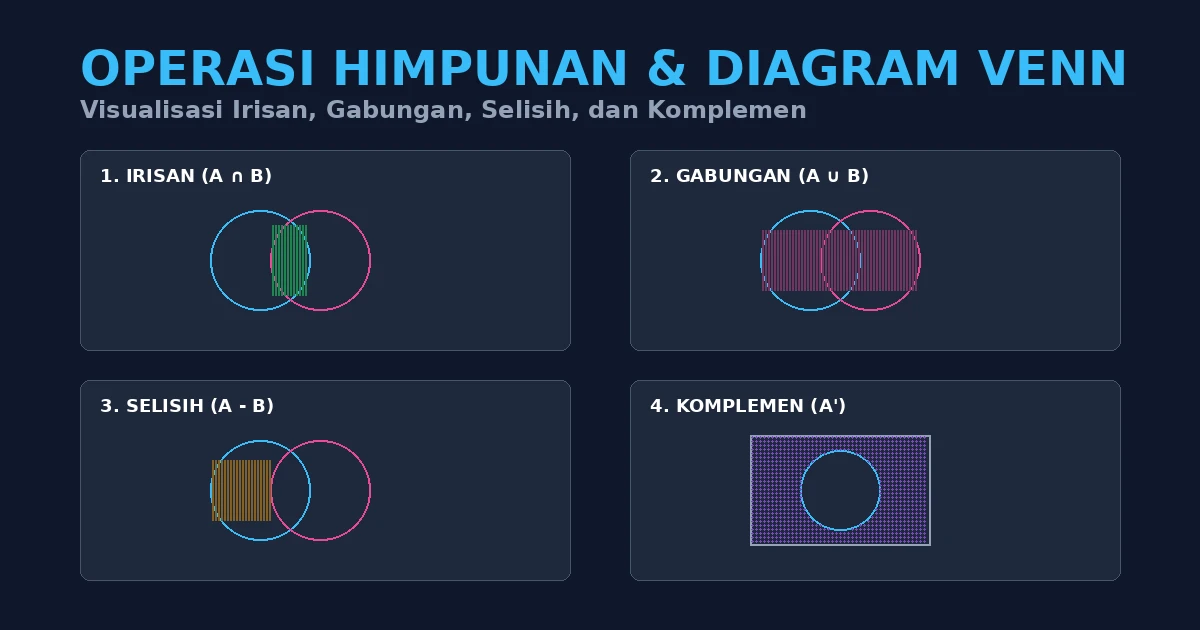
- or by using a Venn diagram.
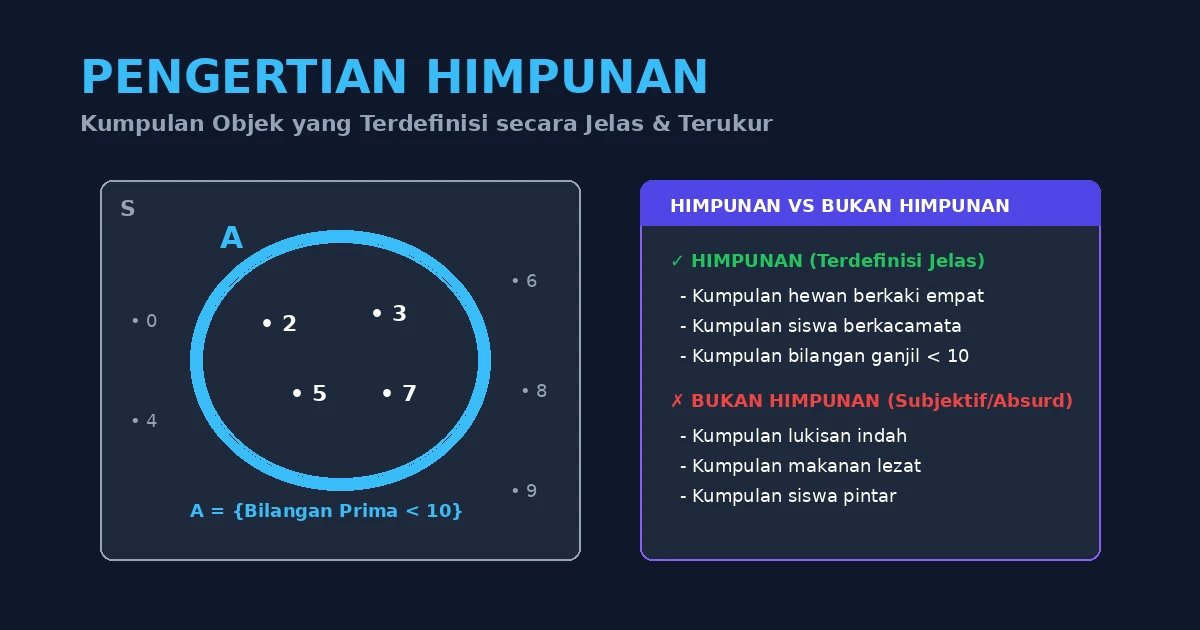
This diagram is named after the British mathematician John Venn (1834-1923).
Basic guidelines for drawing a Venn diagram:
- The universal set is drawn as a rectangle.
- Each set inside the universal set is shown by a simple closed curve.
- Each member of a set is represented by a point or written inside its region.
- If a set has many members, the members do not have to be written one by one.
Example of a Venn diagram:

Relationships Between Sets
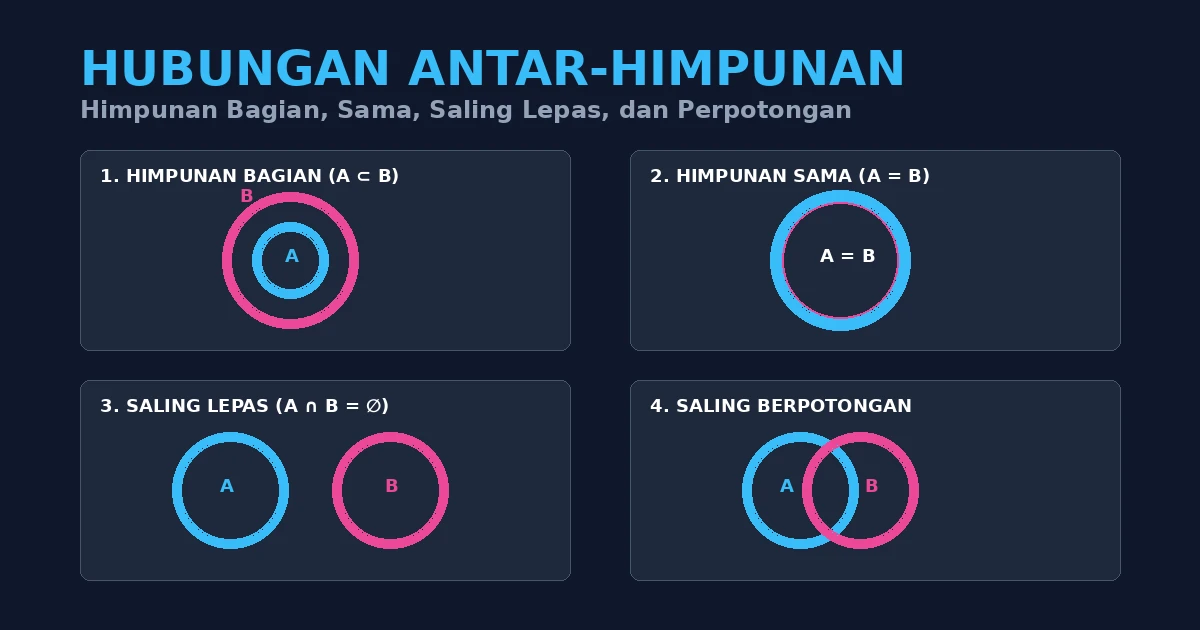
Different relationships between sets can be shown with the following Venn diagrams.

1. Subsets
In figure (a), set is a subset of set .
This means every element of is also an element of .
2. Equal Sets
In figure (b), every element of is an element of , and every element of is an element of .
3. Disjoint Sets
In figure (c), sets and have no common elements, so they are called disjoint sets.
4. Intersecting Sets
In figure (d), sets and have common elements, but each also has elements not shared by the other.
Equivalent Sets
To understand equivalent sets, consider the following example.
If:
with belonging to the whole numbers set and belonging to the natural numbers set , then we obtain:
| 0 | 1 | 2 | 3 | … | |
|---|---|---|---|---|---|
| 1 | 2 | 3 | 4 | … |
From the table:
The relationship between and can be shown as a one-to-one correspondence.

Because both sets have the same number of elements, they are equivalent sets.
Conclusion:
Two sets and are said to be equivalent if , written as .
Example Problems
Example 1
Given:
If is the universal set, draw a Venn diagram for these sets.

In the diagram, , , and are the common elements of sets and .
Example 2
Given:
Questions:
- Show the pairs of sets with Venn diagrams.
- Which pairs are disjoint, intersecting, and subsets?
- Are there any equal sets?
- Are there any equivalent sets?
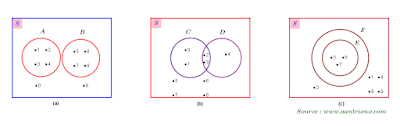
Solution:
- Sets and are disjoint.
- Sets and intersect, with common elements and .
- Set is a subset of .
- There are no equal pairs of sets.
- There is an equivalent pair, namely and , because:
Closing
Venn diagrams are an effective way to present several sets at once and show their relationships clearly. With them, subsets, intersections, disjoint sets, and equivalent sets become easier to see and understand.