Surface Area of a Rectangular Prism

Introduction
A. Basic Competencies
3.9 Distinguish and determine the surface area and volume of flat-sided solid figures (cube, cuboid, prism, and pyramid). 4.9 Solve problems related to the surface area and volume of flat-sided solid figures (cube, cuboid, prism, and pyramid), as well as their combinations.
B. Learning Objectives
After studying the material on the surface area of a cuboid, students are expected to:
- Find and determine the surface area of a cuboid.
- Solve problems related to the surface area of a cuboid.
C. Material
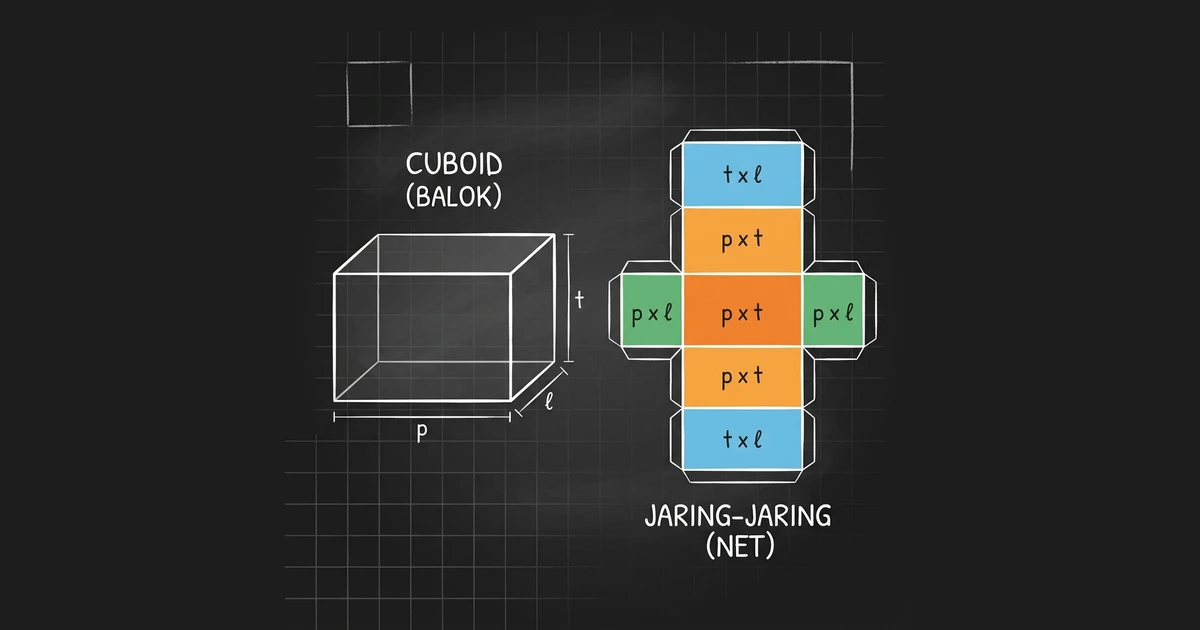
Look at the following picture!
 The figure shows a block ABCD.EFGH with length dimensions
, width , and height . If we slice the block according to
the ribs, it will become a web of beams. One
The block net looks like the following picture.
The figure shows a block ABCD.EFGH with length dimensions
, width , and height . If we slice the block according to
the ribs, it will become a web of beams. One
The block net looks like the following picture.
 The beam net consists of three pairs of shaped sides
congruent rectangles. The surface area of a block is the sum of the areas
the three pairs of rectangles on the block.
The surface area of the block is formulated as follows:
\(\begin{aligned}
&=Area of ABFE + Area of ABCD + Area of ADHE + Area of CDHG + Area of BCGF + Area of EFGH\\
&=(p\times t)+(p\times l)+(l \times t)+(p\times t)+(l\times t)+(p\times l)\\
&=2(pl+pt+lt)
\end{aligned}\)
Problems example :
Calculate the surface area of the block if it is known that its length is cm, its width
cm, and the height is cm.
Solution:
So, the surface area of the block is
The beam net consists of three pairs of shaped sides
congruent rectangles. The surface area of a block is the sum of the areas
the three pairs of rectangles on the block.
The surface area of the block is formulated as follows:
\(\begin{aligned}
&=Area of ABFE + Area of ABCD + Area of ADHE + Area of CDHG + Area of BCGF + Area of EFGH\\
&=(p\times t)+(p\times l)+(l \times t)+(p\times t)+(l\times t)+(p\times l)\\
&=2(pl+pt+lt)
\end{aligned}\)
Problems example :
Calculate the surface area of the block if it is known that its length is cm, its width
cm, and the height is cm.
Solution:
So, the surface area of the block is
Beam Surface Area Simulation
To better understand the surface area of the beam, please move the following slider to right or left.
D. Evaluation
After studying the material about the surface area of a cuboid, please answer the following questions to measure your understanding.
- Calculate the surface area of a cuboid with length cm, width cm, and height cm.
- Calculate the height of the cuboid if its length is cm, its width is cm, and its surface area is .
That concludes the material on the surface area of a cuboid. I hope it is helpful. Thank you 😊🙏.