Cartesian coordinates

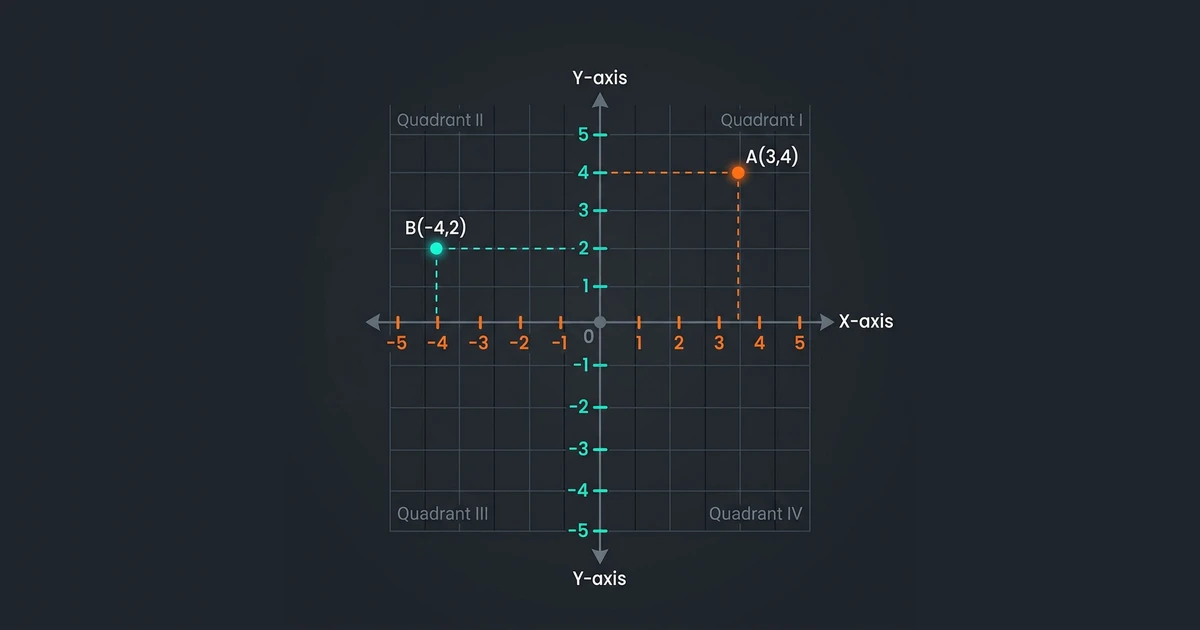
Origin of the Cartesian Coordinate System
 The term Cartesius (read: Cartesius) is a latinization of Descartes. This term is used to commemorate the French mathematician and philosopher, Descartes, who played a major role in combining algebra and geometry. He introduced the new idea of describing the position of a point or object on a surface using two axes that are perpendicular to each other. Cartesian coordinates are used to determine object points on a plane using two numbers which are usually called the x coordinate and y coordinate of the points. To define coordinates, two lines are needed perpendicular to each other, namely the X-axis and the Y-axis, and the unit length of which is made by markings on these two axes.
Quadrant Division in Cartesian Coordinates
Look at the following image: According to the applicable convention, the four quadrant areas are ordered starting from the top right, circular counterclockwise. In quadrant I, both x and y coordinates will be positive. In quadrant II, the x coordinate will be negative and the y coordinate will be positive. In quadrant III, both coordinates will be negative and in quadrant IV, the x coordinate will be positive and y will be negative. For more clarity, please see the following slide: