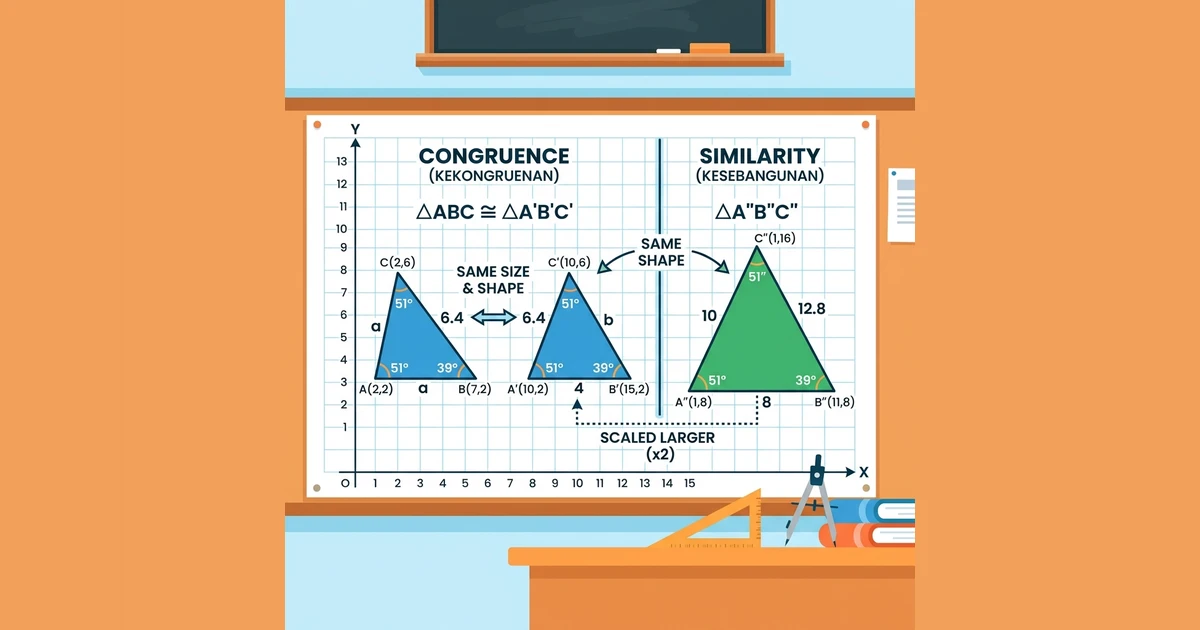
This lesson discusses two important geometry ideas: similarity and congruence . Both are used to compare figures based on shape, size, side relationships, and angle relationships.
Explain and determine similarity and congruence among plane figures. Solve problems related to similarity and congruence among plane figures. After studying this material, students are expected to be able to:
distinguish similar and non-similar figures, distinguish congruent and non-congruent figures, determine unknown side lengths in similar figures, state the conditions for congruent triangles, prove that two triangles are similar, apply similarity ratios to solve geometry problems. Consider the following figure.
[
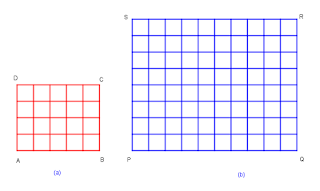
Similar plane figures https://blogger.googleusercontent.com/img/b/R29vZ2xl/AVvXsEg_ZKZ8mIt3mtQ7IcEhkZABSwGgu2UkpldYZYeBiQcblMFXUNzkLYDWy9J5DEcYJvHfEtVufEPRwgPVCKQDBixAWxnS-iRk0Gt7vRX6RUMGLfcJg1Npb6zBINqZf3gJb5hXBNuIK1oQ4Ok/s645/kesebangunan1.png )
Suppose rectangles A B C D ABCD A BC D P Q R S PQRS PQRS
A B ‾ \overline{AB} A B P Q ‾ \overline{PQ} PQ B C ‾ \overline{BC} BC Q R ‾ \overline{QR} QR C D ‾ \overline{CD} C D R S ‾ \overline{RS} RS A D ‾ \overline{AD} A D P S ‾ \overline{PS} PS Their side ratios are:
A B P Q = B C Q R = C D R S = A D P S = 1 2
\frac{AB}{PQ}=\frac{BC}{QR}=\frac{CD}{RS}=\frac{AD}{PS}=\frac{1}{2}
PQ A B = QR BC = RS C D = PS A D = 2 1 The corresponding angles are also equal:
∠ A = ∠ P , ∠ B = ∠ Q , ∠ C = ∠ R , ∠ D = ∠ S
\angle A=\angle P,\quad \angle B=\angle Q,\quad \angle C=\angle R,\quad \angle D=\angle S
∠ A = ∠ P , ∠ B = ∠ Q , ∠ C = ∠ R , ∠ D = ∠ S So:
A B C D ≃ P Q R S
ABCD \simeq PQRS
A BC D ≃ PQRS Two plane figures are similar if:
corresponding sides are proportional, corresponding angles are equal. Consider the two kites below.
[
Similar kites https://blogger.googleusercontent.com/img/b/R29vZ2xl/AVvXsEje57Ka8U_khSvjjx7wqeWJL_dJWzwjCIuDvLXqw82F_MUHDJ2fme2Cw9DMbOoLKHMqTZ2BlI4EidMd6-RdPJ8oi19zKMcbF8SjzOzKGbEYjlIDRi0CBtP25zMCEkTPdM31kekHGSGokyU/s424/kesebangunan2.png )
Using the properties of kites, the corresponding angles are equal and the corresponding sides have the same ratio:
B C F G = D C G H = A D E H = A B E F = 3 2
\frac{BC}{FG}=\frac{DC}{GH}=\frac{AD}{EH}=\frac{AB}{EF}=\frac{3}{2}
FG BC = G H D C = E H A D = EF A B = 2 3 Therefore:
A B C D ≃ E F G H
ABCD \simeq EFGH
A BC D ≃ EFG H Consider two identical banknotes.
[
Example of congruent figures https://blogger.googleusercontent.com/img/b/R29vZ2xl/AVvXsEiI1ir1U_jQodqelyRcsIuJMQvycYjp_TN6QGbudoAvnoztN3NyQjYDOqVNMUuzHhglobGeqC8oaVO54v1HyjxelMFc26hK8h7px-WRxJl7sOa_KTCyPY1QtFmSZWA_2YAENi8ookan9aU/s598/kekongruenan.jpg )
If all corresponding sides are equal and all corresponding angles are equal, then the figures are congruent .
Two figures are congruent if:
corresponding sides are equal in length, corresponding angles are equal. [
Congruent rhombuses https://blogger.googleusercontent.com/img/b/R29vZ2xl/AVvXsEhLPU8t53gBSAUo-wNN_dRqS171cf9PLgMBNC6f-XhxAXfMVkScqOfza-aUt3Co5BqMkgJbZ_D0Y_jHk51cdxs0KS_r09fK4ZhIy1Le6UtZ_L9RxHiYKlh6CpIIF6WeYwnOp0ro5uFSPME/s515/kongruen.png )
If all corresponding sides of the two rhombuses have the same length and all corresponding angles are equal, then:
A B C D ≅ E F G H
ABCD \cong EFGH
A BC D ≅ EFG H Similarity can be used to find an unknown side length.
[
Finding unknown sides in similar figures https://blogger.googleusercontent.com/img/b/R29vZ2xl/AVvXsEiJQBiMpX0atYxR0E3PN_I2QPKK-cdNB-Mbbjro5XNseyXJom6WbsdEQXQjyNo7oxhkSaR_PP-7gYFCXzoMpp1bG3WguXom50dilJKFoF1MgNfM6bMWu134jO-eqjbER6mjlLdoRJv3TmQ/s474/kesebangunan3.png )
Given:
21 9 = 7 3
\frac{21}{9}=\frac{7}{3}
9 21 = 3 7 then:
7 x = 7 3 ⇒ x = 3
\frac{7}{x}=\frac{7}{3}\Rightarrow x=3
x 7 = 3 7 ⇒ x = 3 and
14 y = 7 3 ⇒ y = 6
\frac{14}{y}=\frac{7}{3}\Rightarrow y=6
y 14 = 3 7 ⇒ y = 6 So:
x = 3 cm , y = 6 cm
x=3\text{ cm},\quad y=6\text{ cm}
x = 3 cm , y = 6 cm Consider the figure below.
[
Similar triangles https://blogger.googleusercontent.com/img/b/R29vZ2xl/AVvXsEjirwFZW0aUIfzMvtQs21NnXaXnrwM7UPEKhc8dyAVA0M7fgEozm6B8aX3Urjvd3Q5uT8jZm1ONywf9F2uQQ3jaT9itklYEWsE-Zg9lTBPXYw6xi6_yZ5gb6POedOlynCeeVK4BCtgXnWA/s856/kesebangunan4.png )
If:
A B D E = B C E F = A C D F
\frac{AB}{DE}=\frac{BC}{EF}=\frac{AC}{DF}
D E A B = EF BC = D F A C and the corresponding angles are equal, then:
△ A B C ≃ △ D E F
\triangle ABC \simeq \triangle DEF
△ A BC ≃ △ D EF In general, two triangles are similar if:
corresponding sides are proportional, or two pairs of corresponding angles are equal. [
Side comparison in similar triangles https://blogger.googleusercontent.com/img/b/R29vZ2xl/AVvXsEiBQwbXpGi1ce029mlo_k2LmLej3MHyZiCU-Onq_Nc6Q7tAgfhB5gX4ukUVr3hVbr326TnbjQsupqCwcf_-DizYJ3TiJM_rfjnfyQ5lHsuLkLXZz7pvUslXwImQxFC5ERzE88wNpe-tzWI/s446/kongruen1.png )
If:
K L P Q = L M Q R = K M P R = 2 3
\frac{KL}{PQ}=\frac{LM}{QR}=\frac{KM}{PR}=\frac{2}{3}
PQ K L = QR L M = PR K M = 3 2 then:
△ K L M ≃ △ P Q R
\triangle KLM \simeq \triangle PQR
△ K L M ≃ △ PQR [
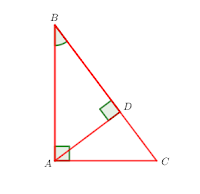
Similarity in right triangles https://blogger.googleusercontent.com/img/b/R29vZ2xl/AVvXsEgRWDMxs_XheXiZ3UMOFiFfI2efQ0TT_u1ay_ji8aveskfxFN3V4-fNRt1IclkcdxORpzYksOv4U95c3Rtd0F4uDVQrD9u_4gIPbIC1uOv3rSAe-uBX0SexWH8M1-tYrKejpOU84bdGfuo/s295/kongruen2.png )
For right triangles, these useful relationships hold:
A D 2 = B D × C D AD^2=BD\times CD A D 2 = B D × C D A B 2 = B D × B C AB^2=BD\times BC A B 2 = B D × BC A C 2 = C D × C B AC^2=CD\times CB A C 2 = C D × CB [
Example of similar right triangles https://blogger.googleusercontent.com/img/b/R29vZ2xl/AVvXsEhAcL4-UHAsf-KJuj9R3FAcyd7wTnIPp2DXRKCvNyy57r1XbGXTj127CwL9FzC0hSOVTjnUzqnuKTE6dDjJiIG4JHVIwId4jTPrhfkcPHhSbo8O_s74wJV9zN27j5rXcSJDE80-ZVRip1U/s287/kongruen3.png )
If A B = 6 AB=6 A B = 6 B C = 8 BC=8 BC = 8
A C = 6 2 + 8 2 = 10 cm
AC=\sqrt{6^2+8^2}=10\text{ cm}
A C = 6 2 + 8 2 = 10 cm Next:
A B 2 = A D × A C ⇒ 36 = 10 A D ⇒ A D = 3.6 cm
AB^2=AD\times AC\Rightarrow 36=10AD\Rightarrow AD=3.6\text{ cm}
A B 2 = A D × A C ⇒ 36 = 10 A D ⇒ A D = 3.6 cm D C = 10 − 3.6 = 6.4 cm
DC=10-3.6=6.4\text{ cm}
D C = 10 − 3.6 = 6.4 cm B D 2 = A D × D C = 3.6 × 6.4 = 23.04
BD^2=AD\times DC=3.6\times 6.4=23.04
B D 2 = A D × D C = 3.6 × 6.4 = 23.04 B D = 4.8 cm
BD=4.8\text{ cm}
B D = 4.8 cm [
Finding side lengths in similar triangles https://blogger.googleusercontent.com/img/b/R29vZ2xl/AVvXsEgq72y5ddBnTZBVnwYLjgT9lZoyh39L88mA-fbOkqgd3lgGLG_pzgHf91fukGAu-5u4-xkgclQMUqKmQBH0Nx20aR_xWjddD-Q8Se4X-ZFXaAlk4iChFrjB2l8WOfsSrtqI4xFdUHRVd5g/s474/kongruen4.png )
If △ A B C ≃ △ D E F \triangle ABC \simeq \triangle DEF △ A BC ≃ △ D EF
A B D E = B C E F
\frac{AB}{DE}=\frac{BC}{EF}
D E A B = EF BC 12 6 = 15 E F ⇒ E F = 7.5 cm
\frac{12}{6}=\frac{15}{EF}
\Rightarrow EF=7.5\text{ cm}
6 12 = EF 15 ⇒ EF = 7.5 cm Another example:
[
Similar triangles formed by parallel lines https://blogger.googleusercontent.com/img/b/R29vZ2xl/AVvXsEihUjZzch7oIfocLwS9nH6uvd4MGZkSOZdPPFATO2JHcNe87nAcBMwfiXLnhgFUisa7lrYe_YIp3qTD60BUSBA0AKtz_IH6hJTbbD43ni5epjU7ZtAIBJDI768eRYumI_LShxhDImGTe4c/s293/kongruen5.png )
Because △ A E D ≃ △ B C E \triangle AED \simeq \triangle BCE △ A E D ≃ △ BCE
A D B C = A E C E
\frac{AD}{BC}=\frac{AE}{CE}
BC A D = CE A E 9 16 = A E 12 ⇒ A E = 6.75 cm
\frac{9}{16}=\frac{AE}{12}
\Rightarrow AE=6.75\text{ cm}
16 9 = 12 A E ⇒ A E = 6.75 cm [
Parallel lines on a triangle https://blogger.googleusercontent.com/img/b/R29vZ2xl/AVvXsEiOwyY4A6iCEAKuubHHgifqXjVOdsmyqNAcFzrv_l_USj2QlSQ8pKebR_Bly0vVtCgT93W4auN2owWNcAbRDJWQfbC7c6o5EmEsrz2jeKbdvD1EzPcR_PmF3aXsJHRrIZPxlXHF19nO7LA/s481/kongruen6.png )
If D E ∥ A B DE\parallel AB D E ∥ A B
△ D E C ≃ △ A B C
\triangle DEC \simeq \triangle ABC
△ D EC ≃ △ A BC So:
C D A C = C E B C = D E A B
\frac{CD}{AC}=\frac{CE}{BC}=\frac{DE}{AB}
A C C D = BC CE = A B D E This often leads to:
d a = c b
\frac{d}{a}=\frac{c}{b}
a d = b c [
Example of parallel lines in a triangle https://blogger.googleusercontent.com/img/b/R29vZ2xl/AVvXsEj9lsjToGeqTzQv4CQUmLPG5gG54wIU_RBF3s3vt8quu8Kg-gaQVKKOjEdfRlRK6-6kzgpVsvBhj-FRxrNyUacpmEAd_T6s0sBm9-bUR3ecndZL5MplGR2lcp_56Fz1Bv5n1fxrv8gdJmE/s426/kongruen7.png )
If P T ‾ ∥ Q S ‾ \overline{PT}\parallel \overline{QS} PT ∥ QS
Q S P T = Q R P Q + Q R
\frac{QS}{PT}=\frac{QR}{PQ+QR}
PT QS = PQ + QR QR 3 4 = Q R 2 + Q R ⇒ Q R = 6 cm
\frac{3}{4}=\frac{QR}{2+QR}
\Rightarrow QR=6\text{ cm}
4 3 = 2 + QR QR ⇒ QR = 6 cm And:
Q S P T = R S S T + R S
\frac{QS}{PT}=\frac{RS}{ST+RS}
PT QS = ST + RS RS 3 4 = 4 S T + 4 ⇒ S T = 4 3 cm
\frac{3}{4}=\frac{4}{ST+4}
\Rightarrow ST=\frac{4}{3}\text{ cm}
4 3 = ST + 4 4 ⇒ ST = 3 4 cm Two common applications are:
finding the height of a pole using a smaller reference object, finding missing dimensions in a photo and frame setup. For the pole problem:
2 t = 3 9 ⇒ t = 6
\frac{2}{t}=\frac{3}{9}\Rightarrow t=6
t 2 = 9 3 ⇒ t = 6 So the height of the pole is 6 m .
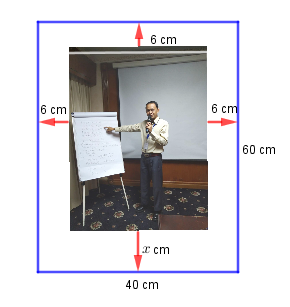
For the frame problem:
[
Frame similarity problem https://blogger.googleusercontent.com/img/b/R29vZ2xl/AVvXsEiGbJAGPh8lQCrQsTcTdJrPk4FAmZJKcDQfBrIB3Hl4jhqAOx0c36AExis7sJQT1tlwZRwhAH5quh4gBPtXrX-pi02SRgUhAROFvaXqFIadRd-peX7ab6EuTWhUolY04D6Gx-re7lebILI/s307/kongruen12.png )
54 − x 60 = 28 40 = 7 10
\frac{54-x}{60}=\frac{28}{40}=\frac{7}{10}
60 54 − x = 40 28 = 10 7 54 − x = 42 ⇒ x = 12
54-x=42\Rightarrow x=12
54 − x = 42 ⇒ x = 12 So the lower frame width is 12 cm .
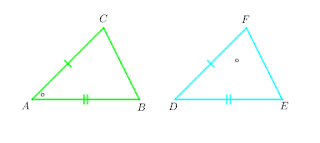
Congruent triangles have:
the same shape, the same size, equal corresponding side lengths, equal corresponding angles. [
Properties of congruent triangles https://blogger.googleusercontent.com/img/b/R29vZ2xl/AVvXsEjY1KhS3uwpgCLsHzjagznwWF58gG_Dw7QFSMsrsDfj_WGW7iZvWyWussyL6v8nBXfviKaVpWGfDvL7dgXnFZb1i_RkHxSsiHi41QXX02UEAOTIS2f0dDDri5olOCeL0Vs0RI75v7uvReo/s514/kongruen8.png )
Two triangles are congruent if they satisfy one of these conditions:
SSS : all three corresponding sides are equal,SAS : two corresponding sides and the included angle are equal,ASA : two corresponding angles and the included side are equal.[
Congruence by SSS https://blogger.googleusercontent.com/img/b/R29vZ2xl/AVvXsEjxfQu3wweo2717qoYWnybjxlCqoAU1jieZP4bA9JsNpI07JEL7-4F1rexBMDVTsufA8KoX5k3uYSTd54YES8VN9eiCuzW740S6rwisPAe3WTOlMT963KqTUbO0xMwtzYb7WKvqOnlLVIs/s480/kongruen9.png )
If:
A B = D E , B C = E F , A C = D F
AB=DE,\quad BC=EF,\quad AC=DF
A B = D E , BC = EF , A C = D F then:
△ A B C ≅ △ D E F
\triangle ABC \cong \triangle DEF
△ A BC ≅ △ D EF [
Congruence by SAS https://blogger.googleusercontent.com/img/b/R29vZ2xl/AVvXsEhMSyW8WFjUkzKMd7T86mJudESYC9RrC4B7-fpllf1jDyyYbA49r75KpTDm22Bs6gvrMSLkgqvfovWJlCSKCxi6of0rHYjHFEulXAWcwSVaskj8nV_V3ILhciFM8TS8bIZ8n2n_5RyjD00/s448/kongruen11.png )
If:
A B = D E , A C = D F , ∠ B A C = ∠ E D F
AB=DE,\quad AC=DF,\quad \angle BAC=\angle EDF
A B = D E , A C = D F , ∠ B A C = ∠ E D F then:
△ A B C ≅ △ D E F
\triangle ABC \cong \triangle DEF
△ A BC ≅ △ D EF [
Congruence by ASA https://blogger.googleusercontent.com/img/b/R29vZ2xl/AVvXsEjdRI1oBtJiRc5ROsGFOdUXCbyxMRGQ89OnC2q8fDMU8aEXlpGaenlVPDSqW9uiRdPHnvyun-BJGZelDfypoczD7_dZ940yJzzAUV-SED2DOrl2BNEljwu5pmNtbZQlnNY_l29Mo91yOoU/s425/kongruen10.png )
If:
A B = D E , ∠ A = ∠ D , ∠ B = ∠ E
AB=DE,\quad \angle A=\angle D,\quad \angle B=\angle E
A B = D E , ∠ A = ∠ D , ∠ B = ∠ E then:
△ A B C ≅ △ D E F
\triangle ABC \cong \triangle DEF
△ A BC ≅ △ D EF [
Congruent triangles in a kite https://blogger.googleusercontent.com/img/b/R29vZ2xl/AVvXsEhLM0hBvOROOw3Ae1pqvEdSlHeSme9n2U5bm_Dduey6pLp1Q7BNYQF_9Rusp1ocPqlqmLwljEqaP88rBB7T-Wx7GqhHWk0XWnG4urc4cE8Swidt6yivAU6akCcBRiWbGuQCD4UaBtc939U/s334/kongruen12.png )
Some congruent pairs that can be identified are:
△ A E D ≅ △ A B E \triangle AED \cong \triangle ABE △ A E D ≅ △ A BE △ D E C ≅ △ B E C \triangle DEC \cong \triangle BEC △ D EC ≅ △ BEC △ A C D ≅ △ A B C \triangle ACD \cong \triangle ABC △ A C D ≅ △ A BC D. Finding Sides and Angles in Congruent Triangles [
Finding sides and angles in congruent triangles https://blogger.googleusercontent.com/img/b/R29vZ2xl/AVvXsEhoPAegiuVDnz6SJiq1LeKs66CLxI3QW9ZCHWZtJtWZLMIDzSdQWmqsd1yLW_q9LMC2q9juWguxnnY85CTxr082yvR-G7PbqybRmFdMMBeCItjXL-3jBpKBUSAG1aUhyphenhyphenWb_tABxsz3gneE/s310/kongruen13.png )
If △ K N M ≅ △ L N M \triangle KNM \cong \triangle LNM △ K NM ≅ △ L NM
K M = M L = 10 cm , K N = L N = 5 cm
KM=ML=10\text{ cm},\quad KN=LN=5\text{ cm}
K M = M L = 10 cm , K N = L N = 5 cm The length of M N MN MN
M N = 10 2 − 5 2 = 75 = 5 3 cm
MN=\sqrt{10^2-5^2}=\sqrt{75}=5\sqrt{3}\text{ cm}
MN = 1 0 2 − 5 2 = 75 = 5 3 cm If ∠ N K M = 60 ∘ \angle NKM=60^\circ ∠ N K M = 6 0 ∘
∠ M L N = 60 ∘
\angle MLN=60^\circ
∠ M L N = 6 0 ∘ and
∠ K M N = ∠ N M L = 30 ∘
\angle KMN=\angle NML=30^\circ
∠ K MN = ∠ NM L = 3 0 ∘ Move the points in the simulation below to observe how similar and congruent triangles behave.
Notice that:
△ A B C ∼ △ D E F
\triangle ABC \sim \triangle DEF
△ A BC ∼ △ D EF and
△ A B C ≅ △ A ′ B ′ C ′
\triangle ABC \cong \triangle A'B'C'
△ A BC ≅ △ A ′ B ′ C ′ After studying this material, try the following questions.
A person stands 2 meters from a lamppost and casts a 3-meter shadow. If the person’s height is 1.8 meters, what is the height of the lamppost? A photo measuring 12 cm x 15 cm is placed on cardboard. The top, left, and right margins are each 2 cm. If the photo and the cardboard are similar, what is the area of the cardboard? If A D : D B = 2 : 1 AD:DB=2:1 A D : D B = 2 : 1 D E = 6 DE=6 D E = 6 B C BC BC [
Similarity evaluation problem https://blogger.googleusercontent.com/img/b/R29vZ2xl/AVvXsEjAfvmUiwjiMsp67EffHapOXv72iMba6cuCCavTUvRCNO2qcHyJ4vM1L0f07BVXwEy68MnawhwO9yfs6TpSbq6o8cgqdZgVRNVk8EUfOEpxZS3XnWwc9VUn6hzdmXpC-tLRwbJPCuMDt7g/s298/kongruen15.png )
In a trapezoid with A B ∥ C D AB\parallel CD A B ∥ C D E F ∥ A B EF\parallel AB EF ∥ A B D E : E A = 5 : 3 DE:EA=5:3 D E : E A = 5 : 3 C D = 2 CD=2 C D = 2 A B = 10 AB=10 A B = 10 E F EF EF [
Trapezoid similarity evaluation problem https://blogger.googleusercontent.com/img/b/R29vZ2xl/AVvXsEg3yrIjC9oDrg3E2EQtArm8SXf0_4lgWgB0qU_1GQOHZBtPV0cMEb2j_o4wCmO8Ea6_Fgv20eG4aBN0QUjABbXbbX3U5T908T3upTJ8OcbtnFHv8D2XM_UWxQ432pcStFcD8boyWzPdnTg/s353/kongruen16.png )
If A B = C D = 8 AB=CD=8 A B = C D = 8 A D = 20 AD=20 A D = 20 B C BC BC [
Two similar triangles evaluation problem https://blogger.googleusercontent.com/img/b/R29vZ2xl/AVvXsEg38SxRpYzmBStVr5LO46cwnmiS3zQVfXOjDmkiR9-0I1119TzNKqHlw7cqOFsJrYZ9GF_IOAAUgNbmEN1y2mVDYwS6_6jq-ZvRt4ZXttidu5S90PAAinoAQHRvVE7G7Z2dg8BRVKlkpiQ/s317/kongruen17.png )
This material can be used as a foundation for solving many geometry problems involving ratios, proportions, and triangle properties.