A cone is a solid with one circular base and one apex. This lesson covers the elements of a cone, its slant height, its net, surface area, volume, and several common example problems.
3.7 Generalize the surface area and volume of curved solids, especially cylinders, cones, and spheres.
After studying this material, students are expected to be able to:
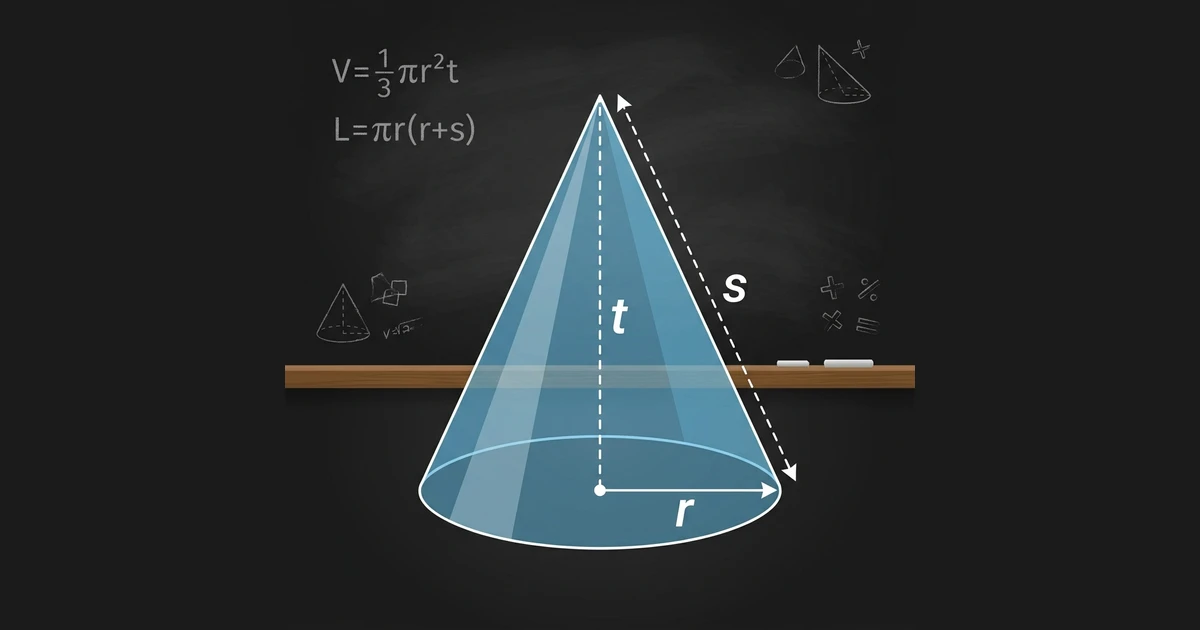
identify the elements of a cone, calculate the base area, lateral area, and total surface area, calculate the volume of a cone, determine unknown cone elements from given data, compare cone volumes after size changes. Look at the figure below.
[
Elements of a cone https://blogger.googleusercontent.com/img/b/R29vZ2xl/AVvXsEipRkyYJwojSRjEP4QDXqpWp-KRgJ_zyQ5WBrec-OVLQZEL0YDD4cwlWw6yRJcrv3VGrdIm6RtU9PIkVBcGz1rrJp6D9aR_LP-VsgP3r87kEdvTt21z6baSf9GuDCeT1pOpQqmbZWrYtJS5ELzxsIO9VAVqit3iZOY8s18rxmeYi9JmOEJSd1XaGiCI/s1280/kerucut.png )
A cone has:
one flat circular base, one curved lateral surface, one apex, a base radius r r r a height t t t a circular edge where the base meets the lateral surface. Consider the right triangle below.
[
Triangle forming a cone https://blogger.googleusercontent.com/img/b/R29vZ2xl/AVvXsEjXDsuQZIn3fc4P9dU1QaRQy3WgYJGBNTI-yOKEFecoJiJGAB45fbTHLuUvM5y3aQITtv0nNS7exnGp6Iz3pF8MTbXrzM_VA3nicru9IsVwwtUbo9eOiEwdYQBm36HdKa6dy3QeXoA9qnY/s253/kerucut1.png )
When the triangle is rotated around its height, it forms a cone.
[
Cone and its slant height https://blogger.googleusercontent.com/img/b/R29vZ2xl/AVvXsEhQMmr8cibcUHh8FddJA9zq8GpNGMiQ_maOL6y0eETO71v5Gg8jLJbyYQpXeqOZmP80PdTdTVm1b0Pmv038WLfGGshTh94pVn-Ri3BnLlMjcvGaI6dKKc_u2Fc_j1ilrivI68q4YjXDONc/s310/kerucut2.png )
The segment from the apex to a point on the edge of the base is called the slant height , denoted by s s s
By the Pythagorean theorem:
s 2 = t 2 + r 2
s^2=t^2+r^2
s 2 = t 2 + r 2 or
s = t 2 + r 2
s=\sqrt{t^2+r^2}
s = t 2 + r 2 [
Closed cone https://blogger.googleusercontent.com/img/b/R29vZ2xl/AVvXsEj3qysAQ50IeUTAk7v0xUsixfxBI7w8Pj1mo0jOlLJ8DW0IsUBH_imp7gLqY0VXdpO2Ha9xzg_AsTOYg7q998pweVcYodmIs_V08kL6XkYIvU2PzpqpceLeY3bS4Z5va67sn7AQWAMKF6A/s307/kerucut3.png )
If the lateral surface is opened, the net looks like this.
[
Cone net https://blogger.googleusercontent.com/img/b/R29vZ2xl/AVvXsEiVhCobjqQli5HC7zHsPOc2rRSnWaD_hPte2gU-VQ_zhfZvM4PELTonrRplZUPokgleEL859I_cv5QioB02BwVPXmBSJxscIrvS6hiv9Q3tDhzn-o0gUW7hofav-UG2YjTljOM0oghn9xY/s337/kerucut4.png )
A cone net consists of:
one circle of radius r r r one sector of a circle with radius s s s 2 π r 2\pi r 2 π r [
Cone for surface area https://blogger.googleusercontent.com/img/b/R29vZ2xl/AVvXsEhCCqadpoQWCk7tgN2JkA0D3z0GGwRqXfsbjb3IHv7G5NPgzH_IBeHowzdZFwG1hRr89H3L7ueyBwOKx02g36aL4OLO0-u8qKPXbAI61e1oirc1mLBLxlQPPBYCvbVNCXyYOF0FdVxJHg0/s545/kerucut5.png )
The lateral area of a cone is:
L s = π r s
L_s=\pi rs
L s = π rs The total surface area is:
L = π r 2 + π r s
L=\pi r^2+\pi rs
L = π r 2 + π rs or
L = π r ( r + s )
L=\pi r(r+s)
L = π r ( r + s ) A cone has r = 6 r=6 r = 6 t = 8 t=8 t = 8 π = 3.14 \pi=3.14 π = 3.14
First find the slant height:
s = 6 2 + 8 2 = 100 = 10
s=\sqrt{6^2+8^2}=\sqrt{100}=10
s = 6 2 + 8 2 = 100 = 10 Then:
L = π r ( r + s ) = 3.14 × 6 × ( 6 + 10 ) = 301.44
L=\pi r(r+s)=3.14\times 6\times (6+10)=301.44
L = π r ( r + s ) = 3.14 × 6 × ( 6 + 10 ) = 301.44 So the surface area is:
301.44 cm 2
301.44\text{ cm}^2
301.44 cm 2 If r = 7 r=7 r = 7 s = 14 s=14 s = 14
L = π r ( r + s ) = 22 7 × 7 × ( 7 + 14 ) = 462
L=\pi r(r+s)=\frac{22}{7}\times 7\times (7+14)=462
L = π r ( r + s ) = 7 22 × 7 × ( 7 + 14 ) = 462 So the surface area is:
462 cm 2
462\text{ cm}^2
462 cm 2 [
Cone as a limiting pyramid https://blogger.googleusercontent.com/img/b/R29vZ2xl/AVvXsEgzglDu0ocqWjno7QKgpGHwKLDjNAgs221l2e1ICHEZez_b-QwlQ5JHxYCq5cuBmxxcjnD2ruUGFdJO_8qE-a0KRuXxzPi4r23ivOetNXw2W8wzd9uemTerwKA7tDfGCMN4LHd8UrKXIyY/s349/kerucut8.png )
A cone can be viewed as a limiting case of a pyramid with more and more base sides.
[
Pyramid-to-cone idea https://blogger.googleusercontent.com/img/b/R29vZ2xl/AVvXsEiw4JhLC8tVJJ9p8eLC_3XqK-yQBHv95Th6kmt7OblScK-UY6BYZsKwptTQsfwaIaXwCBc6V2wGEHEVKp4wVAJbDzncg9wERCEgJW9q7ISZq_iSSY2Vpz9bu04Bfrs7mu2GRieV9iVyxdY/s276/kerucut9.png )
The cone volume formula is:
V = 1 3 π r 2 t
V=\frac{1}{3}\pi r^2t
V = 3 1 π r 2 t Using the diameter d d d
V = 1 12 π d 2 t
V=\frac{1}{12}\pi d^2t
V = 12 1 π d 2 t If r = 9 r=9 r = 9 t = 4 t=4 t = 4
V = 1 3 × 3.14 × 9 2 × 4 = 339.12
V=\frac{1}{3}\times 3.14\times 9^2\times 4=339.12
V = 3 1 × 3.14 × 9 2 × 4 = 339.12 So the volume is:
339.12 cm 3
339.12\text{ cm}^3
339.12 cm 3 The cone volume is 314 cm 3 314\text{ cm}^3 314 cm 3 5 5 5
First find the height:
314 = 1 3 × 3.14 × 5 2 × t ⇒ t = 12
314=\frac{1}{3}\times 3.14\times 5^2\times t
\Rightarrow t=12
314 = 3 1 × 3.14 × 5 2 × t ⇒ t = 12 Then find the slant height:
s = 5 2 + 12 2 = 169 = 13
s=\sqrt{5^2+12^2}=\sqrt{169}=13
s = 5 2 + 1 2 2 = 169 = 13 So the slant height is:
13 cm
13\text{ cm}
13 cm Consider the combined solid below.
[
Cylinder and cone combination https://blogger.googleusercontent.com/img/b/R29vZ2xl/AVvXsEj90DQhSJwOIRyllXgCLVeyP033sXYn8wLQOz90_2L2ZlpVmY6R_seOdJiUqTcR38KxEiYpjliR4jV3rF_SXjvvkL4EvlLgazEEY7njOmWafHEwJoRbCNOhzxcLHG76RUaa8pymbCvBoBc/s323/kerucut7.png )
Suppose the cylinder volume is:
V cylinder = π r 2 t = 22 7 × 7 × 7 × 10 = 1540
V_{\text{cylinder}}=\pi r^2 t=\frac{22}{7}\times 7\times 7\times 10=1540
V cylinder = π r 2 t = 7 22 × 7 × 7 × 10 = 1540 And the cone volume is:
V cone = 1 3 π r 2 t = 1 3 × 22 7 × 7 × 7 × 9 = 462
V_{\text{cone}}=\frac{1}{3}\pi r^2 t=\frac{1}{3}\times \frac{22}{7}\times 7\times 7\times 9=462
V cone = 3 1 π r 2 t = 3 1 × 7 22 × 7 × 7 × 9 = 462 Total volume:
1540 + 462 = 2002 cm 3
1540+462=2002\text{ cm}^3
1540 + 462 = 2002 cm 3 If the radius changes from r r r r + a r+a r + a
V : V new = r 2 : ( r + a ) 2
V:V_{\text{new}}=r^2:(r+a)^2
V : V new = r 2 : ( r + a ) 2 If the radius becomes k k k
V : V new = 1 : k 2
V:V_{\text{new}}=1:k^2
V : V new = 1 : k 2 A cone has radius 2 cm.
If the radius increases by 1 cm: V : V new = 2 2 : 3 2 = 4 : 9
V:V_{\text{new}}=2^2:3^2=4:9
V : V new = 2 2 : 3 2 = 4 : 9 If the radius becomes 3 times the original: V : V new = 1 : 3 2 = 1 : 9
V:V_{\text{new}}=1:3^2=1:9
V : V new = 1 : 3 2 = 1 : 9 Use the simulation below to observe the relationship between radius, height, slant height, surface area, and volume.
Try these questions:
Find the surface area of a cone if the radius and height are known. Find the volume of a cone if the diameter and height are known. Find the slant height if the radius and volume are known. Find the ratio of volumes when the radius changes. You can watch the supporting lesson video below:
VIDEO