Lines and Angles

Understanding Angles
An angle is formed by two rays that meet at the same endpoint. Angles are denoted by the symbol . In an angle, we recognize the angle arms, the vertex, and the angle region.
.png)
In the picture, the arms of the angle are rays and . Point is the vertex, while the shaded area is the angle region.
Notes:
- the vertex is the intersection point of the two angle arms;
- the angle region is the area bounded by the two arms.
Angle Measures
Degrees are the most common unit for measuring angles. One full turn is . If a full turn is divided into 360 equal parts, each part measures .
Smaller units than degrees are minutes and seconds:
Conversion Example
Find the equivalent values:
Answer:
Addition and Subtraction of Angles
Find the results:
Answer:
Drawing and Naming Angles
Drawing Angles
To draw an angle with a known measure, we can use a ruler and a protractor.
A protractor has two scales:
- if the angle is measured clockwise, use the outer scale;
- if the angle is measured counterclockwise, use the inner scale.
Example: draw an angle of .
Steps:
- Draw a straight line .
- Place the protractor on line with its center exactly at point .

- Mark point at .
- Connect points and to form the angle.

Angle Notation and Names
Angles are usually named in three ways:
- using symbols such as , , or ;
- using the name of the vertex;
- using three capital letters, with the vertex letter in the middle.

The angle in the figure may be named , , , or .
Types of Angles
Based on their measure, angles are divided into:
- acute angles, less than ;
- right angles, exactly ;
- obtuse angles, more than and less than ;
- straight angles, exactly ;
- reflex angles, more than and less than .

Relationships Between Angles
Complementary Angles
The sum of two complementary angles is .

Supplementary Angles
The sum of two supplementary angles is .

Vertical Angles
If two lines intersect, the opposite angles are called vertical angles. Their measures are equal.

Example Problems
- Observe the following figure.

Find:
- the value of ;
- the measure of .
Answer:
- Observe the following figure.

The supplementary angle of is:
- In the following figure, . Find and .

Since and are supplementary:
Since and are vertical angles:
Lines

Figure (a) is a line segment , written . If end is extended, we get ray , written . If both ends are extended indefinitely, we get line , written .
Position of Two Lines
There are four possible positions of two lines: parallel, intersecting, coinciding, and skew.
Parallel Lines
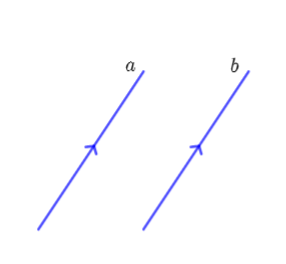
Line is parallel to line , written .
Note: two or more lines are parallel if they lie in the same plane and never intersect even when extended.
Intersecting Lines

Two lines intersect if they have exactly one common point.
Coinciding Lines

Two lines coincide if they lie on the same straight line and appear as a single line.
Skew Lines

Skew lines only appear in three-dimensional figures. They do not lie on the same plane and do not intersect even when extended.
Properties of Parallel Lines
An axiom is a statement accepted as true without proof.
One example of an axiom:
- through a point outside a line, exactly one line can be drawn parallel to that line.
Some properties of parallel lines:
- If a line intersects one of two parallel lines, it also intersects the other.
- If a line is parallel to two other lines, then those two lines are parallel to each other.
Relationship Between Lines and Angles
In the figure below, line intersects two parallel lines, and . Line is called a transversal.

At point there are four angles: , , , and . At point there are also four angles: , , , and .
Corresponding Angles
Each pair of corresponding angles has the same measure:
Alternate Interior and Alternate Exterior Angles
Each pair of alternate interior angles is equal:
Each pair of alternate exterior angles is also equal:
GeoGebra simulation
Same-Side Interior and Same-Side Exterior Angles
Each pair of same-side interior angles sums to :
Each pair of same-side exterior angles also sums to :
GeoGebra simulation
Closing
That concludes the material about lines and angles. If you notice any mistake or want to add a suggestion, please leave a comment.