FUNCTION part 1

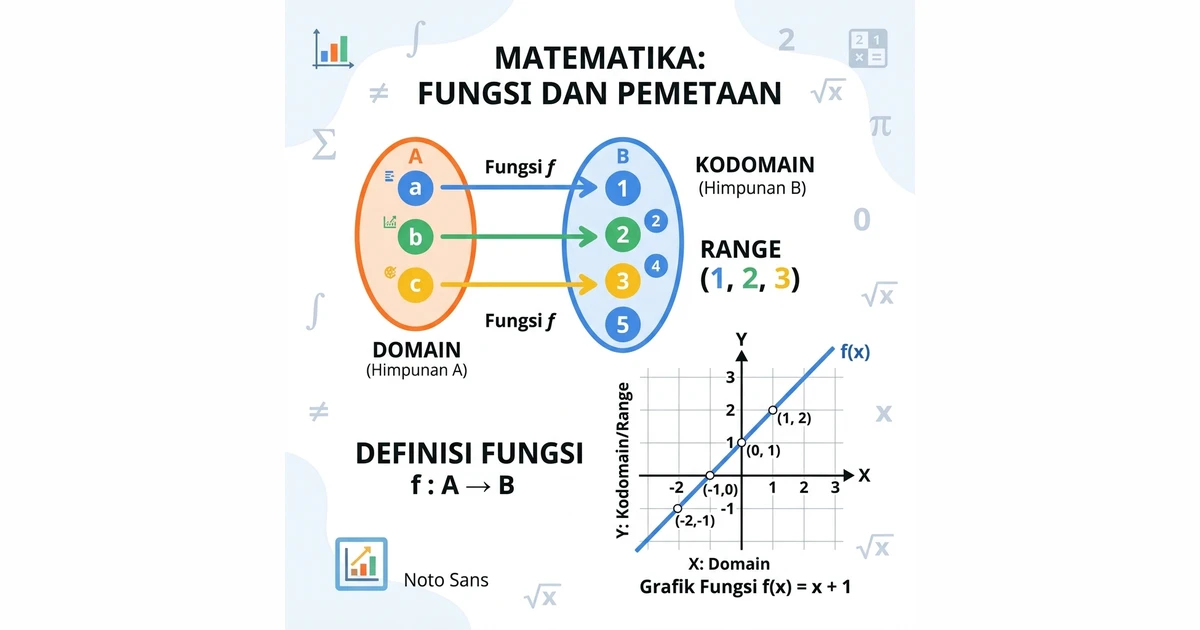
Introduction

Definition of a Function
A function from set to set is a special relation that maps every member of set to exactly one member of set .
Characteristics of a function:
- every member of set must have a partner,
- every member of set has only one partner.
Examples of Functions and Non-Functions
Observe the following figures to distinguish a function from a non-function.


Determining the Number of Possible Functions
Example 1
Determine the number of possible mappings from:
to:
Observe the illustration below.

Since each member of can be paired with two choices in , the number of possible functions is:
So, the number of possible mappings from to is 4.
Example 2
Determine the number of possible mappings from:
to:
Observe the following figure.

The number of possible functions is:
So, the number of possible mappings from to is 8.
Conclusion
If the number of members of set is and the number of members of set is , then:
- the number of possible functions from to is
- the number of possible functions from to is
Example
The number of possible mappings from:
to:
is …
Known:
Asked: the number of possible mappings from to .
Solution:
Therefore, the number of possible mappings from to is 64.
Explanation Video
To better understand this material, watch the following video.
The next topic covers function notation, evaluating functions, determining a function rule from known values, and one-to-one correspondence. That material is presented in Function part 2.