Quadratic Functions

Introduction

Basic Competencies
3.2 Explain quadratic functions using tables, equations, and graphs.
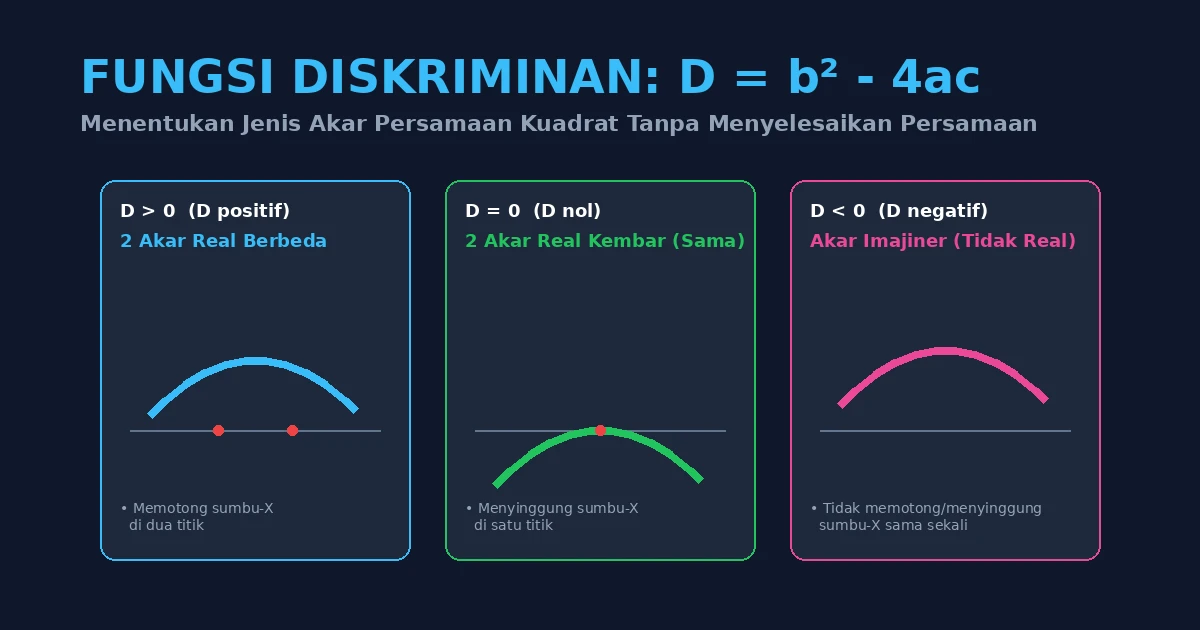
3.3 Explain the relationship between the coefficients and discriminant of a quadratic function and its graph.
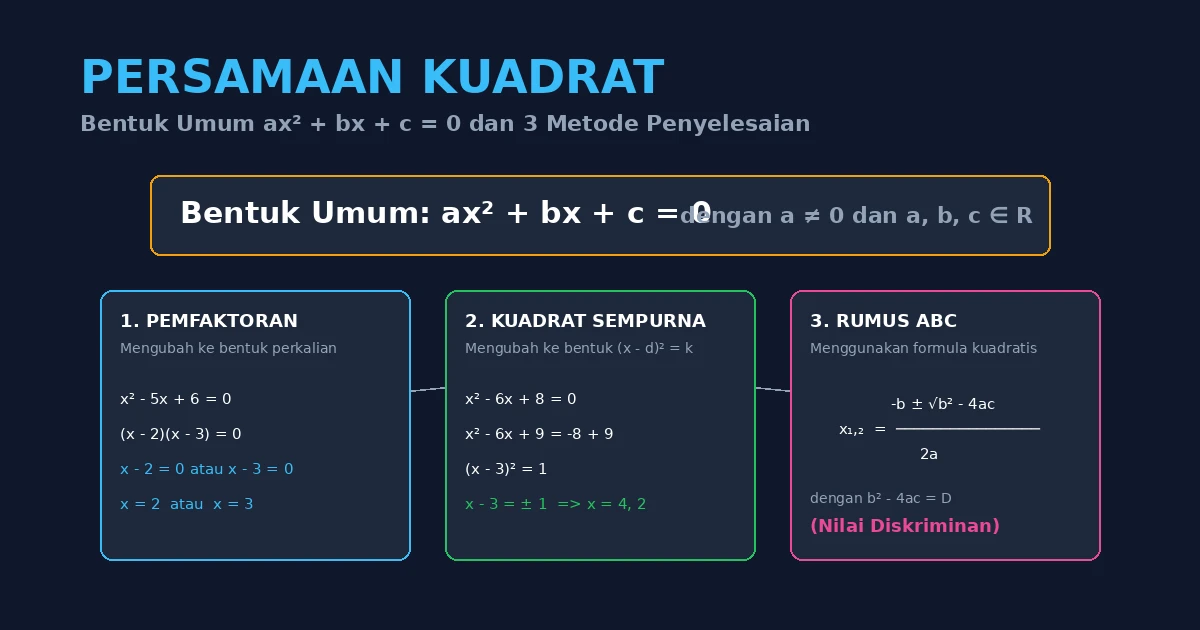
4.2 Solve problems related to quadratic equations.
4.3 Present quadratic functions using tables, equations, and graphs.
4.4 Present and solve contextual problems using the properties of quadratic functions.
Quadratic Function Material
A quadratic function has the form:
with and .
It can also be written as:
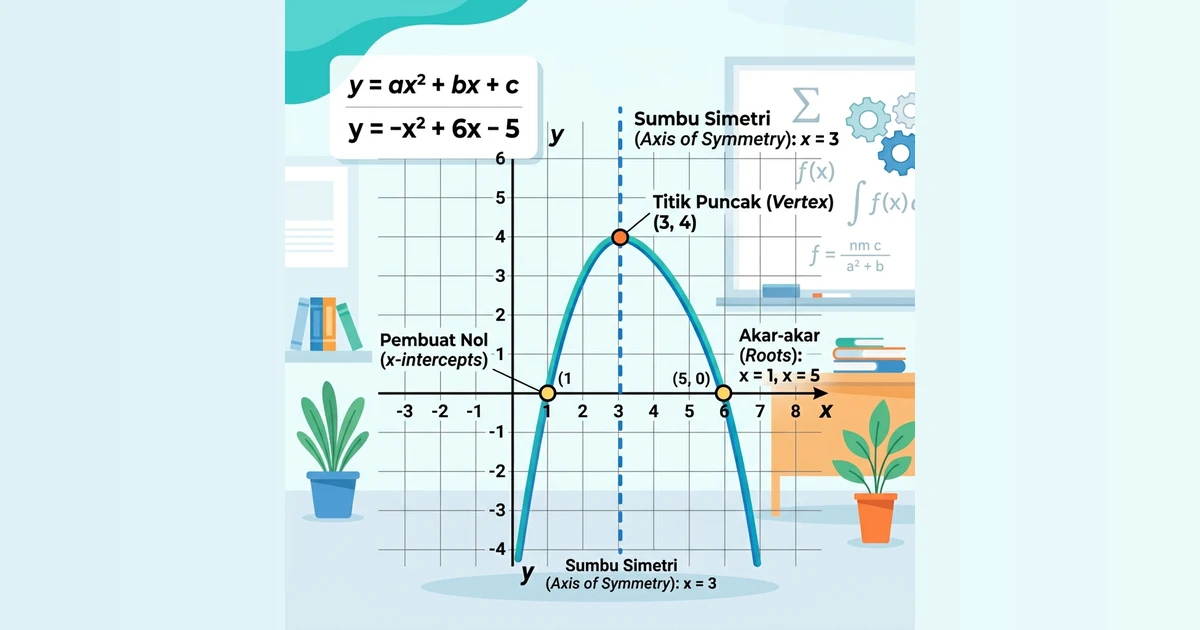
In studying quadratic functions, common topics include:
- how to draw the graph,
- axis of symmetry,
- zeros of the function,
- intercepts,
- vertex,
- the effect of , , and on the graph.
For a more complete explanation, study the slide deck below.
Slide Material
Video Lesson
To make the material easier to understand, watch the following explanation video.
Graph Simulation
To understand the effect of , , and on the graph of a quadratic function, move the values in the simulation below and observe the changes.
Use a computer or laptop for a better simulation experience.
Download Material
Readers who want to download the quadratic function material in PPT format can use the following link:
That concludes this quadratic function material.