Differences Between BSD and Linux


This article discusses the differences between BSD and GNU/Linux operating systems.
Most Influential Operating Systems: Unix, BSD, and Linux
When discussing the most influential operating systems of all time, it’s impossible to overlook Unix, BSD, and Linux. Our modern world, from the internet to mobile devices, stands on the foundation they built. All three share basic principles—multi-user, multitasking, modularity—yet evolved with unique characteristics that distinguish them from one another. This article will explain the origins, characteristics, and uses of Unix, BSD, and Linux, while comparing their roles in the modern computing landscape.
Unix: The Foundation of Modern Operating Systems
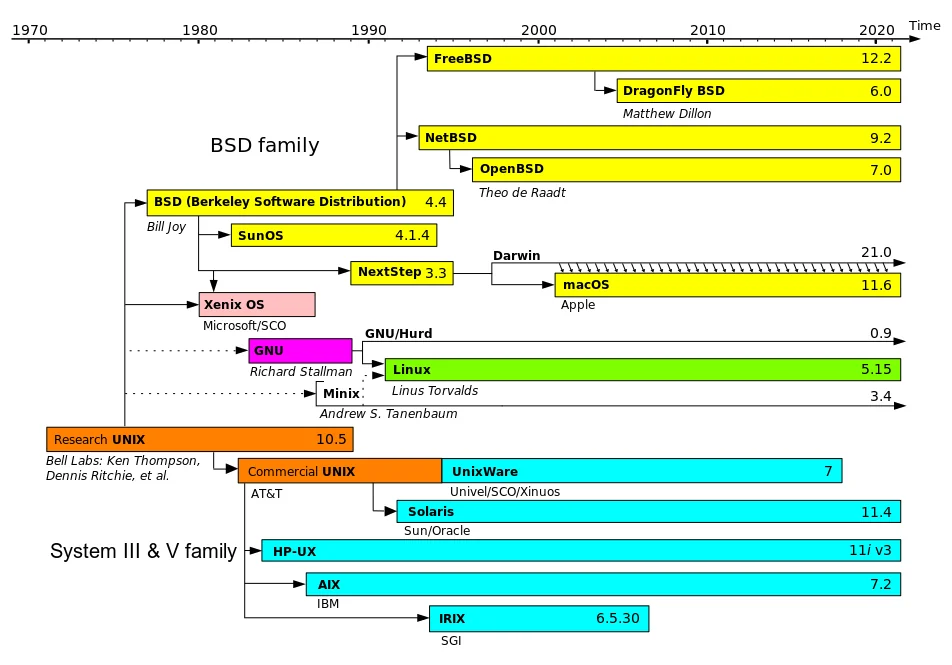
Unix was born in the late 1960s at AT&T Bell Labs, led by Ken Thompson and Dennis Ritchie. They created a simple yet powerful multi-user and multitasking operating system. Unix’s design principles—simplicity, modularity, hierarchical file system—became the foundation for many subsequent OS developments. One of its key innovations was the “pipe”, which allowed the output of one program to be used as input for another, enhancing command-line flexibility. Unix evolved rapidly during the 1970s-1980s, adopted by universities, research institutions, and corporations. Its portability (thanks to being rewritten in C language) made it an industry standard. From Unix came many commercial variants (Solaris, HP-UX, AIX) as well as inspiration for open-source systems like BSD and Linux. Additionally, Unix gave birth to the POSIX (Portable Operating System Interface) standard, which ensures compatibility among modern operating systems.
BSD: Innovation from Berkeley
BSD (Berkeley Software Distribution) emerged in the late 1970s at the University of California, Berkeley, as an enhancement to the Unix source code. BSD contributed important innovations, such as:
- TCP/IP stack, the main foundation of the modern internet
- vi editor, which remains popular to this day
Modern BSD Variants
BSD evolved into an independent ecosystem, with main derivatives:
- FreeBSD – focuses on performance & scalability, popular for servers and embedded systems
- OpenBSD – emphasizes security & code auditing, widely used for firewalls and network infrastructure
- NetBSD – known for portability, can run on almost any hardware architecture BSD also became the basis for major technologies: Darwin (macOS & iOS kernel), and the PlayStation 4 operating system. One thing that distinguishes BSD from Linux is its licensing. The BSD License is more permissive compared to Linux’s GPL, allowing companies to adopt BSD code without having to open their modifications—the reason Apple chose BSD as the basis for macOS.
Linux: Open Source for Everyone
Linux emerged in 1991, created by Linus Torvalds at the University of Helsinki. Unlike BSD, Linux was not directly derived from Unix code, but was written from scratch with Unix philosophy as inspiration. Linux is compatible with Unix standards (POSIX), modular, and open-source under the GNU General Public License (GPL).
Integration with GNU
Before Linux was born, the GNU Project (Richard Stallman, 1983) had already provided many important components:
- GNU Compiler Collection (GCC)
- GNU C Library (glibc)
- GNU Core Utilities However, GNU lacked a fully functional kernel. The Linux kernel filled this gap, so the combination of GNU/Linux resulted in a complete and free operating system.
Linux Dominance
Today, Linux:
- Powers >95% of the world’s supercomputers
- Forms the core of Android, the most popular smartphone operating system
- Runs the majority of web servers & cloud computing
- Used in IoT, embedded devices, and desktops Popular distributions include Ubuntu, Debian, Fedora, Arch Linux, and Red Hat Enterprise Linux.
Kernel and Architecture
All three systems use monolithic kernels, but with different approaches:
- Unix: large kernel managing all services & hardware
- BSD: monolithic kernel with enhancements like ZFS filesystem, optimized network stack, and security features like Mandatory Access Control (MAC)
- Linux: modular monolithic kernel, allowing drivers & features to be loaded/unloaded as needed. This makes Linux flexible for various devices, from IoT to supercomputers
Ecosystem and Community
- Unix: now mostly survives in commercial variants (Solaris, AIX) in companies with legacy systems
- BSD: small but dedicated community, known for code quality and documentation
- Linux: has the largest ecosystem with thousands of distributions and active global communities
Usage and Considerations
- Unix → Still used in large corporations with legacy systems (banking, telecommunications, aerospace)
- BSD → Suitable for firewalls, routers, and systems with high security/stability demands
- Linux → Most flexible, used in cloud, servers, desktops, IoT, and supercomputers
Interoperability and Compatibility
All three share the same heritage, so many applications can be easily ported between systems, especially those written in C/C++. Core command-line utilities (like ls, grep, awk) are also similar, making it relatively easy for users of one system to adapt to others.
Comparison Table: Unix, BSD, and Linux
| Aspect | Unix | BSD | Linux |
|---|---|---|---|
| Origins | 1969, AT&T Bell Labs | 1977, UC Berkeley, Unix derivative | 1991, Linus Torvalds, independent |
| License | Proprietary (AT&T, commercial) | BSD License (permissive) | GPL (copyleft, open-source) |
| Focus | Commercial systems, stability | Networking, security, portability | Flexibility, community, open-source |
| Variants | Solaris, AIX, HP-UX | FreeBSD, OpenBSD, NetBSD | Ubuntu, Debian, Fedora, RHEL, Arch |
| Usage | Corporations, mission-critical | Servers, firewalls, basis for macOS & PS4 | Cloud, servers, desktop, Android, IoT |
| Current Status | Limited, declining dominance | Niche but important (security & research) | Global dominance, extensive ecosystem |
Conclusion
Unix, BSD, and Linux are not just operating systems, but the backbone of the modern digital world.
- Unix laid the foundation with design principles and POSIX standards
- BSD contributed important innovations, especially in networking and security
- Linux extended influence worldwide through the open-source model, from global servers to smartphones in our pockets Together, these three form an ecosystem that continues to drive the evolution of computing technology.