Integers

A. Introduction
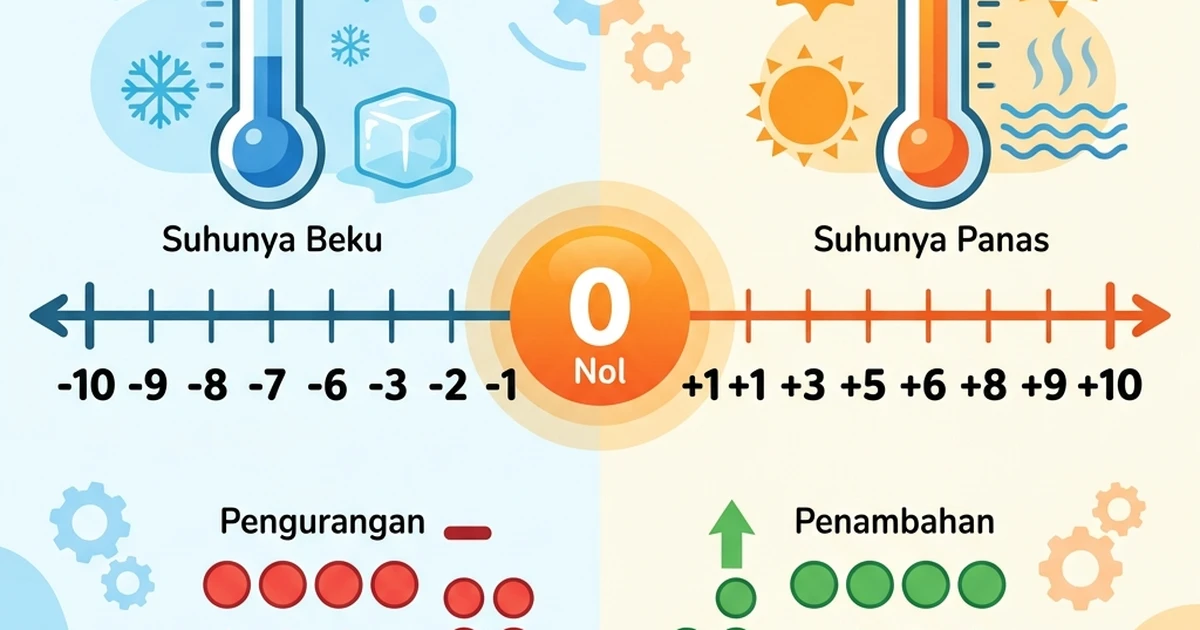
Integers are used to describe many everyday situations, such as temperature, elevation, profit and loss, or positions on a number line. On a thermometer, temperatures below zero are written as negative numbers, while temperatures above zero are written as positive numbers.
- Negative integers are to the left of zero.
- Zero is in the middle.
- Positive integers are to the right of zero.
Examples of integers: ..., -3, -2, -1, 0, 1, 2, 3, ...
B. Definition
Integers are the set of negative integers, zero, and positive integers. The standard notation is:
On a number line, numbers become larger as you move to the right. Because of that, the symbols < and > are used to compare integers.
Examples:
C. Arithmetic Operations with Integers
1. Addition
Properties of addition:
- Closure: the sum of two integers is always an integer.
Example: - Commutative:
- Associative:
- Identity element:
- Inverse element:
2. Subtraction
Properties of subtraction:
- Closure: the difference of two integers is still an integer.
- Not commutative:
- Not associative:
- The following identities are useful:
3. Multiplication
Properties of multiplication:
- Closure: the product of two integers is always an integer.
- Commutative:
- Associative:
- Identity element:
- Distributive:
4. Division
Properties of division:
- Not closed: the quotient of two integers is not always an integer.
Example: - Not commutative:
- Not associative
- Division by zero is undefined.
D. Mixed Operations
Use these rules when working with mixed operations:
- Evaluate expressions inside parentheses first.
- Multiplication and division are done before addition and subtraction.
- For operations at the same level, work from left to right.
E. Worked Examples
Find the value of
Find the value of
If , , and , find
If , , and , find the value of
The classroom temperature is C. The office temperature is C lower. Therefore, the office temperature is
A pulley is meters above the ground, while the water surface is meters below the ground. The rope length from the water surface to the pulley is
So the rope is meters long.
F. GeoGebra Simulation
The following GeoGebra simulation can be used to explore addition with integers.
G. Practice Questions
The value of is
- A.
- B.
- C.
- D.
The value of that satisfies is
- A.
- B.
- C.
- D.
In a test, each correct answer is worth , each wrong answer is worth , and each unanswered question is worth . Out of questions, Andika answered correctly, incorrectly, and left the rest blank. Andika’s score is
- A.
- B.
- C.
- D.
The result of is
- A.
- B.
- C.
- D.
If the initial temperature of an object is degrees and then it drops by degrees, the final temperature is
- A.
- B.
- C.
- D.
Answer key
- A, because
- B, because
- C, because
- D, because , so the result is
- D, because
If you still find this topic difficult, review the examples above and discuss them with your teacher or classmates.
H. Evaluation
Interactive exercises for this lesson are available in the original source. They are not reproduced here because the imported legacy HTML and JavaScript are no longer stable in the current site.
Closing
That completes this short introduction to integers. Once you understand the number line and the basic operation rules, integer problems become much easier to solve.