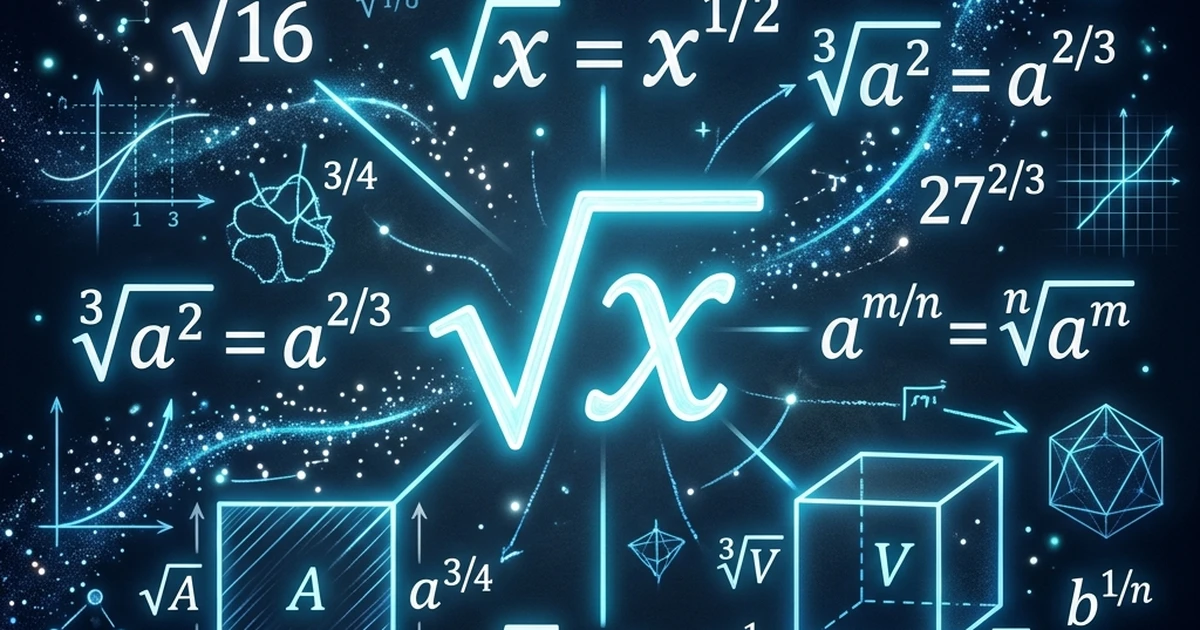
Exponents are widely used in daily life, especially when writing very large or very small quantities. Learning exponents helps us write and calculate such quantities efficiently.
If a ∈ R a \in \mathbb{R} a ∈ R n n n
a n = a × a × ⋯ × a ⏟ n times
a^n=\underbrace{a \times a \times \cdots \times a}_{n\ \text{times}}
a n = n times a × a × ⋯ × a where:
a n a^n a n a a a n n n Write the following powers as repeated multiplication, then calculate the result:
2 5 2^5 2 5 ( − 3 ) 2 (-3)^2 ( − 3 ) 2 ( 0.5 ) 4 (0.5)^4 ( 0.5 ) 4 ( − 4 ) 3 (-4)^3 ( − 4 ) 3 2 5 = 2 × 2 × 2 × 2 × 2 = 32 2^5=2 \times 2 \times 2 \times 2 \times 2=32 2 5 = 2 × 2 × 2 × 2 × 2 = 32 ( − 3 ) 2 = ( − 3 ) × ( − 3 ) = 9 (-3)^2=(-3)\times(-3)=9 ( − 3 ) 2 = ( − 3 ) × ( − 3 ) = 9 ( 0.5 ) 4 = ( 0.5 ) × ( 0.5 ) × ( 0.5 ) × ( 0.5 ) = 0.0625 (0.5)^4=(0.5)\times(0.5)\times(0.5)\times(0.5)=0.0625 ( 0.5 ) 4 = ( 0.5 ) × ( 0.5 ) × ( 0.5 ) × ( 0.5 ) = 0.0625 ( − 4 ) 3 = ( − 4 ) × ( − 4 ) × ( − 4 ) = − 64 (-4)^3=(-4)\times(-4)\times(-4)=-64 ( − 4 ) 3 = ( − 4 ) × ( − 4 ) × ( − 4 ) = − 64 a m × a n = a m + n
a^m \times a^n = a^{m+n}
a m × a n = a m + n where a a a m , n m,n m , n
Simplify:
6 3 × 6 4 6^3 \times 6^4 6 3 × 6 4 ( − 4 ) × ( − 4 ) 2 (-4)\times(-4)^2 ( − 4 ) × ( − 4 ) 2 5 2 × 3 3 × 2 5^2\times 3^3\times 2 5 2 × 3 3 × 2 7 a 3 × b 4 × 3 a 2 × b 7a^3\times b^4 \times 3a^2 \times b 7 a 3 × b 4 × 3 a 2 × b 6 3 × 6 4 = 6 3 + 4 = 6 7 6^3 \times 6^4 = 6^{3+4}=6^7 6 3 × 6 4 = 6 3 + 4 = 6 7 ( − 4 ) × ( − 4 ) 2 = ( − 4 ) 1 + 2 = ( − 4 ) 3 (-4)\times(-4)^2 = (-4)^{1+2}=(-4)^3 ( − 4 ) × ( − 4 ) 2 = ( − 4 ) 1 + 2 = ( − 4 ) 3 Since the bases are not the same, the expression cannot be simplified further. 7 a 3 × b 4 × 3 a 2 × b = 7 a 3 × 3 a 2 × b 4 × b = 21 a 3 + 2 b 4 + 1 = 21 a 5 b 5
\begin{aligned}
7a^3\times b^4 \times 3a^2 \times b
&= 7a^3\times 3a^2\times b^4\times b \\
&= 21a^{3+2}b^{4+1} \\
&= 21a^5b^5
\end{aligned}
7 a 3 × b 4 × 3 a 2 × b = 7 a 3 × 3 a 2 × b 4 × b = 21 a 3 + 2 b 4 + 1 = 21 a 5 b 5 a m a n = a m − n
\frac{a^m}{a^n}=a^{m-n}
a n a m = a m − n with a ≠ 0 a \neq 0 a = 0 m > n m>n m > n
6 12 6 10 \dfrac{6^{12}}{6^{10}} 6 10 6 12 9 3 6 2 \dfrac{9^3}{6^2} 6 2 9 3 ( − 3 ) 4 × ( − 3 ) 3 ( − 3 ) 2 \dfrac{(-3)^4\times (-3)^3}{(-3)^2} ( − 3 ) 2 ( − 3 ) 4 × ( − 3 ) 3 6 12 6 10 = 6 12 − 10 = 6 2 \dfrac{6^{12}}{6^{10}}=6^{12-10}=6^2 6 10 6 12 = 6 12 − 10 = 6 2 Since the bases are different, the expression cannot be simplified further. ( − 3 ) 4 × ( − 3 ) 3 ( − 3 ) 2 = ( − 3 ) 4 + 3 ( − 3 ) 2 = ( − 3 ) 7 ( − 3 ) 2 = ( − 3 ) 7 − 2 = ( − 3 ) 5
\frac{(-3)^4\times (-3)^3}{(-3)^2}
=\frac{(-3)^{4+3}}{(-3)^2}
=\frac{(-3)^7}{(-3)^2}
=(-3)^{7-2}
=(-3)^5
( − 3 ) 2 ( − 3 ) 4 × ( − 3 ) 3 = ( − 3 ) 2 ( − 3 ) 4 + 3 = ( − 3 ) 2 ( − 3 ) 7 = ( − 3 ) 7 − 2 = ( − 3 ) 5 ( a m ) n = a m × n
(a^m)^n=a^{m\times n}
( a m ) n = a m × n ( 5 4 ) 2 (5^4)^2 ( 5 4 ) 2 2 5 × ( 2 3 ) 2 2 4 \dfrac{2^5\times (2^3)^2}{2^4} 2 4 2 5 × ( 2 3 ) 2 ( 5 4 ) 2 = 5 4 × 2 = 5 8 (5^4)^2=5^{4\times 2}=5^8 ( 5 4 ) 2 = 5 4 × 2 = 5 8 2 5 × ( 2 3 ) 2 2 4 = 2 5 × 2 6 2 4 = 2 5 + 6 2 4 = 2 11 2 4 = 2 11 − 4 = 2 7
\begin{aligned}
\frac{2^5\times (2^3)^2}{2^4}
&= \frac{2^5\times 2^6}{2^4} \\
&= \frac{2^{5+6}}{2^4} \\
&= \frac{2^{11}}{2^4} \\
&= 2^{11-4} \\
&= 2^7
\end{aligned}
2 4 2 5 × ( 2 3 ) 2 = 2 4 2 5 × 2 6 = 2 4 2 5 + 6 = 2 4 2 11 = 2 11 − 4 = 2 7 4. Addition and Subtraction Property a n + a m = a n ( 1 + a m − n )
a^n+a^m=a^n(1+a^{m-n})
a n + a m = a n ( 1 + a m − n ) for m ≥ n m \ge n m ≥ n
a n − a m = a n ( 1 − a m − n )
a^n-a^m=a^n(1-a^{m-n})
a n − a m = a n ( 1 − a m − n ) or:
a m − a n = a n ( a m − n − 1 )
a^m-a^n=a^n(a^{m-n}-1)
a m − a n = a n ( a m − n − 1 ) ( − 8 ) 3 + ( − 8 ) 5 (-8)^3+(-8)^5 ( − 8 ) 3 + ( − 8 ) 5 7 7 − 7 3 7^7-7^3 7 7 − 7 3 ( − 8 ) 3 + ( − 8 ) 5 = ( − 8 ) 3 + ( − 8 ) 3 + 2 = ( − 8 ) 3 + ( − 8 ) 3 ⋅ ( − 8 ) 2 = ( − 8 ) 3 ( 1 + ( − 8 ) 2 )
\begin{aligned}
(-8)^3+(-8)^5
&= (-8)^3+(-8)^{3+2} \\
&= (-8)^3+(-8)^3\cdot(-8)^2 \\
&= (-8)^3(1+(-8)^2)
\end{aligned}
( − 8 ) 3 + ( − 8 ) 5 = ( − 8 ) 3 + ( − 8 ) 3 + 2 = ( − 8 ) 3 + ( − 8 ) 3 ⋅ ( − 8 ) 2 = ( − 8 ) 3 ( 1 + ( − 8 ) 2 ) 7 7 − 7 3 = 7 4 + 3 − 7 3 = 7 4 ⋅ 7 3 − 7 3 = 7 3 ( 7 4 − 1 )
\begin{aligned}
7^7-7^3
&= 7^{4+3}-7^3 \\
&= 7^4\cdot 7^3-7^3 \\
&= 7^3(7^4-1)
\end{aligned}
7 7 − 7 3 = 7 4 + 3 − 7 3 = 7 4 ⋅ 7 3 − 7 3 = 7 3 ( 7 4 − 1 ) Observe:
2 2 2 4 = 2 × 2 2 × 2 × 2 × 2 = 1 2 × 2 = 1 2 2
\frac{2^2}{2^4}
=\frac{2\times2}{2\times2\times2\times2}
=\frac{1}{2\times2}
=\frac{1}{2^2}
2 4 2 2 = 2 × 2 × 2 × 2 2 × 2 = 2 × 2 1 = 2 2 1 Also:
2 2 2 4 = 2 2 − 4 = 2 − 2
\frac{2^2}{2^4}=2^{2-4}=2^{-2}
2 4 2 2 = 2 2 − 4 = 2 − 2 So:
1 2 2 = 2 − 2
\frac{1}{2^2}=2^{-2}
2 2 1 = 2 − 2 a − n = 1 a n
a^{-n}=\frac{1}{a^n}
a − n = a n 1 with a ≠ 0 a \neq 0 a = 0 n n n
Rewrite in positive-exponent form:3 − 5 3^{-5} 3 − 5 ( − 8 ) − 4 (-8)^{-4} ( − 8 ) − 4 a − 2 a^{-2} a − 2 Rewrite in negative-exponent form:1 7 2 \dfrac{1}{7^2} 7 2 1 1 2 6 \dfrac{1}{2^6} 2 6 1 1 a 9 \dfrac{1}{a^9} a 9 1 Positive-exponent form:3 − 5 = 1 3 5 3^{-5}=\dfrac{1}{3^5} 3 − 5 = 3 5 1 ( − 8 ) − 4 = 1 ( − 8 ) 4 (-8)^{-4}=\dfrac{1}{(-8)^4} ( − 8 ) − 4 = ( − 8 ) 4 1 a − 2 = 1 a 2 a^{-2}=\dfrac{1}{a^2} a − 2 = a 2 1 Negative-exponent form:1 7 2 = 7 − 2 \dfrac{1}{7^2}=7^{-2} 7 2 1 = 7 − 2 1 2 6 = 2 − 6 \dfrac{1}{2^6}=2^{-6} 2 6 1 = 2 − 6 1 a 9 = a − 9 \dfrac{1}{a^9}=a^{-9} a 9 1 = a − 9 Observe:
3 2 3 2 = 3 × 3 3 × 3 = 1
\frac{3^2}{3^2}=\frac{3\times3}{3\times3}=1
3 2 3 2 = 3 × 3 3 × 3 = 1 and:
3 2 3 2 = 3 2 − 2 = 3 0
\frac{3^2}{3^2}=3^{2-2}=3^0
3 2 3 2 = 3 2 − 2 = 3 0 Thus:
3 0 = 1
3^0=1
3 0 = 1 a 0 = 1
a^0=1
a 0 = 1 with a ≠ 0 a \neq 0 a = 0
Calculate:
( 5 ) 0 (5)^0 ( 5 ) 0 ( 12 ) 0 (12)^0 ( 12 ) 0 34 a 2 b 0 34a^2b^0 34 a 2 b 0 ( 5 ) 0 = 1 (5)^0=1 ( 5 ) 0 = 1 ( 12 ) 0 = 1 (12)^0=1 ( 12 ) 0 = 1 34 a 2 b 0 = 34 a 2 ⋅ 1 = 34 a 2 34a^2b^0=34a^2\cdot 1=34a^2 34 a 2 b 0 = 34 a 2 ⋅ 1 = 34 a 2 Numbers that can be written as fractions are called rational numbers. The properties of exponents also apply to rational numbers.
( 2 3 ) 3 (\dfrac{2}{3})^3 ( 3 2 ) 3 ( 2 7 ) 5 × ( 2 7 ) 2 ( 2 7 ) 6 \dfrac{(\dfrac{2}{7})^5 \times (\dfrac{2}{7})^2}{(\dfrac{2}{7})^6} ( 7 2 ) 6 ( 7 2 ) 5 × ( 7 2 ) 2 ( 2 3 ) 3 = 2 3 × 2 3 × 2 3 = 2 3 3 3 = 8 27
\left(\frac{2}{3}\right)^3
=\frac{2}{3}\times\frac{2}{3}\times\frac{2}{3}
=\frac{2^3}{3^3}
=\frac{8}{27}
( 3 2 ) 3 = 3 2 × 3 2 × 3 2 = 3 3 2 3 = 27 8 ( 2 7 ) 5 × ( 2 7 ) 2 ( 2 7 ) 6 = ( 2 7 ) 5 + 2 ( 2 7 ) 6 = ( 2 7 ) 7 ( 2 7 ) 6 = ( 2 7 ) 7 − 6 = 2 7
\frac{\left(\frac{2}{7}\right)^5 \times \left(\frac{2}{7}\right)^2}{\left(\frac{2}{7}\right)^6}
=\frac{\left(\frac{2}{7}\right)^{5+2}}{\left(\frac{2}{7}\right)^6}
=\frac{\left(\frac{2}{7}\right)^7}{\left(\frac{2}{7}\right)^6}
=\left(\frac{2}{7}\right)^{7-6}
=\frac{2}{7}
( 7 2 ) 6 ( 7 2 ) 5 × ( 7 2 ) 2 = ( 7 2 ) 6 ( 7 2 ) 5 + 2 = ( 7 2 ) 6 ( 7 2 ) 7 = ( 7 2 ) 7 − 6 = 7 2 To measure your understanding of exponents, follow this evaluation:
choose the correct answer, click Next to move to the next question, click Submit to send your answers, check the score shown below the questions, the final value is the score divided by the maximum score, multiplied by 100, the minimum passing score is 70, the time limit is 30 minutes. That concludes this material on exponents for Grade IX.