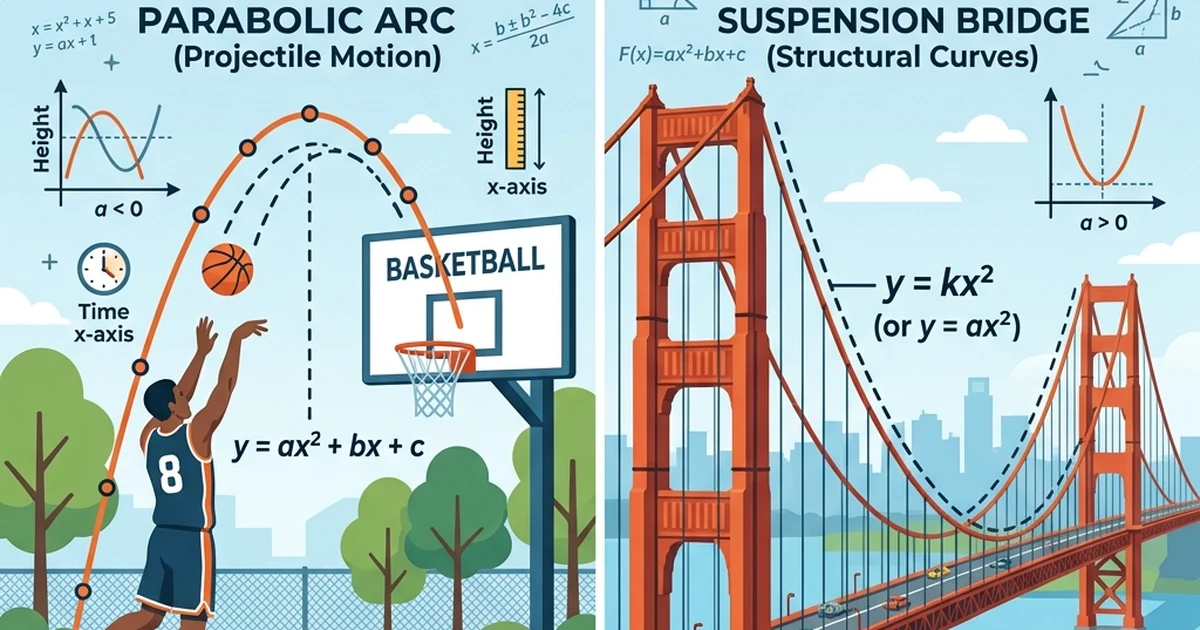
Many daily-life problems can be solved using quadratic functions by first expressing them as mathematical models. Once the model is built, the problem can be solved systematically.
The sum of two integers is 20. Determine the greatest possible product of the two numbers.
Let the two integers be x x x y y y
Since their sum is 20:
x + y = 20
x+y=20
x + y = 20 or:
y = 20 − x
y=20-x
y = 20 − x If their product is written as a function f ( x ) f(x) f ( x )
f ( x ) = x ⋅ y = x ( 20 − x ) = 20 x − x 2
\begin{aligned}
f(x) &= x \cdot y \\
&= x(20-x) \\
&= 20x-x^2
\end{aligned}
f ( x ) = x ⋅ y = x ( 20 − x ) = 20 x − x 2 The maximum value of this quadratic function is:
f max = − b 2 − 4 a c 4 a = − 20 2 − 4 ( − 1 ) ( 0 ) 4 ( − 1 ) = − 400 − 4 = 100
\begin{aligned}
f_{\text{max}} &= \frac{-b^2-4ac}{4a} \\
&= \frac{-20^2-4(-1)(0)}{4(-1)} \\
&= \frac{-400}{-4} \\
&= 100
\end{aligned}
f max = 4 a − b 2 − 4 a c = 4 ( − 1 ) − 2 0 2 − 4 ( − 1 ) ( 0 ) = − 4 − 400 = 100 So, the greatest possible product is 100 .
A rocket is launched vertically upward. Its height after t t t
h ( t ) = 60 t − 5 t 2
h(t)=60t-5t^2
h ( t ) = 60 t − 5 t 2 What is the maximum height reached by the rocket?
Given:
h ( t ) = 60 t − 5 t 2 , a = − 5 , b = 60 , c = 0
h(t)=60t-5t^2,\quad a=-5,\quad b=60,\quad c=0
h ( t ) = 60 t − 5 t 2 , a = − 5 , b = 60 , c = 0 The maximum height occurs when:
t = − b 2 a = − 60 2 ( − 5 ) = − 60 − 10 = 6
\begin{aligned}
t &= \frac{-b}{2a} \\
&= \frac{-60}{2(-5)} \\
&= \frac{-60}{-10} \\
&= 6
\end{aligned}
t = 2 a − b = 2 ( − 5 ) − 60 = − 10 − 60 = 6 The maximum height is:
h max = b 2 − 4 a c − 4 a = 60 2 − 4 ( − 5 ) ( 0 ) − 4 ( − 5 ) = 3600 20 = 180
\begin{aligned}
h_{\text{max}} &= \frac{b^2-4ac}{-4a} \\
&= \frac{60^2-4(-5)(0)}{-4(-5)} \\
&= \frac{3600}{20} \\
&= 180
\end{aligned}
h max = − 4 a b 2 − 4 a c = − 4 ( − 5 ) 6 0 2 − 4 ( − 5 ) ( 0 ) = 20 3600 = 180 So, the rocket reaches a maximum height of 180 meters .
A rectangle has a perimeter of 120 cm. Determine its dimensions so that its area is maximum.
Let the length be x x x
length + width = 1 2 × perimeter x + width = 1 2 × 120 x + width = 60 width = 60 − x
\begin{aligned}
\text{length} + \text{width} &= \frac{1}{2}\times \text{perimeter} \\
x + \text{width} &= \frac{1}{2}\times 120 \\
x + \text{width} &= 60 \\
\text{width} &= 60-x
\end{aligned}
length + width x + width x + width width = 2 1 × perimeter = 2 1 × 120 = 60 = 60 − x The area is:
L ( x ) = length × width = x ( 60 − x ) = 60 x − x 2
\begin{aligned}
L(x) &= \text{length}\times \text{width} \\
&= x(60-x) \\
&= 60x-x^2
\end{aligned}
L ( x ) = length × width = x ( 60 − x ) = 60 x − x 2 From this function, we get a = − 1 a=-1 a = − 1 b = 60 b=60 b = 60 c = 0 c=0 c = 0
Its axis of symmetry is:
x = − b 2 a = − 60 2 ( − 1 ) = − 60 − 2 = 30
\begin{aligned}
x &= -\frac{b}{2a} \\
&= \frac{-60}{2(-1)} \\
&= \frac{-60}{-2} \\
&= 30
\end{aligned}
x = − 2 a b = 2 ( − 1 ) − 60 = − 2 − 60 = 30 The maximum area is:
L ( 30 ) = 60 ( 30 ) − ( 30 ) 2 = 1800 − 900 = 900
\begin{aligned}
L(30) &= 60(30)-(30)^2 \\
&= 1800-900 \\
&= 900
\end{aligned}
L ( 30 ) = 60 ( 30 ) − ( 30 ) 2 = 1800 − 900 = 900 Therefore:
Length = 30 cm Width = 60 − 30 = 30 cm
\begin{aligned}
\text{Length} &= 30 \text{ cm} \\
\text{Width} &= 60-30=30 \text{ cm}
\end{aligned}
Length Width = 30 cm = 60 − 30 = 30 cm The rectangle with maximum area has dimensions 30 cm × 30 cm .
To better understand the worked examples above, study the following video.
VIDEO Those are examples of quadratic function applications in daily life.