Curved-Surface Solids

Introduction
Curved-surface solids include cylinders, cones, and spheres. This article focuses on the cylinder, a solid formed by two parallel congruent circles and one curved lateral surface.
A. Basic Competencies
3.7 Generalize the surface area and volume of curved-surface solids such as cylinders, cones, and spheres.4.7 Solve contextual problems related to the surface area and volume of curved-surface solids and their combinations.
B. Learning Objectives
After studying this lesson, students are expected to be able to:
- identify the elements of a cylinder
- calculate the base area, lateral area, and top area
- calculate the volume of a cylinder
- determine cylinder elements when the volume is known
- compare cylinder volumes after a change in radius
- calculate the change in cylinder volume when the radius changes
C. Lesson Material
1. Elements of a Cylinder
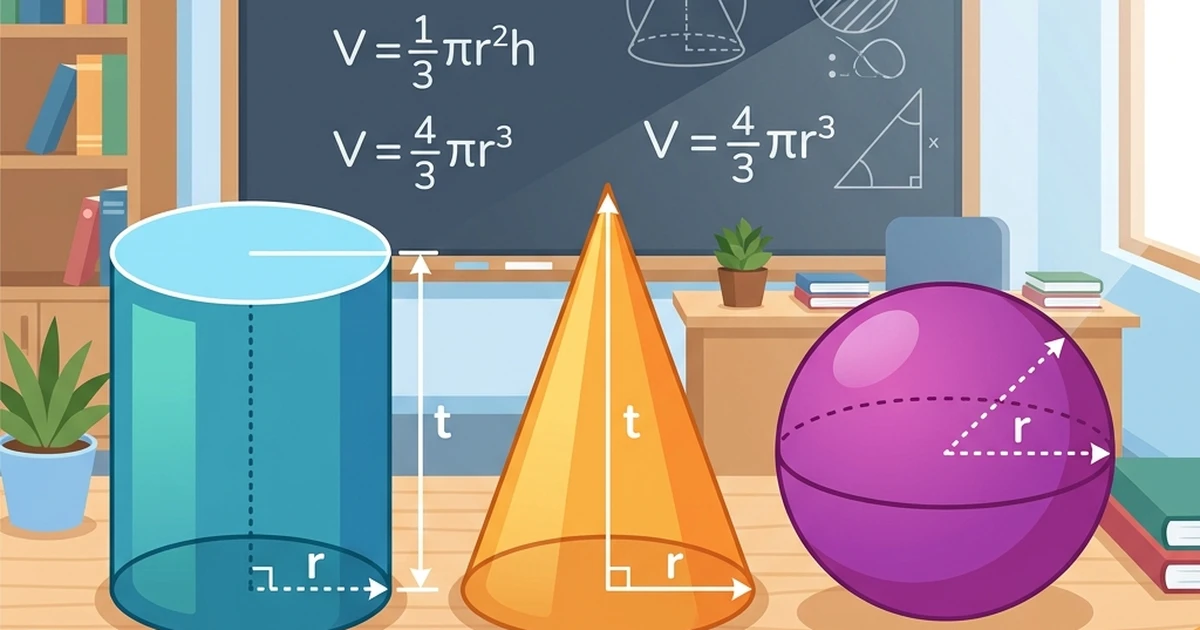
A cylinder is a curved-surface solid formed by two identical parallel circles and a rectangle wrapped around them.

From the picture we see:
- a cylinder has three surfaces: the base, the top, and the curved side
- the base and top are circles
- the curved side is called the lateral surface
- the distance between base and top is the height, denoted by
- the radius is denoted by and the diameter by
2. Cylinder Net
A cylinder net consists of:
- two congruent circles
- one rectangle

The net is useful because the surface area of the cylinder is equal to the total area of this unfolded figure.
3. Surface Area of a Cylinder
The surface area is the sum of:
- the area of the base circle
- the area of the lateral surface
- the area of the top circle
Details:
- base area =
- lateral area = circumference of base height =
- top area =
So:
Example
A cylinder has height 13 cm and base radius 7 cm. Find its surface area.
Therefore:
4. Volume of a Cylinder
Since the base is a circle, the volume of a cylinder is the base area times the height.
Formula:
or, in terms of diameter:
Example 1
A cylinder has radius 14 cm and height 20 cm. Find its volume.
So the volume is:
Example 2
A cylindrical drinking container has volume 693 ml. If its height is 18 cm and the container is full, determine:
- the diameter
- the total surface area
Since 1 ml = 1 cm^3, we have:
a. Diameter
So:
b. Surface area
Therefore:
Important Formulas
- base area =
- lateral area =
- top area =
- total surface area =
- surface area without top =
- volume =
GeoGebra Simulation
Use the following simulation to explore how changes in radius and height affect the surface area and volume of a cylinder.
D. Evaluation
Try the following problems:
- A cylinder has height
14 cmand base radius3 cm. Find its volume. - A cylinder is made of sheet metal with radius
14 cmand height20 cm. Find the sheet area needed to make it. - A cylindrical water tank has height
2 mand diameter7 dm. The bottom leaks and water flows out at an average rate of5liters per minute. If the tank is full, after how many minutes will it be empty?
Closing
The cylinder is one of the most common curved-surface solids in daily life, appearing in cans, pipes, glasses, and water tanks. Understanding its elements, surface area, and volume makes many applied geometry problems much easier to solve.